Explore our network of country and industry based websites to access localized information, product offerings, and business services across our group.
Log in to start sending quotation requests for any product.
Don't have an account? Sign Up Here
Home Potato Starch Procurement: Global Supply, Trade, and Buyer Insights
Trade Insights | Supply Chain | 25 August 2026

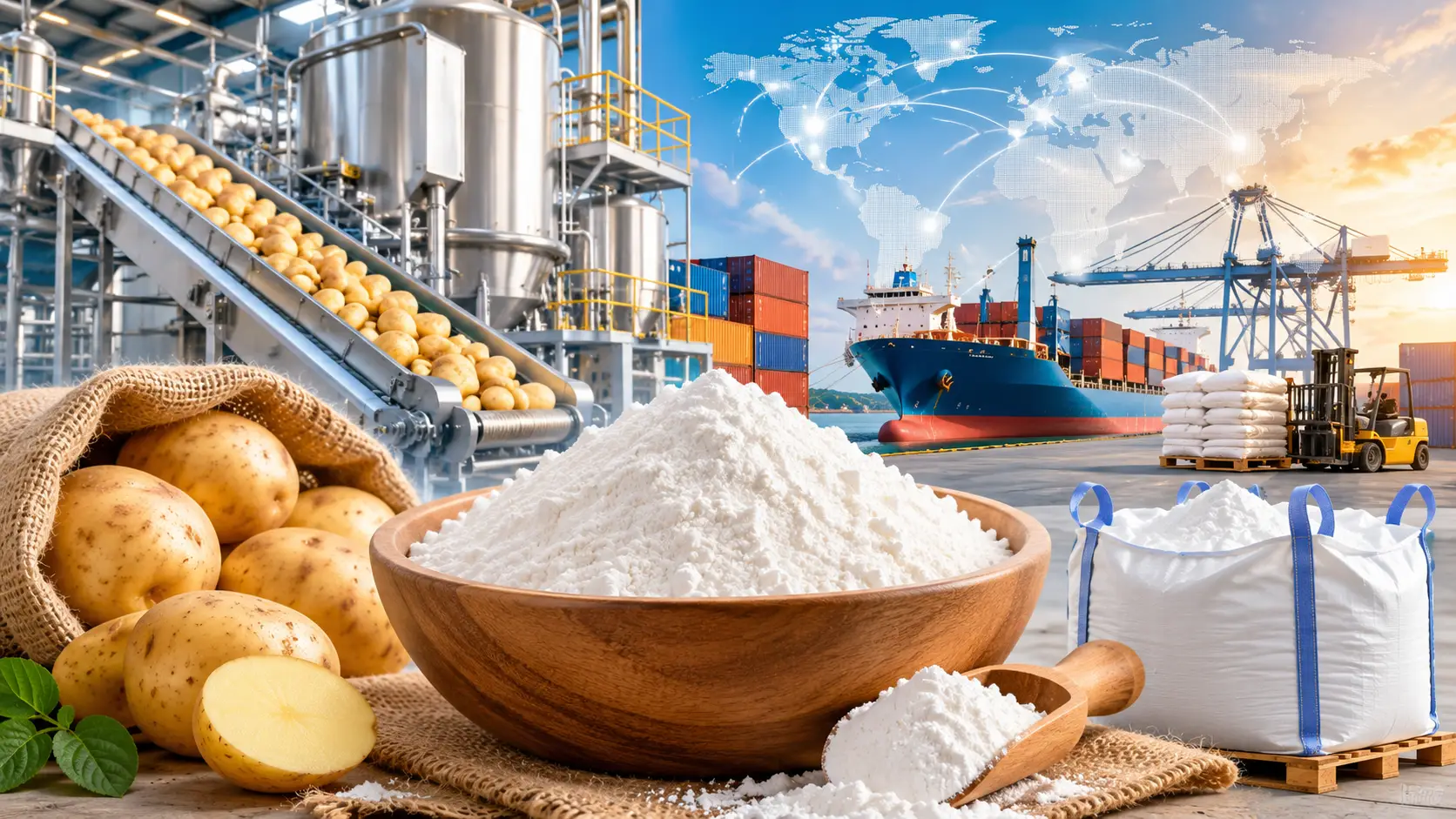
Potato Starch in the Global Supply Chain
Raw Material Sourcing and Starch Production
Quality and Specification Considerations
Potato Starch Applications Across Industries
Buyer Requirements and Procurement Priorities
Distribution, Logistics and Supply Continuity
Strategic Sourcing for B2B Potato Starch Buyers
Conclusion: Building a Reliable Potato Starch Supply Strategy
Sources
Potato starch is a commercially important starch ingredient positioned across food processing and several industrial sectors. Its functional characteristics make it relevant to manufacturers seeking thickening, binding, texturizing, adhesive, and filling properties. FAO describes potato starch as a fine, tasteless powder capable of delivering comparatively high viscosity and useful mouthfeel in food formulations.
For B2B buyers, procurement is not limited to finding a competitive quotation. Consistent raw-material availability, processing capability, product specifications, documentation, packaging, and delivery performance can directly affect production planning. Potato processing therefore becomes an important upstream consideration when assessing the reliability of a potato starch supplier.
Potato starch also participates in a diversified value chain. FAO identifies applications ranging from sauces, dough, biscuits, and ice cream to pharmaceutical, textile, paper, wood, and other industrial uses. This breadth creates demand from multiple buyer groups and makes dependable sourcing particularly important for manufacturers operating continuous production lines.
The supply chain begins with potatoes suitable for processing, followed by cleaning, preparation, starch separation, washing, concentration, drying, and final handling. USDA processing standards demonstrate why raw-potato quality matters upstream, with requirements addressing characteristics, physical condition, disease, foreign material, and other quality factors.
Modern starch processing can recover a substantial proportion of the starch contained in potatoes. FAO notes that processing technology can retrieve up to 96% of the starch present in raw potatoes, illustrating how extraction efficiency can influence the economics of the upstream supply chain.
For commercial buyers, production consistency is as important as extraction efficiency. Suppliers need appropriate processing controls to maintain uniform physical and functional characteristics from batch to batch. Reliable production planning can consequently help reduce procurement interruptions, specification deviations, and unexpected reformulation requirements.
Potato starch is valued partly for its functional behavior in formulated products. Its viscosity, texture contribution, binding performance, and processing characteristics can influence finished-product consistency. USDA research has also examined potato starch pasting and thermal properties, demonstrating that starch behavior during heating and processing can be an important technical consideration.
For food-sector procurement, documentation should be evaluated alongside physical and functional specifications. EFSA explains that food-additive assessment can involve identity, manufacturing process, composition, specifications, stability, proposed uses, exposure, and safety information. Buyers therefore benefit from working with suppliers capable of providing appropriate technical and regulatory documentation for the intended market.
Specification management becomes especially important when potato starch crosses international borders. Different markets can impose different requirements for food ingredients, labeling, testing, and permitted applications. A B2B sourcing strategy should therefore match product documentation with the destination country's regulatory and customer requirements rather than relying solely on a generic product specification.
Food processing remains a major commercial application area. Potato starch can function as a thickener and binding ingredient in products including sauces, stews, cake mixes, dough, biscuits, and ice cream. Its functional profile gives formulators an ingredient option when texture, viscosity, and processing performance are key considerations.
Beyond food, potato starch is used in pharmaceutical, textile, wood, and paper applications, where its adhesive, binder, texture-agent, or filler characteristics can be commercially useful. FAO also identifies applications in biodegradable products, including disposable plates, dishes, and cutlery.
This application diversity broadens the addressable buyer base for suppliers and distributors. Food manufacturers may prioritize food-grade documentation and formulation performance, while industrial customers may place greater emphasis on binding behavior, processing compatibility, consistency, packaging, and cost efficiency.
Procurement teams typically need to assess more than unit price when selecting potato starch. Product grade, technical specifications, documentation, packaging, minimum order quantities, lead times, origin, production capacity, and shipment reliability can all influence the total procurement value. Buyers serving regulated food markets may place additional emphasis on traceability and compliance documentation.
Supplier qualification should connect technical requirements with commercial performance. A supplier able to provide consistent material but unable to support predictable delivery can still create operational risk. Conversely, a competitive quotation becomes more valuable when supported by stable production, responsive documentation, appropriate packaging, and dependable logistics.
For distributors and B2B marketplaces, supplier transparency can also simplify customer qualification. Clear information about grade, intended application, specifications, origin, available quantities, and commercial terms allows buyers to compare offers more effectively and reduces friction during purchasing decisions.
Potato starch is generally traded as a dry powdered ingredient, making packaging, moisture protection, storage conditions, and handling important logistics considerations. Distribution planning must account for the movement from processing facilities to warehouses, ports, distributors, and ultimately industrial users.
Supply continuity depends on coordination across several stages rather than on production alone. Seasonal agricultural conditions, raw-material availability, processing capacity, inventory levels, shipping schedules, and destination-market demand can all influence delivery performance. A diversified sourcing strategy can help buyers reduce dependency on a single supply route.
For manufacturers, supply continuity has a direct commercial dimension because an interruption in starch availability can affect production schedules and customer commitments. Maintaining qualified alternative suppliers, appropriate inventory policies, and clear forecasting processes can therefore strengthen procurement resilience.
The lowest quoted price does not necessarily represent the lowest procurement cost. Buyers should compare offers according to specification compliance, consistency, documentation, logistics, payment terms, packaging, and expected delivery reliability. This total-value approach is particularly relevant when potato starch is incorporated into standardized formulations.
Digital B2B marketplaces can support supplier discovery and comparison by bringing product information and commercial sourcing opportunities into one procurement environment. For potato starch buyers, the objective is to identify suppliers whose capabilities match the technical, regulatory, volume, and logistical requirements of the purchasing organization.
A structured sourcing process also helps procurement teams communicate requirements more efficiently. Sharing target specifications, intended application, destination, estimated volume, packaging expectations, and delivery requirements can make supplier evaluation more precise and reduce unnecessary quotation cycles.
Potato starch represents a supply chain in which agricultural sourcing, extraction efficiency, processing consistency, quality management, regulation, logistics, and buyer requirements are closely connected. Its applications across food processing and industrial markets create opportunities for suppliers capable of delivering consistent products with dependable commercial support.
For procurement teams, the strongest sourcing strategy combines technical suitability with supply reliability and transparent supplier qualification. As global manufacturers and distributors seek dependable starch ingredients, access to qualified suppliers and clear product information becomes increasingly valuable. Tradeasia International can support B2B sourcing by connecting buyers with chemical and ingredient supply opportunities while helping procurement teams evaluate products according to their application and supply-chain requirements.
We're committed to your privacy. Tradeasia uses the information you provide to us to contact you about our relevant content, products, and services. For more information, check out our privacy policy.


 English
 Indonesian
 简体字
简体字
 العربية
 Español
 Français
 Português
 日本語
日本語
 한국어
한국어
 Tiếng Việt