Explore our network of country and industry based websites to access localized information, product offerings, and business services across our group.
Log in to start sending quotation requests for any product.
Don't have an account? Sign Up Here
Home Red Rice Market : Resilience, Trade Shifts, and Value Chain Evolution
Trade Insights | Supply Chain | 23 April 2026
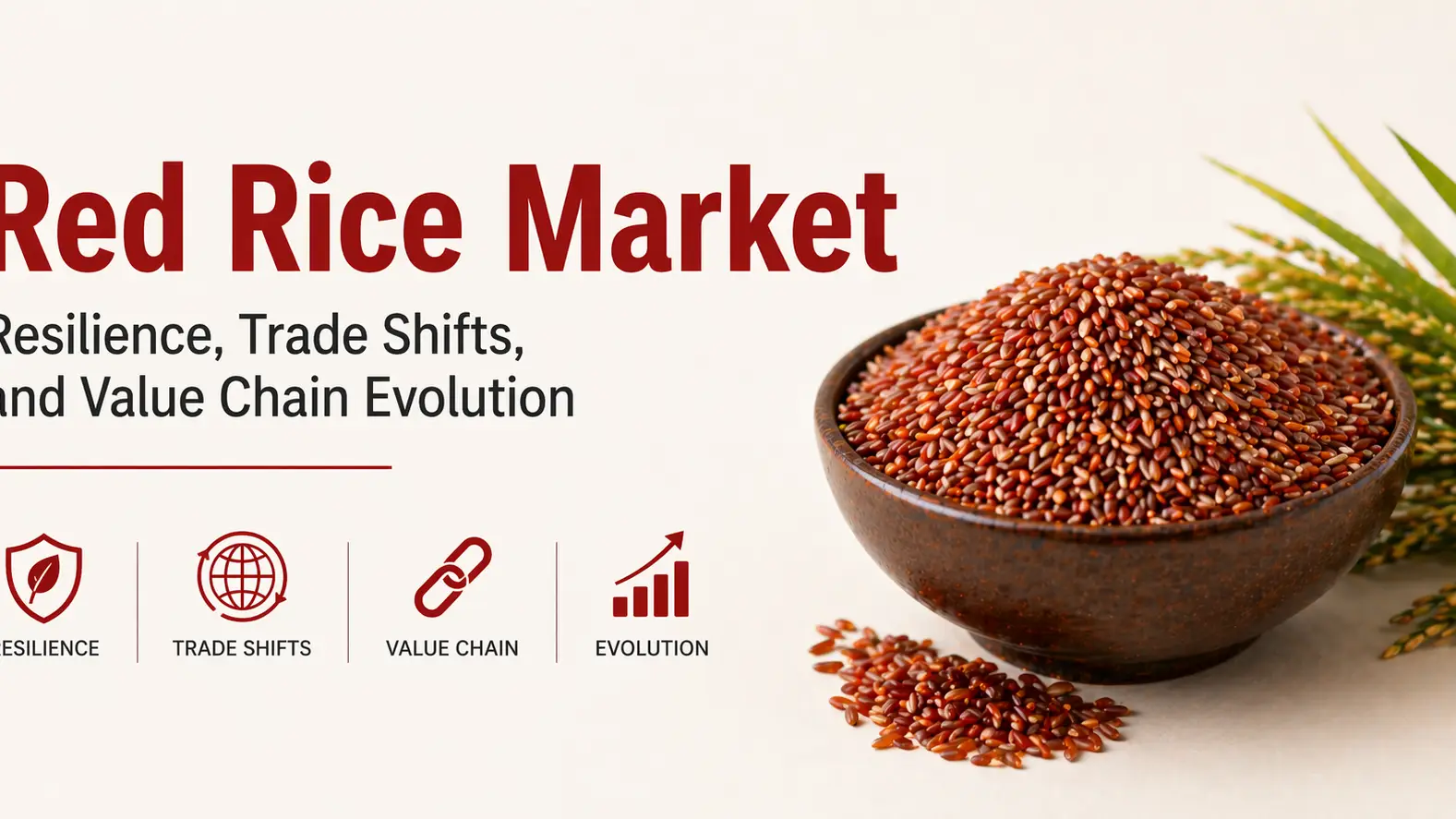
Fragmented Origin Networks and Production Dependency
Trade Corridor Realignment and Export Dynamics
Cold Chain Integrity and Post-Harvest Loss Reduction
Digital Traceability and Contract-Based Procurement Models
In 2026, the global supply chain market for red rice is undergoing a structural transformation driven by shifting agricultural yields, evolving trade corridors, and rising demand for health-oriented staple foods. Once a niche commodity within regional Asian diets, red rice has now entered mainstream global trade discussions as a premium grain linked to functional nutrition and sustainable sourcing. However, its supply chain remains highly fragmented, sensitive to climatic variability, and dependent on multi-tier logistics systems that span rural mills, export hubs, and international food processors.
Within this evolving landscape, stakeholders across procurement, logistics, and commodity trading are re-evaluating how red rice moves from origin markets to end consumers—balancing cost efficiency with quality preservation and regulatory compliance.
The red rice supply chain begins in highly fragmented agricultural ecosystems, primarily across India, Thailand, Bhutan, and parts of Southeast Asia. Production remains largely smallholder-driven, which introduces variability in grain quality, harvest cycles, and availability. As demand for premium whole grains increases, this fragmentation has become a strategic constraint rather than just a structural characteristic.
In 2026, supply reliability is increasingly tied to regional climate conditions and milling capacity consolidation. Even slight disruptions in monsoon patterns or irrigation availability can cascade into downstream shortages, tightening global inventories and amplifying price volatility. Industry analysts note that nearly 15% of post-harvest losses still occur due to inefficient handling and storage in origin markets, which directly affects export competitiveness.
Global trade flows for red rice are also being reshaped by shifting geopolitical and economic alignments. Traditional export routes from South and Southeast Asia toward Europe and the Middle East are becoming more dynamic, with Africa emerging as a rapidly expanding demand center.
This realignment is not purely demand-driven; logistics disruptions in maritime chokepoints and fluctuating freight costs are influencing sourcing decisions. Exporters are increasingly diversifying shipping routes through alternative hubs such as the UAE, Singapore, and regional transshipment ports to mitigate risk exposure. As a result, procurement strategies in 2026 are less about lowest cost sourcing and more about route resilience and contract reliability.
Although rice is less perishable than fresh commodities, red rice requires strict post-harvest handling to preserve its nutritional profile, particularly its anthocyanin content. Poor storage conditions can degrade quality and reduce its premium positioning in global markets.
Supply chain operators are investing in improved drying systems, hermetic storage solutions, and moisture-controlled warehousing to reduce losses and maintain export-grade consistency. These improvements are especially critical for long-haul shipments where transit times extend beyond traditional Asia-to-Europe corridors. The industry’s focus is now shifting toward minimizing quality degradation rather than simply increasing volume throughput.
One of the most significant transformations in 2026 is the adoption of digital traceability systems across agricultural supply chains. Buyers are increasingly demanding transparency on origin, processing methods, and sustainability practices. This has led to the rise of blockchain-enabled documentation and digital contract farming models.
For red rice exporters, this shift has introduced a more structured procurement environment, where long-term contracts are replacing spot-market volatility. According to market projections, digital integration across rice supply chains is expected to become a core competitive differentiator, particularly for exporters targeting high-value functional food markets.
As the red rice supply chain continues to mature in 2026, the industry is clearly moving toward greater integration, transparency, and resilience. Fragmented production bases are being gradually connected through digital procurement systems, while logistics networks are adapting to geopolitical uncertainty and shifting demand corridors.
For global buyers and industrial users seeking stable access to high-quality agricultural inputs, navigating these complexities requires more than transactional sourcing—it demands a structured supply partnership approach.
In this evolving environment, companies like Tradeasia International play a pivotal role as global solution providers, offering end-to-end sourcing, logistics coordination, and supply chain risk management across agricultural and chemical commodities. By bridging origin markets with international demand centers, Tradeasia supports businesses in achieving consistency, efficiency, and long-term procurement stability in an increasingly competitive red rice trade ecosystem.
We're committed to your privacy. Tradeasia uses the information you provide to us to contact you about our relevant content, products, and services. For more information, check out our privacy policy.


 English
 Indonesian
 简体字
简体字
 العربية
 Español
 Français
 Português
 日本語
日本語
 한국어
한국어
 Tiếng Việt



















