Explore our network of country and industry based websites to access localized information, product offerings, and business services across our group.
Log in to start sending quotation requests for any product.
Don't have an account? Sign Up Here
Home Securing Phosphoric Acid Supply in a Volatile Market
Trade Insights | Supply Chain | 01 May 2026
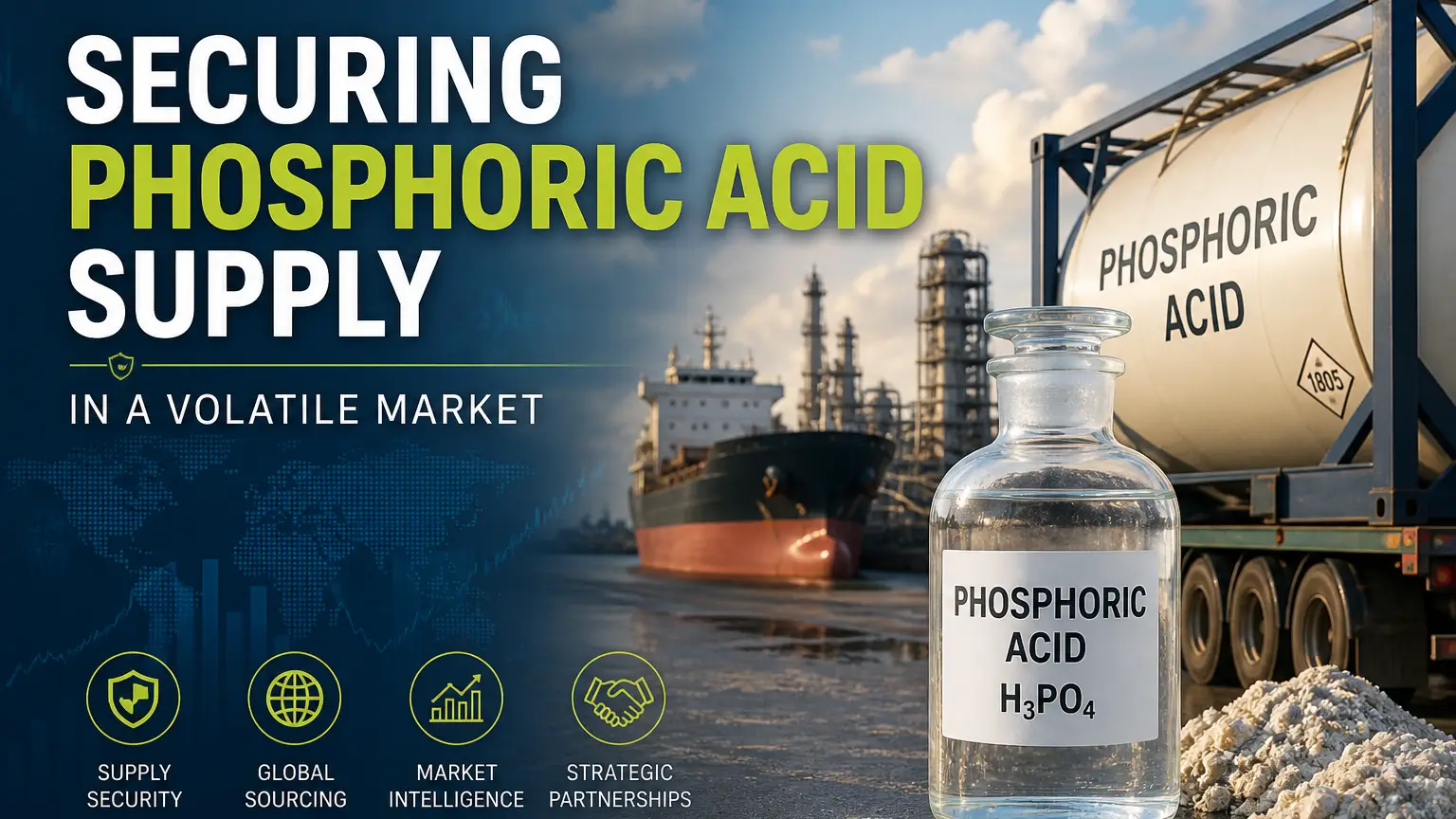
The Expanding Role of Phosphoric Acid in Global Industries
Raw Material Constraints and Geographic Concentration
Production Structures and Vertical Integration Trends
Geopolitical Pressures and Trade Flow Disruptions
Logistics Complexity and Infrastructure Bottlenecks
Cost Volatility and Margin Pressures
Sustainability Demands and Regulatory Shifts
Building Resilient and Adaptive Supply Chains
Phosphoric acid sits at the crossroads of global agriculture, food production, and industrial manufacturing, making it one of the most strategically important chemicals in modern supply chains. As the backbone of phosphate fertilizers and a key ingredient in food-grade and industrial applications, its availability directly influences food security and industrial output. Yet, in recent years, the phosphoric acid market has entered a period of heightened volatility, shaped by geopolitical tensions, resource concentration, fluctuating input costs, and shifting environmental expectations.
For procurement leaders and chemical buyers, the challenge is no longer simply about securing volume—it is about ensuring continuity, flexibility, and resilience. The global supply chain for phosphoric acid has become more interconnected but also more fragile, where disruptions in one region can quickly ripple across continents. Understanding the underlying dynamics of this supply network is essential for businesses aiming to maintain competitive advantage in uncertain conditions.
Phosphoric acid demand continues to expand, largely driven by its dominant use in phosphate fertilizers, which account for the majority of global consumption. However, growth is not limited to agriculture. Food-grade phosphoric acid remains essential in beverages and processed foods, while industrial-grade applications are expanding in sectors such as water treatment, metal finishing, and lithium battery production.
This diversification of demand has introduced both opportunity and complexity. On one hand, it stabilizes long-term growth prospects; on the other, it intensifies competition for supply. Emerging economies in Asia, Africa, and Latin America are increasing their consumption rapidly, creating new demand centers that reshape global trade patterns. As a result, supply chains must evolve to accommodate both traditional agricultural cycles and newer industrial consumption trends.
The phosphoric acid supply chain begins with phosphate rock and sulfur—two inputs that are unevenly distributed across the globe. A significant portion of phosphate reserves is concentrated in a handful of countries, creating structural vulnerabilities in supply availability. This concentration means that disruptions caused by political instability, regulatory changes, or export restrictions can have immediate global consequences.
Sulfur, often sourced as a byproduct of oil and gas refining, introduces another layer of dependency. Fluctuations in energy markets can indirectly impact phosphoric acid production costs and availability. For buyers, this interconnectedness underscores the importance of monitoring upstream markets, as risks are rarely isolated within a single segment of the supply chain.
Phosphoric acid production is capital-intensive and typically follows either integrated or non-integrated models. Integrated producers control the entire value chain, from mining phosphate rock to producing finished acid, allowing them to better manage costs and ensure supply stability. Non-integrated producers, by contrast, rely on external sources for raw materials, making them more exposed to market volatility.
In recent years, there has been a noticeable shift toward vertical integration, particularly among large multinational producers. By securing upstream resources, these companies can mitigate supply risks and maintain pricing power. This trend is reshaping competitive dynamics, as smaller or independent players face increasing pressure to secure long-term supply agreements or partnerships.
Global phosphoric acid supply chains are highly sensitive to geopolitical developments. Trade policies, sanctions, and regional conflicts can disrupt supply routes and limit access to key markets. For example, export restrictions from major producing countries can tighten global supply overnight, leading to price spikes and procurement challenges.
Additionally, shifting alliances and trade agreements are redefining supply routes. Buyers are increasingly diversifying their sourcing strategies to reduce dependency on any single region. This geopolitical awareness has become a critical component of supply chain management, requiring companies to adopt a more proactive and strategic approach to sourcing.
Transporting phosphoric acid presents unique logistical challenges due to its corrosive properties and regulatory requirements. Specialized storage tanks, dedicated vessels, and strict handling protocols are necessary to ensure safe transportation. These requirements add complexity and cost to the supply chain, making logistics a critical factor in overall supply reliability.
Infrastructure constraints, particularly in developing regions, can further complicate distribution. Port congestion, limited storage capacity, and inadequate transportation networks can delay shipments and disrupt supply continuity. As global trade volumes increase, these bottlenecks are becoming more pronounced, highlighting the need for investment in logistics infrastructure and planning.
The cost structure of phosphoric acid production is heavily influenced by fluctuations in raw material prices, particularly phosphate rock and sulfur. Energy costs also play a significant role, as production processes are energy-intensive. When these input costs rise, producers often pass the increases downstream, creating pricing volatility across the market.
For buyers, this volatility translates into margin uncertainty and budgeting challenges. Long-term contracts, hedging strategies, and diversified sourcing are increasingly used to manage cost risks. However, these strategies require careful planning and market insight, as sudden shifts can still disrupt even the most well-structured procurement plans.
Environmental considerations are becoming a defining factor in the phosphoric acid industry. Governments and regulatory bodies are imposing stricter standards on emissions, waste management, and resource utilization. Producers are responding by investing in cleaner technologies and more efficient production processes.
Sustainability is no longer just a compliance issue—it is also a competitive differentiator. Companies that can demonstrate environmentally responsible practices are better positioned to meet the expectations of global customers and stakeholders. This shift is driving innovation across the supply chain, from raw material extraction to final product delivery.
In a volatile market, resilience has become the cornerstone of effective supply chain management. Companies are adopting multi-sourcing strategies, building strategic inventories, and leveraging digital tools to enhance visibility and responsiveness. Collaboration with reliable partners is also critical, as strong relationships can provide stability during periods of disruption.
Digitalization is playing an increasingly important role, enabling real-time tracking, predictive analytics, and improved decision-making. These technologies allow companies to anticipate disruptions and respond more effectively, reducing the impact on operations. Ultimately, resilience is about flexibility—having the ability to adapt quickly to changing conditions while maintaining supply continuity.
Securing phosphoric acid supply in today’s volatile market requires more than traditional procurement strategies. It demands a comprehensive understanding of global supply dynamics, proactive risk management, and a commitment to building resilient and adaptable supply chains. As the industry continues to evolve, companies that invest in strategic sourcing and strong partnerships will be best positioned to navigate uncertainty and sustain growth.
In this context, working with experienced global distributors such as Tradeasia International can provide a valuable advantage. With an established international network and a focus on reliable sourcing solutions, Tradeasia supports businesses in maintaining consistent supply while adapting to shifting market conditions—offering a practical pathway toward stability in an increasingly complex landscape.
We're committed to your privacy. Tradeasia uses the information you provide to us to contact you about our relevant content, products, and services. For more information, check out our privacy policy.


 English
 Indonesian
 简体字
简体字
 العربية
 Español
 Français
 Português
 日本語
日本語
 한국어
한국어
 Tiếng Việt



















