Explore our network of country and industry based websites to access localized information, product offerings, and business services across our group.
Log in to start sending quotation requests for any product.
Don't have an account? Sign Up Here
Home Modern Shortening Production: Hydrogenation vs Interesterification
Trade Insights | Supply Chain | 12 May 2026
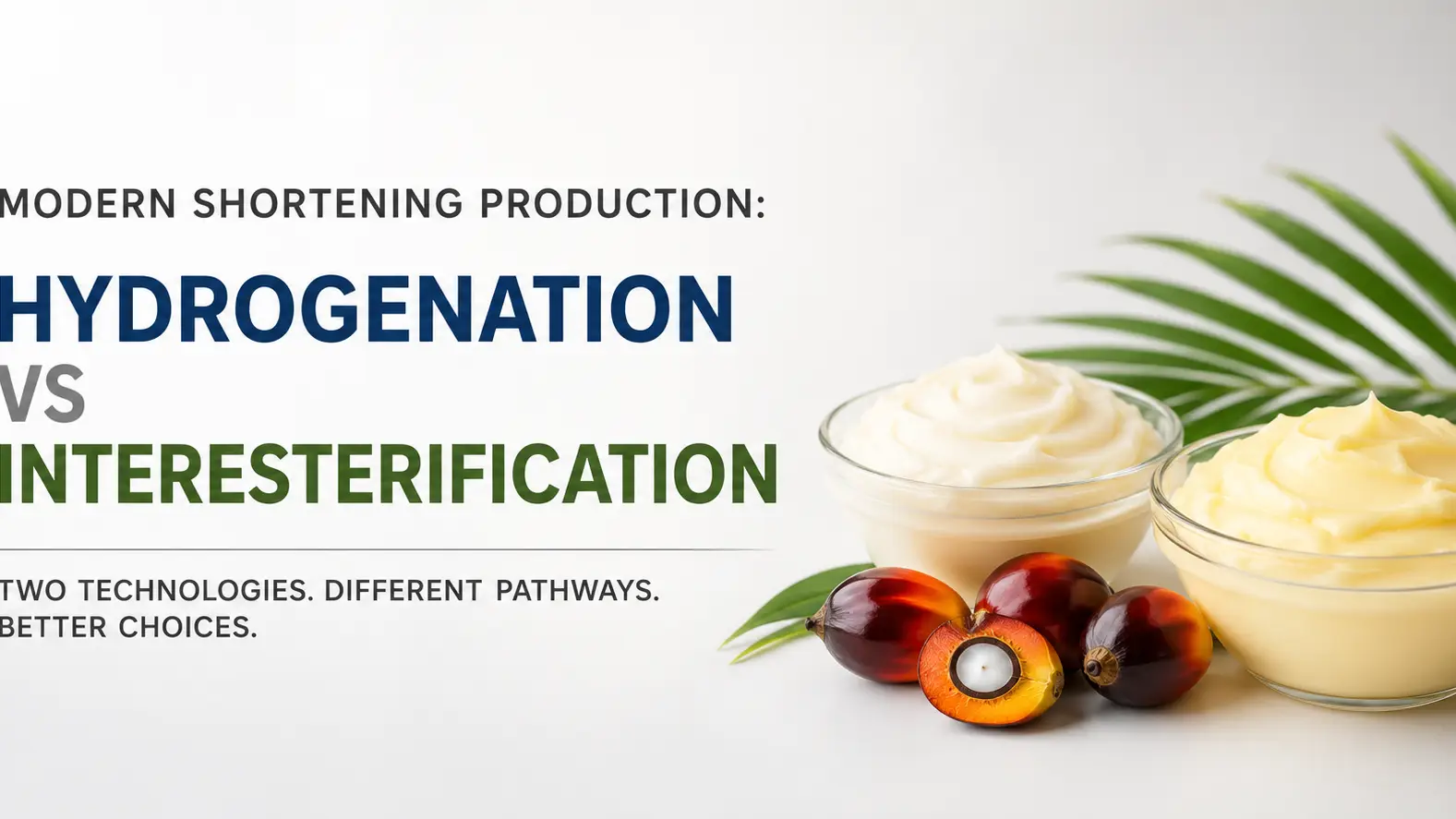
Introduction: The Changing Science of Shortening
Evolution of Shortening Processing in Fats Industry
Hydrogenation: Mechanism and Industrial Role
Health Concerns and Regulatory Shift Away from Trans Fats
Interesterification as a Modern Alternative
Comparative Performance in Bakery and Food Manufacturing
Market Trends and Regional Adoption Dynamics
Conclusion
Shortening plays a foundational role in bakery, confectionery, and processed food manufacturing, shaping texture, stability, and shelf life. Traditionally dominated by hydrogenation, the industry is now transitioning toward interesterification due to rising health concerns and regulatory pressure. As food manufacturers seek trans-fat-free formulations without compromising functionality, the comparison between these two processing methods has become central to modern edible oil innovation and global supply chain strategies.
The evolution of shortening processing reflects broader changes in food technology and consumer awareness. Initially, hydrogenation enabled liquid vegetable oils to become semi-solid fats, revolutionizing industrial baking. However, as nutritional science advanced, attention shifted toward fat composition and metabolic impact. This transition opened pathways for alternative structuring techniques, particularly interesterification, which allows manufacturers to modify fat properties without generating trans fatty acids.
Hydrogenation is a chemical process that adds hydrogen atoms to unsaturated fats, increasing solidity and improving oxidative stability. In industrial applications, it historically enabled cost-efficient production of consistent shortening for mass food production. However, partial hydrogenation unintentionally produces trans fats, which have been linked to cardiovascular risks. Despite its declining use, fully hydrogenated oils still serve niche industrial roles where high stability is required.
Global regulatory bodies, including the World Health Organization, have emphasized the elimination of industrial trans fats from food systems due to their association with heart disease. Many countries now enforce strict limits or outright bans on partially hydrogenated oils. This regulatory shift has significantly accelerated reformulation efforts across the food industry, pushing manufacturers to adopt safer fat structuring technologies that align with public health goals.
Interesterification is a non-hydrogenation process that rearranges fatty acids within triglycerides to achieve desired melting points and functionality. Unlike hydrogenation, it does not produce trans fats, making it a preferred solution for modern food formulation. Both chemical and enzymatic interesterification methods are used to tailor fats for bakery applications, margarine production, and confectionery products, offering flexibility without compromising nutritional safety standards.
In bakery applications, hydrogenated fats traditionally offered superior aeration and texture stability. However, interesterified fats now match or exceed these performance characteristics when properly formulated. Manufacturers value interesterified shortening for its clean-label potential and regulatory compliance. While hydrogenation still provides cost advantages in certain industrial contexts, the balance is increasingly shifting toward healthier and more adaptable fat systems.
The global shortening market is undergoing structural transformation, driven by health-conscious consumers and regulatory enforcement. Regions such as Europe and North America have largely phased out partially hydrogenated oils, while emerging markets are accelerating reformulation timelines. In the Middle East, including the UAE, food manufacturers are actively investing in next-generation edible oil technologies to align with international standards and export requirements.
The comparison between hydrogenation and interesterification highlights a clear industry transition from legacy chemical processes to modern, health-aligned fat structuring technologies. As regulatory frameworks tighten and consumer expectations evolve, interesterification is becoming the dominant solution for sustainable shortening production. For manufacturers navigating this shift, sourcing reliable, high-quality edible oil inputs is critical. Tradeasia International stands as a global partner supporting industrial buyers with consistent supply solutions and expertise across the edible oils and fats value chain.
Article Sources:
We're committed to your privacy. Tradeasia uses the information you provide to us to contact you about our relevant content, products, and services. For more information, check out our privacy policy.


 English
 Indonesian
 简体字
简体字
 العربية
 Español
 Français
 Português
 日本語
日本語
 한국어
한국어
 Tiếng Việt



















