Explore our network of country and industry based websites to access localized information, product offerings, and business services across our group.
Log in to start sending quotation requests for any product.
Don't have an account? Sign Up Here
Home Soda Ash Light Market Demand, Applications and B2B Sourcing
Trade Insights | Supply Chain | 03 September 2026
Soda Ash Light: Product Overview and Commercial Position
Industrial Applications Driving Soda Ash Light Demand
Market Demand and Recent Industry Trends
Who Buys Soda Ash Light and What Procurement Teams Evaluate
Sourcing Soda Ash Light from China
Building a Reliable B2B Soda Ash Light Supply Strategy
Conclusion: Turning Soda Ash Light Demand into Sourcing Opportunities
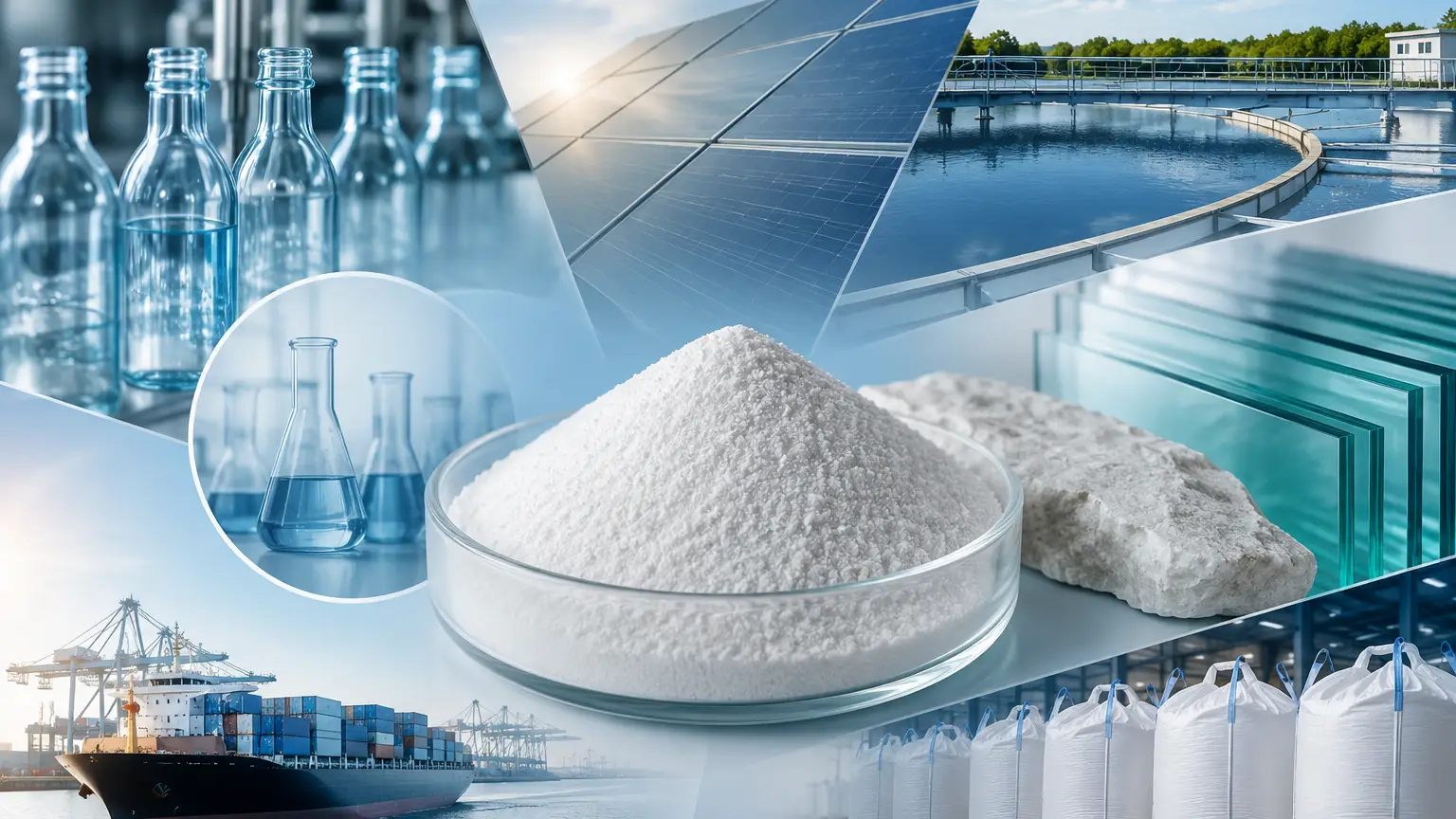
Soda Ash Light is an anhydrous form of sodium carbonate, with the chemical formula Na₂CO₃ and CAS Number 497-19-8. The Tradeasia product listing specifies a China origin, minimum assay of 99.2%, solid physical form, and white to off-white appearance. The material is also known as sodium carbonate, washing soda and E500ii.
From a commercial perspective, soda ash is a foundational inorganic chemical rather than a niche specialty material. The U.S. Geological Survey describes soda ash as the trade name for sodium carbonate and identifies glass, chemicals, detergents and other industrial products among its major uses. This breadth of applications makes demand closely connected to multiple downstream manufacturing sectors.
For procurement teams, the value of Soda Ash Light is closely linked to its combination of chemical functionality, broad industrial use and established international trade. Its alkaline character and water solubility make it useful in formulations and manufacturing processes where sodium carbonate is required. The product information also notes that it is hygroscopic, meaning storage conditions need to control moisture exposure and prevent clumping.
This makes Soda Ash Light relevant to manufacturers, distributors, chemical traders and industrial procurement departments looking for a dependable sodium carbonate supply. Buyers evaluating a soda ash light supplier should therefore consider more than nominal price: assay, technical documentation, packaging, storage, shipping requirements, order quantity and supply consistency all affect the delivered commercial value. The Soda Ash Light supplier information can serve as a starting point for evaluating the listed specification and initiating an inquiry.
Glass is the most commercially significant soda ash end use. USGS data for 2023 estimated that glass represented 47% of U.S. soda ash distribution, ahead of chemicals at 29%, demonstrating how strongly the commodity is connected to the glass value chain. Soda ash is used across container glass, flat glass, fiber glass and other glass products.
For soda ash for glass manufacturing, demand therefore depends on activity across construction, automotive, packaging and other sectors that consume glass products. Container glass manufacturers and flat-glass producers can have substantially different purchasing patterns, but both require dependable industrial raw-material supply. For procurement teams, consistency in chemical specifications and reliable delivery can become particularly important when soda ash is purchased at production scale.
Chemical manufacturing represents another major demand center. USGS identifies sodium bicarbonate, sodium chromates, sodium phosphates and sodium silicates among sodium-based inorganic chemicals manufactured using soda ash. This makes soda ash for chemical manufacturing relevant to producers that use sodium carbonate as a feedstock or process input.
Detergent production provides another established application. Soda ash can function as a builder in detergent formulations, supporting alkalinity, water softening and cleaning performance. Beyond these major applications, USGS data also identify flue-gas desulfurization, pulp and paper, water treatment and miscellaneous uses as additional markets, illustrating the breadth of industrial sodium carbonate consumption.
Soda ash demand is ultimately influenced by the performance of industries that consume it. Glass manufacturing remains particularly important, while chemical production and detergent-related applications provide additional demand diversity. USGS maintains dedicated statistics covering worldwide soda ash supply, demand and flows, underscoring the importance of the material as a globally traded industrial commodity.
A relevant recent demand signal comes from the expansion of solar PV. The International Energy Agency reported that global solar PV capacity additions exceeded 600 GW in 2025, while solar PV accounted for more than three-quarters of new renewable capacity additions. Because solar modules rely heavily on glass, continued expansion of solar manufacturing provides an important downstream consideration for companies participating in glass-related supply chains, although soda ash demand should not be equated directly with solar deployment.
Recent market conditions also demonstrate why buyers should distinguish between underlying demand and short-term pricing. Reuters reported in July 2025 that global soda ash prices had fallen significantly amid oversupply from China, while Indian glass demand was expected to provide a growth driver. This illustrates how production capacity, regional trade flows and downstream consumption can create substantial differences between markets.
For B2B buyers, this environment increases the value of active soda ash sourcing rather than relying on a single historical quotation. Procurement teams can benefit from comparing China-origin material with alternative supply sources while assessing total delivered cost, lead time, documentation, packaging and commercial reliability. The objective is not necessarily to select the lowest quoted price, but to identify a supply option that remains commercially workable across the intended purchasing cycle.
The principal soda ash buyers include glass manufacturers, chemical producers, detergent manufacturers, industrial distributors and chemical traders. Additional demand can come from businesses involved in water treatment, pulp and paper and other processes that require sodium carbonate. The diversity of these buyers reflects the material's role as an industrial input rather than a single-purpose chemical.
Procurement requirements can differ significantly between these groups. A glass producer may prioritize dependable bulk supply and manufacturing consistency, while a chemical manufacturer may focus more heavily on assay and process compatibility. Distributors and traders may additionally emphasize packaging, documentation, shipment flexibility, market competitiveness and the ability to serve downstream customers across different regions.
When evaluating a soda ash light supplier, buyers typically need to confirm product identity, assay, origin, technical specifications, safety documentation, packaging and commercial terms. The listed Tradeasia material has a minimum assay of 99.2%, China origin and HS Code 2836.20.00, while its product information provides access to technical and safety documentation.
Supplier comparison is important because a purchase decision extends beyond the chemical itself. Logistics, moisture protection, order quantity, shipment timing and documentation can affect the actual cost and usability of an industrial chemical. A marketplace product page can support this first stage of evaluation by consolidating specification information and providing an inquiry pathway for pricing, customization and shipping discussions.
China is an important participant in the international soda ash supply chain, making soda ash light China a commercially relevant search and procurement category. The Tradeasia listing specifically identifies China as the origin of the 99.2% minimum assay Soda Ash Light product. For international buyers, China-origin sourcing can therefore be evaluated alongside other available production regions according to specification, logistics and commercial requirements.
At the same time, country of origin should not be treated as a substitute for supplier qualification. Market conditions can change as production capacity, domestic consumption, exports and freight economics evolve. Reuters' reporting on Chinese oversupply and its effect on international soda ash prices demonstrates why procurement teams should monitor market conditions when negotiating supply arrangements.
The physical characteristics of Soda Ash Light create practical sourcing considerations. The product is described as freely soluble in water and hygroscopic, with recommended storage in a cool, dry and sealed environment while avoiding moisture. These characteristics make appropriate packaging, warehousing and transport handling important parts of an effective soda ash sourcing program.
For international procurement, buyers should also align the product specification with their own process requirements before committing to volume. Reviewing the technical data sheet and safety data sheet, confirming the required quantity and unit of measure, and discussing shipping arrangements can reduce avoidable friction after purchase. The Soda Ash Light sourcing page provides the listed product information and an inquiry mechanism for buyers seeking pricing, customization and shipping details.
A strong B2B sourcing strategy should compare total procurement value rather than focusing exclusively on the quoted unit price. For Soda Ash Light, this means considering assay, usable material, packaging, freight, lead time, payment terms, documentation and the supplier's ability to support the required purchasing volume. Such a framework helps procurement teams distinguish a genuinely competitive offer from a quotation that becomes less attractive after logistics and handling costs are included.
This approach is particularly relevant when market prices are volatile. USGS continues to track soda ash production, consumption and trade flows, while recent market reporting has highlighted the impact that changes in Chinese supply can have on global pricing. Buyers can use these market signals as context when deciding whether to negotiate spot purchases, establish repeat orders or diversify suppliers.
A chemical marketplace can shorten the early stages of supplier discovery by bringing product specifications and commercial inquiry capabilities into one sourcing environment. For manufacturers, traders and distributors, this can make it easier to identify potentially relevant material before moving into technical qualification, quotation comparison and logistics planning. The Tradeasia platform describes its role as supporting chemical sourcing, procurement and supply-chain solutions.
For buyers evaluating B2B chemical sourcing, the next step is to connect the market requirement with a verified product specification and a commercial inquiry. The Soda Ash Light product page gives buyers access to the listed China-origin specification and an inquiry route for pricing, quantity, customization and shipping. This marketplace-led approach can help procurement teams move from general soda ash light supplier research toward a more structured sourcing conversation.
The commercial outlook for Soda Ash Light remains closely tied to several major industrial value chains, particularly glass and chemicals, with detergents and other applications providing additional demand. USGS data demonstrate the importance of glass and chemicals within soda ash consumption, while recent energy and manufacturing trends point to continued expansion of glass-intensive technologies such as solar PV.
The market should nevertheless be approached with a procurement rather than purely demand-driven perspective. Regional oversupply, changing production economics, freight costs and downstream manufacturing cycles can influence prices and availability. Recent reporting on China's impact on global soda ash prices reinforces the need for buyers to monitor both supply-side and end-use developments when planning purchases.
For manufacturers, distributors, traders and procurement teams, Soda Ash Light presents a sourcing opportunity across a broad set of industrial applications. The key is to match the required application with an appropriate specification and then evaluate suppliers on quality, documentation, logistics, commercial terms and supply reliability. This makes supplier comparison an important part of managing the overall procurement risk.
The Tradeasia-listed Soda Ash Light (99.2%) from China provides a defined product specification from which buyers can begin that evaluation. Reviewing the Soda Ash Light for industrial applications information and submitting an inquiry can help procurement teams move from market research toward a more concrete assessment of quantity, pricing and shipping requirements.
We're committed to your privacy. Tradeasia uses the information you provide to us to contact you about our relevant content, products, and services. For more information, check out our privacy policy.


 English
 Indonesian
 简体字
简体字
 العربية
 Español
 Français
 Português
 日本語
日本語
 한국어
한국어
 Tiếng Việt



















