Explore our network of country and industry based websites to access localized information, product offerings, and business services across our group.
Log in to start sending quotation requests for any product.
Don't have an account? Sign Up Here
Home Soda Ash Light Supply Chain Market : Trends and Global Outlook
Trade Insights | Supply Chain | 26 February 2026
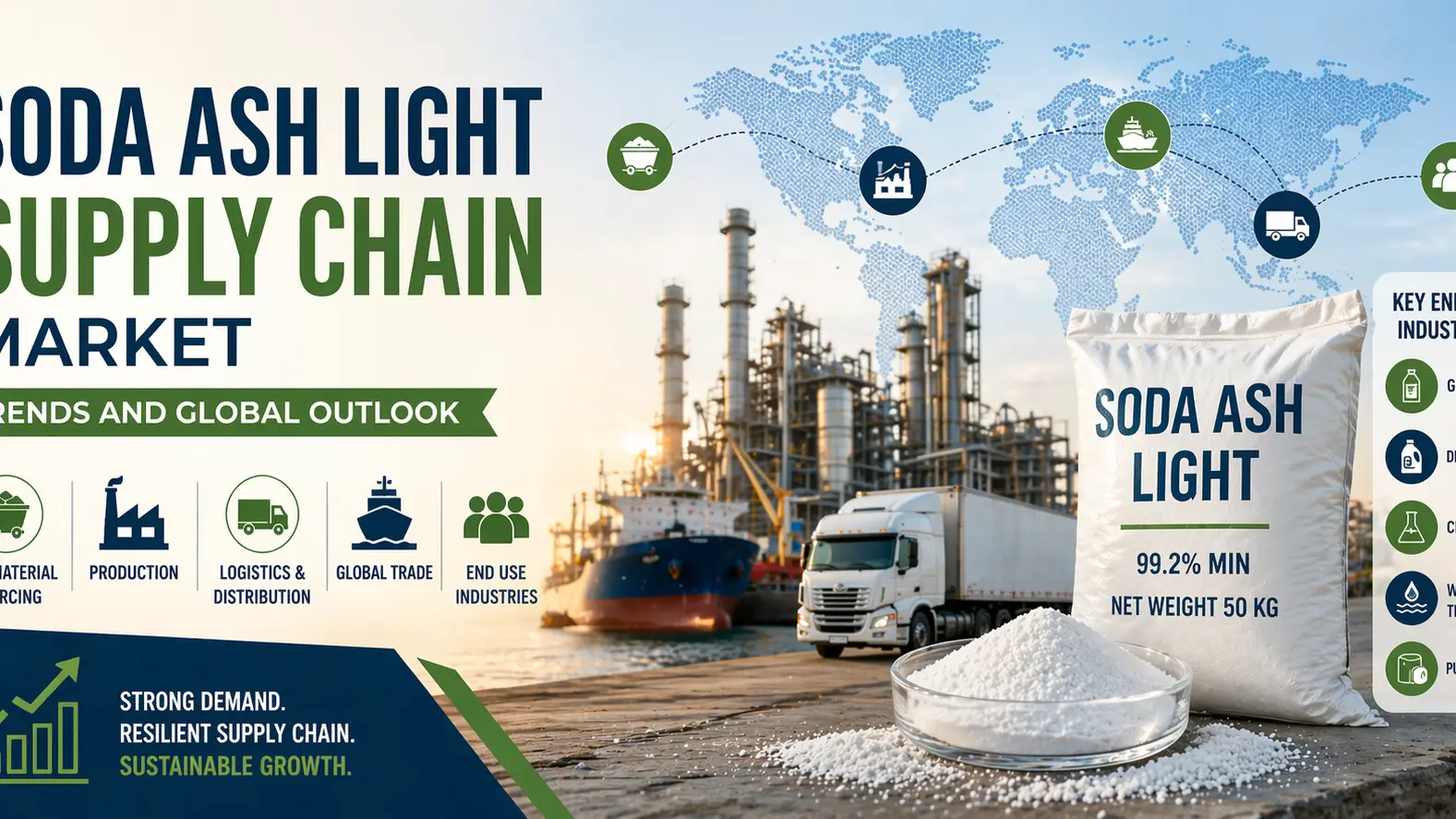
The Soda Ash Light supply chain market in 2026 is undergoing a significant transformation shaped by industrial diversification, geopolitical shifts, and sustainability pressures. As a critical raw material for glass manufacturing, detergents, chemicals, and water treatment, its supply chain has evolved from a price-driven model to a strategic procurement ecosystem. With global market value projected to exceed USD 15.8 billion in 2026 and continue expanding steadily, supply chain optimization has become central to maintaining competitiveness.
In 2026, the global soda ash light market reflects a delicate balance between supply expansion and diversified demand. Production volumes have surpassed 60 million metric tons, led by major producers such as China, the United States, and Europe.
However, demand is no longer concentrated in traditional sectors alone. Beyond glass manufacturing—which remains the dominant consumer—emerging applications such as lithium processing, solar glass, and water treatment are reshaping procurement patterns.
Additionally, trade policy changes, including tariffs introduced in recent years, have redirected supply flows toward Asia, improving regional availability while intensifying competition among exporters. This realignment has pushed buyers to diversify sourcing strategies and reduce dependency on single-origin supply hubs.
Energy remains the most influential factor in the soda ash light supply chain, accounting for up to 40% of total production costs. Fluctuations in natural gas and electricity prices—particularly in Europe—have introduced regional cost disparities and pricing instability.
Price volatility is further amplified by logistics disruptions and downstream demand cycles. For example, variations in glass industry demand and shipping constraints have historically caused fluctuations in global price benchmarks.
In response, industrial buyers are increasingly turning to long-term contracts, hedging strategies, and supplier diversification to stabilize procurement costs and ensure supply continuity in a volatile market environment.
Sustainability has become a defining theme in the 2026 soda ash light supply chain. Regulatory frameworks focused on carbon emissions and environmental compliance are reshaping production and sourcing decisions.
Manufacturers are investing in energy-efficient technologies, renewable power integration, and emissions reduction systems to align with global sustainability targets. These innovations can reduce energy consumption by up to 20%, improving both environmental performance and cost efficiency.
At the same time, buyers are prioritizing suppliers that demonstrate transparency, compliance, and lower carbon footprints. This shift is particularly evident in industries such as detergents and water treatment, where sustainability credentials increasingly influence procurement decisions.
To navigate increasing complexity, companies are adopting advanced sourcing and logistics strategies. Multi-regional procurement models, digital supply chain platforms, and inventory buffering have become essential tools for mitigating risk.
Logistics efficiency is equally critical. Bulk shipping, port infrastructure, and freight availability directly impact delivery timelines and cost structures in this high-volume commodity market. Moreover, regulatory compliance—covering import/export documentation, safety standards, and trade policies—now contributes up to 10–12% of total costs.
As a result, supply chain agility and regulatory expertise are emerging as key differentiators for both suppliers and buyers in the global soda ash light market.
The soda ash light supply chain market in 2026 is defined by complexity, where shifting demand patterns, energy-driven cost volatility, sustainability mandates, and logistics challenges intersect. Success in this evolving landscape depends on resilient sourcing strategies, data-driven procurement, and strong global partnerships.
For businesses seeking stability and efficiency, Tradeasia International offers a reliable pathway forward as a global solution provider. With established sourcing networks, regulatory expertise, and market intelligence, Tradeasia supports companies in securing consistent supply and navigating the dynamic chemical trade environment with confidence.
Sources:
We're committed to your privacy. Tradeasia uses the information you provide to us to contact you about our relevant content, products, and services. For more information, check out our privacy policy.


 English
 Indonesian
 简体字
简体字
 العربية
 Español
 Français
 Português
 日本語
日本語
 한국어
한국어
 Tiếng Việt



















