Explore our network of country and industry based websites to access localized information, product offerings, and business services across our group.
Log in to start sending quotation requests for any product.
Don't have an account? Sign Up Here
Home Sodium Acetate Supply Chain Market 2026: Global Trade, Risks & Strategy Shift
Trade Insights | Supply Chain | 16 April 2026
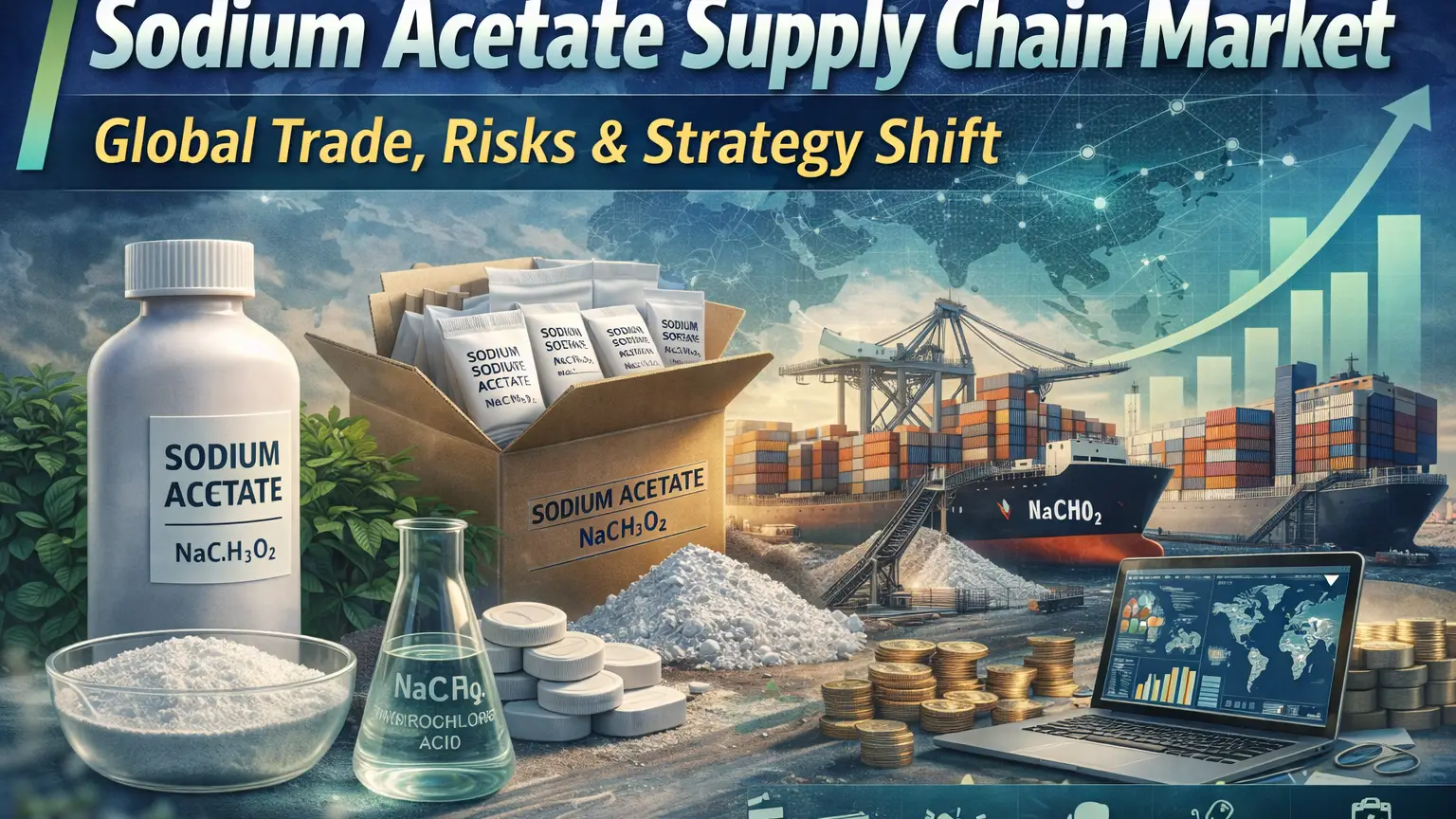
The sodium acetate supply chain market in 2026 is evolving under the pressure of structural realignments in global chemical trade, energy volatility, and end-use diversification. Once considered a relatively stable downstream derivative of acetic acid, sodium acetate has become increasingly sensitive to geopolitical fragmentation and regional manufacturing strategies. Its role as a buffering agent, food additive, and industrial processing chemical continues to expand, yet the way it is sourced, produced, and distributed is undergoing a significant transformation.
For industrial buyers and chemical distributors, the market is no longer defined purely by price competitiveness but by supply assurance, regional proximity, and compliance-driven procurement frameworks. As global producers adjust to shifting trade corridors and localized production strategies, sodium acetate is becoming a case study in how mid-tier commodity chemicals adapt to a more fragmented global economy.
One of the most influential dynamics shaping the sodium acetate market is the acceleration of supply chain regionalization. Manufacturers are increasingly investing in localized production hubs to reduce exposure to cross-border disruptions and energy price differentials. According to industry analysis, companies are prioritizing geographically diversified manufacturing footprints to stabilize margins and improve delivery reliability under shifting trade policies .
This shift is particularly visible in North America and Europe, where industrial buyers are seeking shorter supply routes and reduced dependence on Asian exports. Regional clusters are emerging around integrated acetic acid production facilities, enabling tighter control over upstream feedstock flows and downstream conversion efficiency.
At the core of sodium acetate’s supply chain structure lies its dependency on acetic acid, a feedstock known for significant price and availability fluctuations. Volatility in upstream acetic acid pricing directly impacts production economics and contract stability across the value chain. Studies highlight that raw material price instability remains one of the most persistent constraints for sodium acetate producers globally .
This dependency has pushed manufacturers toward vertical integration strategies or long-term sourcing agreements to secure cost predictability. However, the concentration of acetic acid production in specific regions continues to expose sodium acetate supply chains to systemic risks, particularly during energy shocks or trade restrictions.
Logistics networks supporting sodium acetate distribution are also undergoing significant restructuring. Port congestion, shipping volatility, and geopolitical disruptions have forced chemical traders to diversify transport routes and storage hubs. The result is a more layered and regionally redundant logistics model, where inventory buffering plays a greater role in maintaining supply continuity.
In 2026, supply chain resilience is increasingly defined by agility rather than cost optimization alone. Distributors are expanding bonded warehousing and near-market storage facilities to reduce lead time variability. This is especially important for industrial-grade sodium acetate used in wastewater treatment and textile processing, where uninterrupted supply is critical for continuous operations.
Demand-side dynamics are reinforcing supply chain complexity. Sodium acetate is no longer confined to traditional food preservation and buffering applications; it is now deeply embedded in wastewater treatment systems, textile processing, and emerging thermal energy storage solutions. Industrial applications account for a major share of global consumption, driven by large-scale municipal and manufacturing infrastructure requirements .
This diversification is reshaping procurement strategies. Buyers increasingly demand multi-grade availability—food, pharmaceutical, and technical—within a single supply framework. As a result, suppliers must maintain flexible production lines and stringent quality segmentation to serve multiple regulated industries simultaneously.
The sodium acetate supply chain market in 2026 reflects a broader transformation in global chemical trade—one defined by regionalization, feedstock dependency, logistics resilience, and diversified industrial demand. While the compound itself remains chemically stable and widely standardized, its supply chain architecture is becoming increasingly complex and strategically important.
In this evolving landscape, companies are prioritizing partners that can ensure consistent quality, reliable logistics, and multi-region sourcing capabilities. Tradeasia International continues to position itself as a global solution provider, supporting industries with integrated chemical sourcing, distribution expertise, and supply chain reliability across key markets.
Sources:
We're committed to your privacy. Tradeasia uses the information you provide to us to contact you about our relevant content, products, and services. For more information, check out our privacy policy.


 English
 Indonesian
 简体字
简体字
 العربية
 Español
 Français
 Português
 日本語
日本語
 한국어
한국어
 Tiếng Việt



















