Explore our network of country and industry based websites to access localized information, product offerings, and business services across our group.
Log in to start sending quotation requests for any product.
Don't have an account? Sign Up Here
Home Stearic Acid Supply Chain: Feedstock Volatility & Regional Dominance
Trade Insights | Supply Chain | 15 April 2026
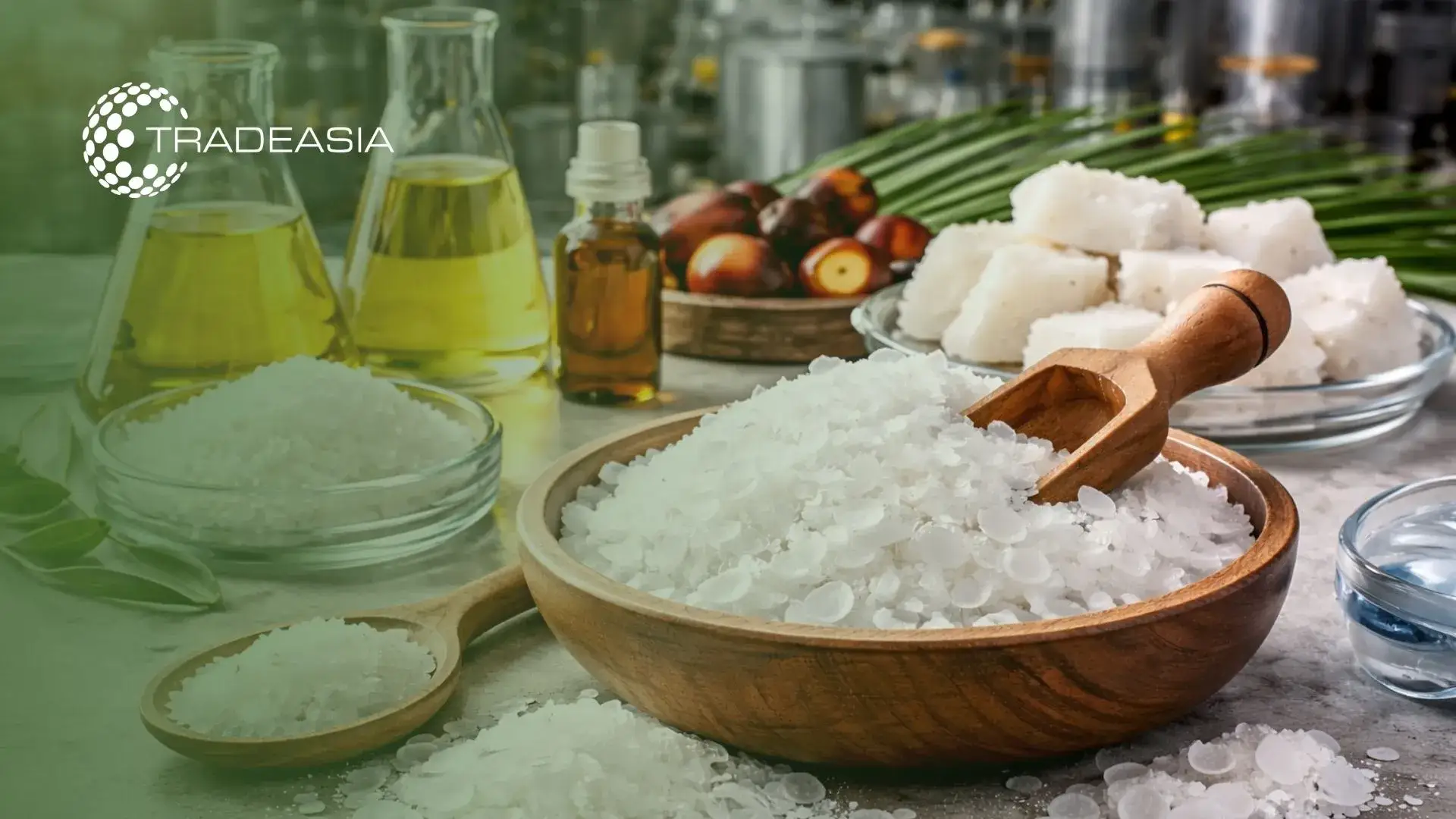
The global stearic acid market in 2026 is undergoing structural transformation, shaped by feedstock volatility, regional production concentration, and evolving downstream demand. With market value reaching approximately USD 46.0 billion and steady expansion driven by industrial applications, supply chain efficiency has become a defining competitive factor.
Stearic acid production remains heavily reliant on palm oil and animal tallow, with feedstock costs accounting for up to 70% of total production expenses. In 2026, supply chains are particularly sensitive to palm oil disruptions in Southeast Asia, where biodiesel mandates and seasonal factors have pushed crude palm oil prices up by over 11%, tightening margins across oleochemical producers.
This upstream pressure has forced manufacturers to diversify sourcing strategies, including increased adoption of plant-based alternatives, which are gaining traction due to sustainability mandates and regulatory compliance.
Global production reached approximately 10.51 million tons in 2026, with Asia-Pacific controlling nearly 71.78% of total supply. This concentration highlights a critical supply chain risk: dependency on Indonesia and Malaysia for palm-derived feedstocks.
Major integrated producers benefit from vertical supply chains, enabling cost advantages and stable output. However, geopolitical and environmental risks in these regions continue to influence global availability and lead times.
Stearic acid prices have shown consistent volatility, largely driven by feedstock costs and logistics constraints. By late 2025, benchmark prices ranged between USD 1,116–1,357/MT, depending on regional supply-demand dynamics.
In 2026, this pricing trend persists, with buyers facing elevated procurement costs due to tight supply and sustained demand from personal care, rubber, and plastics sectors. Contract pricing mechanisms and long-term sourcing agreements are increasingly used to mitigate volatility.
Demand growth remains stable, supported by diverse industrial applications. The market is projected to grow at a CAGR of approximately 5.3%–5.7%, driven by expanding rubber processing, plastics manufacturing, and personal care industries.
Additionally, emerging applications in electric vehicles and advanced materials are reshaping consumption patterns, reinforcing the importance of supply chain resilience and product consistency.
As the stearic acid market evolves in 2026, supply chain optimization is no longer optional—it is strategic. From feedstock sourcing to regional production dependencies and pricing dynamics, companies must adopt integrated procurement strategies to remain competitive.
For businesses navigating these complexities, Tradeasia International offers a reliable global sourcing network, consistent quality supply, and real-time market insights. With strong partnerships across Asia-Pacific and beyond, Tradeasia continues to support industries with efficient, transparent, and scalable stearic acid solutions.
Sources:
We're committed to your privacy. Tradeasia uses the information you provide to us to contact you about our relevant content, products, and services. For more information, check out our privacy policy.


 English
 Indonesian
 简体字
简体字
 العربية
 Español
 Français
 Português
 日本語
日本語
 한국어
한국어
 Tiếng Việt



















