Explore our network of country and industry based websites to access localized information, product offerings, and business services across our group.
Log in to start sending quotation requests for any product.
Don't have an account? Sign Up Here
Home Sucrose Acetate Isobutyrate Supply Chain Market Insights and Trends
Trade Insights | Supply Chain | 27 April 2026
Raw Material Sourcing and Upstream Dependencies
Manufacturing Complexity and Value Chain Integration
Global Distribution and Supply Chain Risks
Demand Drivers and End-Use Market Expansion
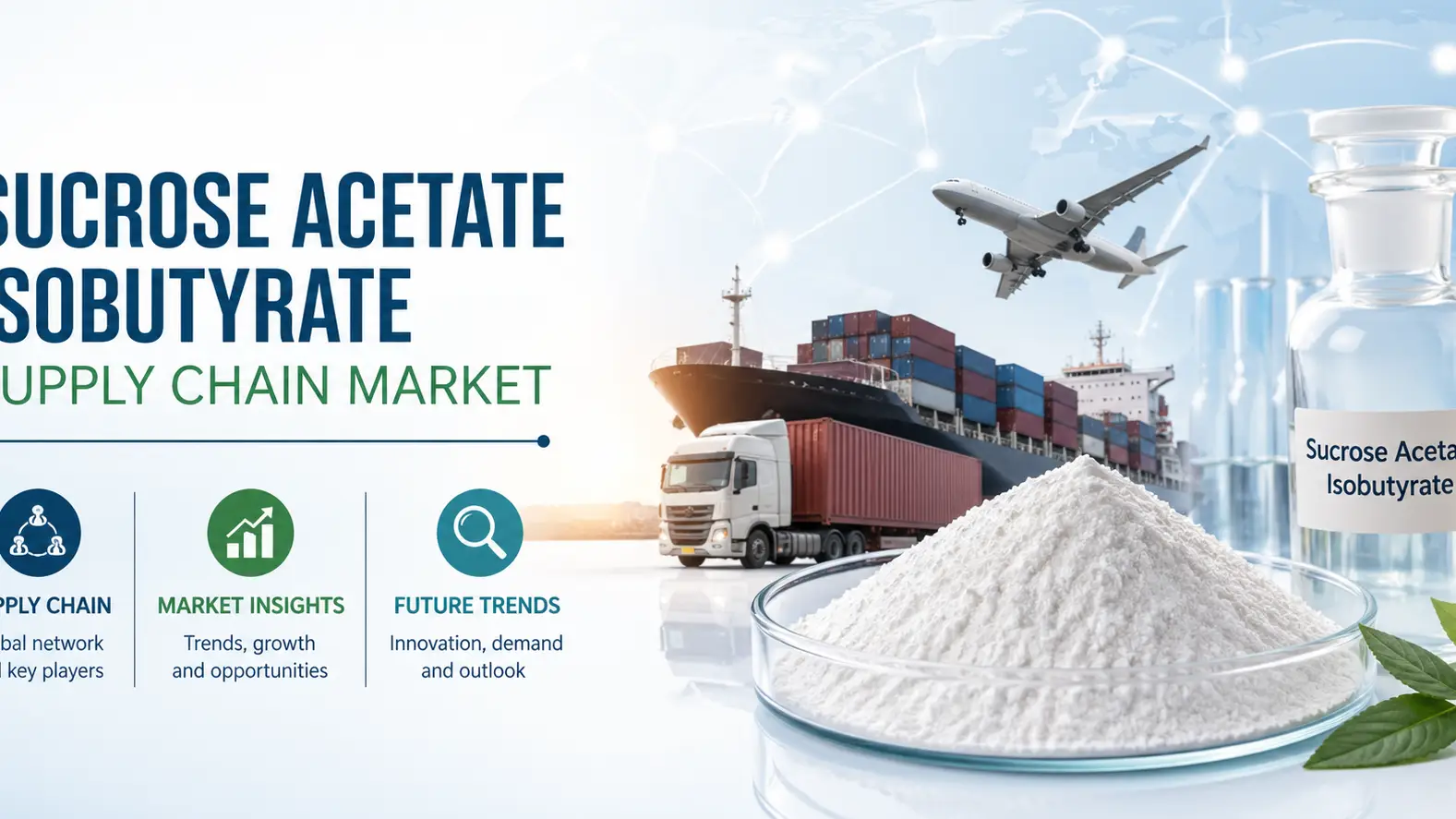
Sucrose acetate isobutyrate (SAIB) has emerged as a niche yet strategically significant compound within the global specialty chemicals market. Widely recognized for its role as a stabilizer and weighting agent in beverages and industrial formulations, SAIB connects agricultural feedstocks, petrochemical intermediates, and downstream manufacturing sectors into a tightly interwoven supply chain. As industries increasingly prioritize formulation stability and regulatory compliance, understanding the supply chain dynamics of SAIB becomes critical for procurement leaders and B2B stakeholders.
The SAIB supply chain begins with three core inputs: sucrose, acetic anhydride, and isobutyric anhydride. These materials originate from two fundamentally different industries—agriculture and petrochemicals—creating a dual-dependency structure. Sucrose is derived from sugarcane or sugar beet crops, making it vulnerable to climate variability and agricultural cycles. Meanwhile, isobutyric derivatives depend on petrochemical production, which is sensitive to energy markets and refinery disruptions.
This hybrid sourcing model introduces volatility, as disruptions in either sector can cascade downstream. For instance, reduced sugar yields due to drought conditions or petrochemical outages can directly constrain SAIB availability and pricing.
The production of SAIB involves esterification processes that combine sucrose with acetic and isobutyric anhydrides under controlled conditions. The result is a highly viscous, thermally stable compound with unique emulsifying properties.
From a supply chain perspective, this manufacturing stage demands specialized chemical processing capabilities, quality control systems, and compliance with food-grade or industrial standards. Manufacturers often operate in integrated ecosystems, sourcing raw materials through long-term contracts while optimizing batch production for efficiency.
Because SAIB is not a commodity chemical but a performance ingredient, suppliers must maintain consistent specifications across global markets. This has led to the emergence of specialized distributors that bridge producers and end-users, ensuring reliability and traceability across the value chain.
Distribution of SAIB reflects the broader complexity of specialty chemical logistics. The product is typically transported in liquid form, requiring controlled handling conditions and compliance with international chemical transport regulations.
Global supply chains for SAIB are geographically dispersed, with production hubs in Asia, North America, and Europe serving multinational demand. However, this dispersion also introduces risks such as shipping delays, trade policy shifts, and logistical bottlenecks.
Recent global disruptions—from extreme weather events to industrial shutdowns—have exposed vulnerabilities in the SAIB supply chain. These events highlight the importance of diversified sourcing strategies, regional warehousing, and strategic supplier partnerships to mitigate risk and maintain continuity.
SAIB demand is primarily driven by its application in the food and beverage industry, where it functions as an emulsifier and density-adjusting agent in citrus-based drinks. Beyond beverages, it is increasingly used in cosmetics, fragrances, and pharmaceutical delivery systems due to its stability and compatibility with active ingredients.
Market growth is closely tied to evolving consumer preferences for stable, visually appealing products and regulatory shifts away from alternative additives such as brominated vegetable oil. Additionally, innovation in drug delivery systems and personal care formulations is expanding SAIB’s application scope, reinforcing its strategic importance in multiple industries.
The supply chain of sucrose acetate isobutyrate illustrates the complexity of modern specialty chemical markets, where agricultural inputs, petrochemical derivatives, and advanced manufacturing converge. For businesses navigating this landscape, resilience depends on strategic sourcing, reliable distribution networks, and deep market insight.
In this context, Tradeasia International positions itself as a global solution provider, supporting businesses with integrated chemical sourcing, consistent quality assurance, and responsive logistics capabilities. By bridging suppliers and industries worldwide, Tradeasia enables companies to secure stable access to SAIB and other specialty chemicals in an increasingly dynamic global market.
We're committed to your privacy. Tradeasia uses the information you provide to us to contact you about our relevant content, products, and services. For more information, check out our privacy policy.


 English
 Indonesian
 简体字
简体字
 العربية
 Español
 Français
 Português
 日本語
日本語
 한국어
한국어
 Tiếng Việt



















