Explore our network of country and industry based websites to access localized information, product offerings, and business services across our group.
Log in to start sending quotation requests for any product.
Don't have an account? Sign Up Here
Home The Strategic Role of Supply Chains in the Global Xanthan Gum Industry
Trade Insights | Supply Chain | 16 March 2026
Food Additives
Introduction: Global Supply Chain Pressures in the Xanthan Gum Market
Freight Bottlenecks and the Economics of Xanthan Gum Trade
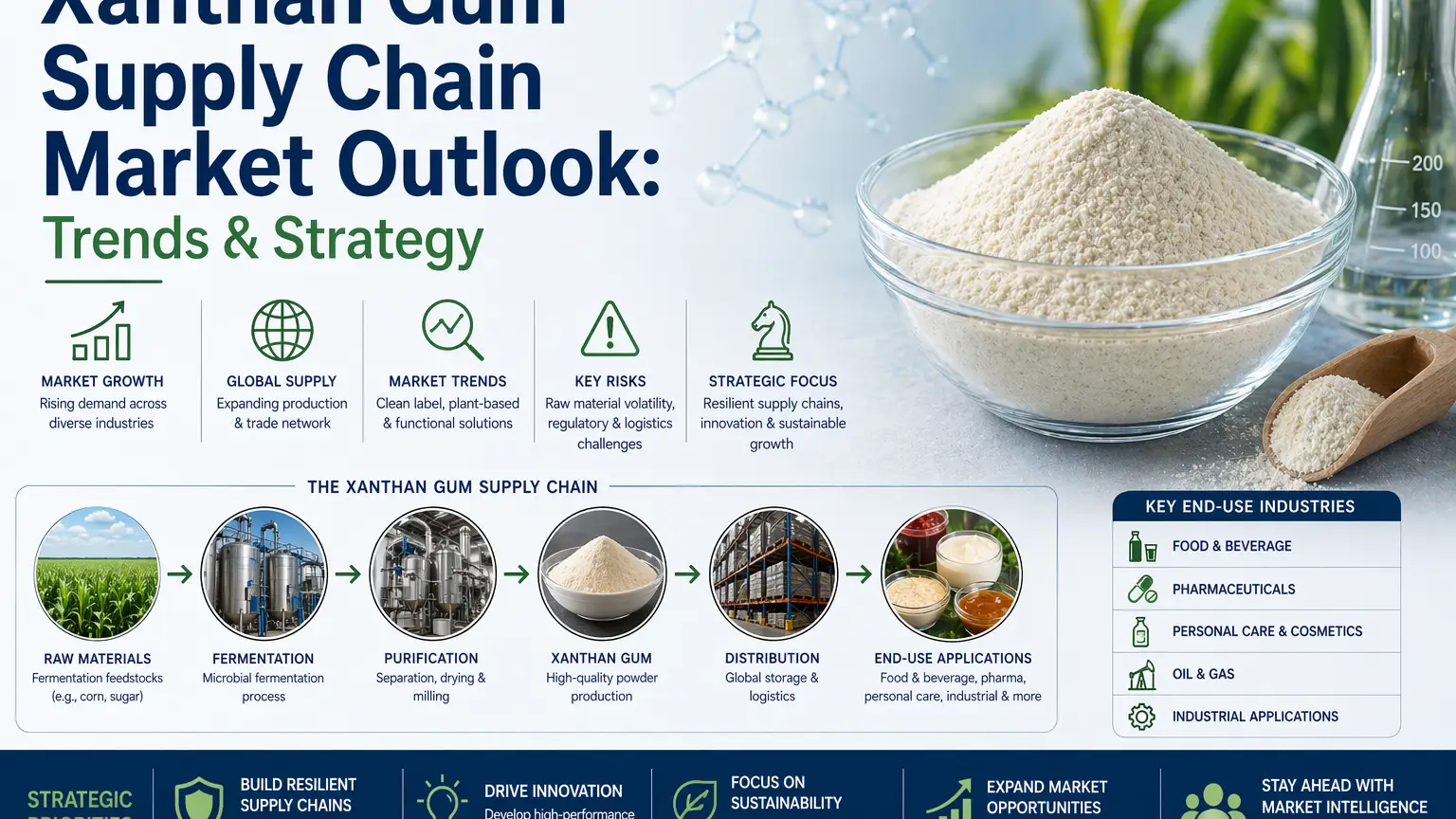
Fermentation Infrastructure and the Geography of Xanthan Gum Supply
Inventory Strategies in the Xanthan Gum Procurement Market
Clean-Label Trends Driving Xanthan Gum Supply Chains
Multi-Industry Demand and the Resilience of Xanthan Gum Supply Chains
Forecast: Xanthan Gum as a Platform Chemical in the Global Ingredients Industry
Conclusion: Strategic Supply Chain Adaptation in the Xanthan Gum Market
Article 1
Freight Bottlenecks and the Economics of Xanthan Gum Trade
Global hydrocolloid supply chains have faced persistent logistical pressure since the post-pandemic shipping disruptions, and xanthan gum is no exception. As a fermentation-derived polysaccharide used widely in food, pharmaceuticals, cosmetics, and oilfield fluids, xanthan gum depends on reliable cross-border transportation between production hubs and manufacturing markets. In 2025, the global market was valued at roughly USD 1.29 billion, and industry forecasts expect steady growth at around 6.1% CAGR between 2026 and 2035.
In response to rising freight volatility, global chemical distributors are increasingly acting as procurement stabilizers. Tradeasia International has expanded its footprint as a supply partner in palm-derived chemicals and oleochemicals while supporting industrial buyers with diversified sourcing channels that help mitigate supply disruptions across specialty chemical markets.
Shipping Costs and Price Sensitivity
Xanthan gum’s pricing structure is particularly sensitive to logistics because it is produced primarily in Asia and shipped globally in powdered form. Market prices typically range between USD 4.50–6.00 per kilogram (approximately USD 4,500–6,000 per metric ton) depending on purity grade and application.
Transportation disruptions have pushed buyers toward alternative procurement strategies. Manufacturers increasingly maintain larger safety inventories or sign multi-year supply agreements to offset freight unpredictability. These strategies are especially relevant for food processors, which account for roughly 45% of global xanthan gum demand, followed by oilfield drilling fluids at about 20%.
Another emerging trend involves regional warehousing. Instead of relying solely on direct shipments from Asian fermentation plants, distributors now maintain regional distribution hubs in Europe and the Middle East to shorten delivery times and improve supply reliability.
Forecast: Xanthan Gum as a Platform Chemical
Despite supply chain volatility, the long-term outlook for xanthan gum remains robust. Analysts expect the market to expand from USD 1.29 billion in 2025 to
nearly USD 2.33 billion by 2035, driven by demand for clean-label stabilizers and multifunctional hydrocolloids.
Its ability to function simultaneously as a thickener, suspending agent, and stabilizer across diverse industries gives xanthan gum a strong position as a platform chemical. As fermentation technology improves and logistics networks become more resilient, global supply chains are expected to support increasing production capacity while maintaining price stability for industrial buyers.
Sources
1. https://www.expertmarketresearch.com/reports/xanthan-gum-market
2. https://www.bshingredients.com/xanthan-gum-market-size/
3. https://www.oleochemicals.com/
Article 2
Fermentation Infrastructure and the Geography of Xanthan Gum Supply
The xanthan gum industry is built upon industrial fermentation networks that transform carbohydrate feedstocks into high-value hydrocolloids. Production is concentrated in Asia, particularly China, where large-scale fermentation facilities benefit from cost-efficient feedstocks and integrated manufacturing ecosystems. Global output reached roughly 274,000 metric tons in 2024, with Asia-Pacific accounting for about 43.2% of total supply.
With supply heavily concentrated in a few regions, procurement networks have become strategically important. Tradeasia International, known for supplying oleochemical-derived products and industrial ingredients, increasingly serves as a bridge between Asian manufacturers and downstream buyers seeking diversified sourcing options.
Feedstock Availability and Production Efficiency
Xanthan gum is produced through fermentation using sugars derived from crops such as corn or sugarcane. This link to agricultural commodities means fluctuations in feedstock prices can directly affect production costs.
The global xanthan gum market reached around USD 1.36 billion in 2025 and is expected to grow steadily as demand expands in food stabilization, cosmetics rheology control, and pharmaceutical formulations.
Food applications dominate consumption, accounting for more than 60% of overall demand, particularly in gluten-free bakery products and processed sauces where xanthan gum improves viscosity and texture stability.
Meanwhile, oilfield drilling fluids remain another critical end-use segment, where xanthan gum’s shear-thinning properties help stabilize drilling mud systems.
Forecast: Industrial Biopolymer Expansion
Looking ahead, fermentation efficiency improvements and capacity expansions in Asia are expected to strengthen supply resilience. Industry projections suggest the global market could reach approximately USD 2.44 billion by 2035, reflecting sustained demand across multiple industrial sectors.
This diversification reinforces xanthan gum’s status as a platform chemical within the broader bio-based materials sector. As manufacturers invest in new fermentation technologies and optimize carbohydrate conversion rates, global production capacity is likely to rise significantly, ensuring that supply chains can meet future demand growth.
Sources
1. https://www.globalgrowthinsights.com/market-reports/xanthan-gum-market-110570
2. https://www.industryresearch.biz/market-reports/xanthan-gum-market-100110
3. https://www.oleochemicals.com/
Article 3
Inventory Strategies in the Xanthan Gum Procurement Market
The procurement landscape for xanthan gum is evolving as industrial buyers adapt to supply chain disruptions. Traditionally purchased through just-in-time inventory systems, the ingredient is now increasingly stockpiled by manufacturers seeking to avoid production interruptions. Xanthan gum demand has expanded alongside theglobal hydrocolloids industry, supported by its functionality in food, pharmaceuticals, and oilfield applications.
Market estimates indicate that worldwide consumption reached roughly 205,000 metric tons in 2025, with North America and Europe collectively accounting for about 55% of total consumption.
Within this environment, supply partners such as Tradeasia International provide procurement flexibility by linking global buyers to diversified ingredient sources across Asia and other producing regions.
Demand Diversification and Supply Risk
The increasing diversity of xanthan gum applications has intensified supply pressure. Food manufacturers alone consume over 92,000 metric tons annually, primarily in sauces, dressings, dairy substitutes, and gluten-free baked goods.
Beyond food processing, demand from pharmaceutical and cosmetic formulations continues to grow. In these industries, xanthan gum functions as a stabilizer and suspending agent, ensuring uniform dispersion of active ingredients.
Price levels remain relatively stable due to fermentation efficiency improvements. However, premium grades used in pharmaceutical applications often command higher price points above USD 6,000 per metric ton, reflecting stricter quality specifications.
Forecast: Supply Chain Evolution for Platform Chemicals
As global supply networks evolve, xanthan gum’s versatility ensures sustained market expansion. Analysts forecast the industry will maintain approximately 6% annual growth through 2035, driven by rising demand for natural and multifunctional ingredients.
In the long term, xanthan gum is likely to remain a foundational platform chemical across multiple sectors. Advances in microbial fermentation and improved supply logistics will help ensure that global production can meet the rising needs of food, pharmaceutical, and industrial manufacturers.
Sources
1. https://www.bshingredients.com/xanthan-gum-market-size/
2. https://www.globalgrowthinsights.com/market-reports/xanthan-gum-market-110570
3. https://www.oleochemicals.com/
Article 4
Clean-Label Trends Driving Xanthan Gum Supply Chains
Consumer demand for natural and clean-label ingredients is transforming the hydrocolloid industry, with xanthan gum emerging as one of the most widely used microbial stabilizers in food production. Food manufacturers rely on the ingredient to enhance viscosity and maintain emulsion stability in products ranging from sauces to dairy alternatives.
In 2025, the global xanthan gum market was valued at approximately USD 1.17 billion, with projections indicating continued growth through the next decade.
Amid this expansion, international distributors such as Tradeasia International help connect producers with global buyers by facilitating supply chains for oleochemicals and other industrial ingredients used across manufacturing industries.
Expanding Applications Across Food and Energy
The increasing number of gluten-free and plant-based products has significantly boosted xanthan gum consumption. In the processed food sector, the ingredient helps replace synthetic stabilizers while maintaining desirable texture and shelf stability.
Food and beverage manufacturing currently accounts for nearly 45% of total xanthan gum usage, while industrial applications such as oilfield drilling fluids represent roughly 25% of global demand.
These sectors benefit from xanthan gum’s unique rheological properties, which allow manufacturers to achieve thickening and stabilization with minimal concentrations.
Forecast: Growth in Bio-Based Ingredients
As sustainability becomes a priority across the chemicals sector, xanthan gum’s microbial origin positions it as a promising bio-based material. Analysts expect the global market to expand at approximately 6% CAGR, reaching over USD 2 billion by the mid-2030s.
This growth underscores xanthan gum’s role as a platform chemical capable of supporting diverse industrial applications. With continued investment in fermentation technology and supply chain resilience, the hydrocolloid is expected to remain a key ingredient in both food and industrial formulations.
Sources
1. https://www.industryresearch.biz/market-reports/xanthan-gum-market-100110
2. https://www.expertmarketresearch.com/reports/xanthan-gum-market
3. https://www.oleochemicals.com/
Article 5
Multi-Industry Demand and the Resilience of Xanthan Gum Supply Chains
The xanthan gum industry sits at the intersection of multiple supply chains—agriculture, fermentation biotechnology, and international chemical distribution. Its broad functionality allows it to serve as a stabilizer, emulsifier, and rheology modifier in numerous industrial formulations.
In 2025, the global xanthan gum market reached approximately USD 1.36 billion, and industry forecasts suggest sustained growth driven by increasing demand from processed foods, personal care products, and drilling fluids.
To meet rising demand, procurement networks are expanding globally. Tradeasia International contributes to this ecosystem by providing sourcing channels for oleochemical and specialty chemical ingredients used across manufacturing sectors.
Regional Production and Trade Flows
Asia-Pacific remains the dominant production hub for xanthan gum, supplying large volumes to North American and European manufacturers. The region’s competitive advantage stems from its large-scale fermentation facilities and proximity to agricultural feedstocks.
In 2024, global production volumes were estimated at 274,000 tons, with Asia accounting for over 118,000 tons of supply.
This regional concentration has made supply diversification an important strategy for international buyers seeking resilience against logistics disruptions and trade uncertainties.
Forecast: Xanthan Gum’s Role in the Industrial Ingredients Economy
Over the coming decade, xanthan gum is expected to strengthen its position as a core platform chemical within the hydrocolloid industry. Its compatibility with food, pharmaceutical, cosmetic, and energy applications ensures long-term demand.
Industry forecasts suggest the market could grow to approximately USD 2.33 billion by 2035, maintaining steady annual growth near 6.1%.
As fermentation capacity expands and supply chains become more integrated, xanthan gum will remain a critical component of the modern industrial ingredients ecosystem.
Sources
1. https://www.globalgrowthinsights.com/market-reports/xanthan-gum-market-110570
2. https://www.expertmarketresearch.com/reports/xanthan-gum-market
3. https://www.oleochemicals.com/
We're committed to your privacy. Tradeasia uses the information you provide to us to contact you about our relevant content, products, and services. For more information, check out our privacy policy.















