Explore our network of country and industry based websites to access localized information, product offerings, and business services across our group.
Log in to start sending quotation requests for any product.
Don't have an account? Sign Up Here
Home Who Buys Corn Starch Globally? Buyer Segments & Market Demand 2026
Trade Insights | Applications and Buyers | 13 May 2026
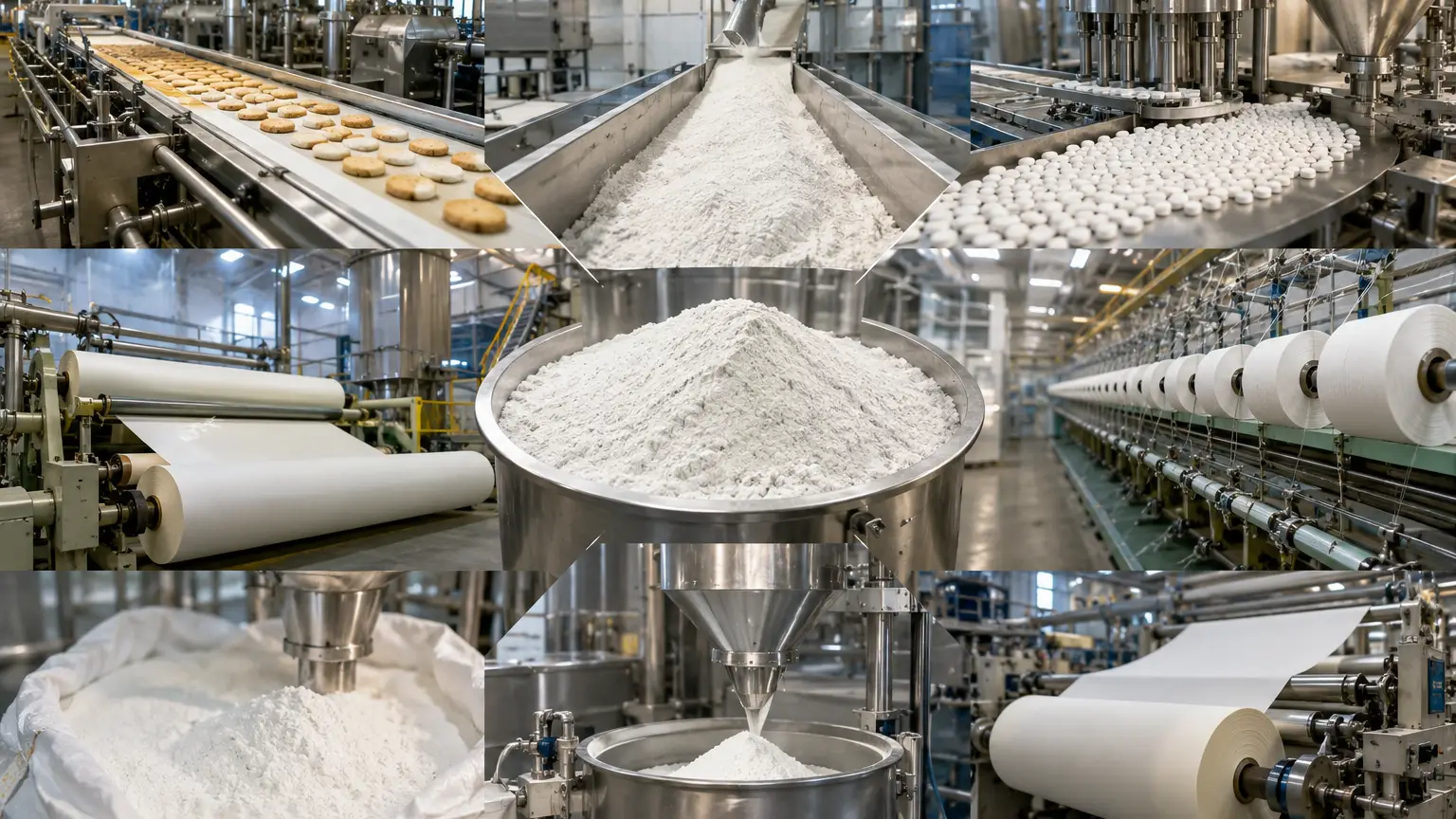
Corn starch is one of the most widely consumed industrial raw materials on earth; the global market reached approximately 90.32 million tonnes in 2025, valued at approximately USD 27.15 billion, and is projected to grow to USD 53.97 billion by 2034 at a CAGR of 8.3%. Yet unlike many commodity chemicals, its buyer base is extraordinarily diverse. The same product, a white, odorless, tasteless powder extracted from the endosperm of corn kernels, serves a food processor thickening soup, a pharmaceutical company binding tablets, a paper mill coating packaging, and a bioplastics manufacturer producing biodegradable films. Understanding who buys corn starch globally, what they need it for, and what procurement behaviors define each segment is the starting point for any supplier, distributor, or trading company operating in this market.
Corn starch (also referred to as maize starch or corn flour) is a carbohydrate polymer, specifically a polysaccharide composed of amylose and amylopectin glucose chains, extracted from corn kernels through a wet milling process that separates starch from the germ, fiber, and protein fractions. The resulting fine white powder functions across applications as a thickener, binder, stabilizer, film forming agent, adhesive, and fermentation feedstock.
Three properties explain why corn starch serves such a diverse buyer base: its chemical versatility because it can be used native or enzymatically and chemically modified to enhance specific functional properties, its cost effectiveness relative to alternative natural and synthetic materials, and its natural, plant derived origin that aligns with clean label, bio based, and sustainability requirements across multiple industries simultaneously. Rising clean label mandates, a widening preference for bio based industrial feedstocks, and regulatory support for natural excipients are reshaping procurement decisions across food, pharmaceutical, and paper value chains.
The commercial corn starch market is structured into three product categories: native starch (unmodified), modified starch (chemically, enzymatically, or physically processed to enhance performance), and sweeteners (enzymatically converted to glucose, fructose, or maltose syrups). In 2025, food and beverages represented 51.28% of demand, driven by categories such as bakery, dairy, confectionery, and sauces that depend on corn starch for thickening, gelling, and stabilizing. The pharmaceutical segment is experiencing the fastest growth, with an 8.55% CAGR.
Food and beverage manufacturing is the dominant buyer segment for corn starch globally, accounting for 63.6% of global corn starch consumption in 2025. This segment spans an enormous range of product categories and company sizes, from multinational food corporations running continuous processing lines to regional sauce manufacturers and artisan confectionery producers.
In food and beverage applications, corn starch functions primarily as a thickener and stabilizer in soups, sauces, gravies, salad dressings, fruit pie fillings, and ready to eat meals, where its gelatinization at 62 to 72°C produces the viscosity and texture that define product quality. In bakery, it is used as a binder and moisture retention agent that extends shelf life and improves crumb structure. In confectionery, it is the essential ingredient in gummy candy molding (starch mogul process) and the anti caking and dusting agent in hard candy production. In dairy products including yogurt, cream, and processed cheese, modified corn starch delivers freeze thaw stability and prevents syneresis during shelf storage.
Sweeteners derived from corn starch, including high fructose corn syrup (HFCS), glucose syrup, dextrose, and maltodextrin, represent the single largest commercial use of corn starch by volume. These products are consumed by beverage manufacturers, confectionery producers, bakeries, and dairy processors globally, with China, the United States, and India among the largest sweetener consuming markets.
Large multinational food and beverage corporations, companies such as Nestlé, PepsiCo, Unilever, and their regional equivalents, represent the top tier of corn starch buyers. Their procurement is characterized by large volume, long term contracts, stringent and standardized quality requirements, and a preference for suppliers with strong certification portfolios and global supply chain transparency.
These buyers typically require ISO 22000 or HACCP certification, non GMO verified status for specific markets, Kosher and Halal certification for global product lines, and increasingly carbon footprint documentation. Mid market food processors and regional manufacturers represent the second tier of food sector buyers, often sourcing through ingredient distributors rather than directly from corn wet millers, with more flexible order volumes and procurement timelines.
The clean label shift is the most commercially significant trend reshaping food sector corn starch procurement in 2026. As consumers in Europe, North America, and premium Asian markets demand shorter, recognizable ingredient lists, food manufacturers are specifying native or minimally modified corn starch over synthetic thickeners and stabilizers. This trend is growing demand for non GMO and organic certified corn starch grades at premium prices, particularly in European retail and North American natural food channels.
The pharmaceutical sector is the fastest growing buyer segment for corn starch globally, with a CAGR of approximately 8.55%, the highest of any corn starch application segment. Pharmaceutical grade corn starch is used as a tablet disintegrant, tablet binder, diluent, and ointment base across solid and semi solid dosage form manufacturing globally.
In tablet manufacturing, the dominant dosage form for most oral medications globally, corn starch serves two primary excipient functions. As a disintegrant, typically 5 to 15% of tablet weight, it swells rapidly on contact with water in the gastrointestinal tract, breaking the tablet apart and releasing the active pharmaceutical ingredient (API) for absorption. As a binder, corn starch paste, a suspension of corn starch in water gelatinized by heating, is used in wet granulation to create granules with the flowability and compressibility required for tablet pressing. In ointments, creams, and topical formulations, corn starch functions as an absorbent and powder base.
Pharmaceutical grade corn starch meets United States Pharmacopeia (USP), British Pharmacopoeia (BP), and/or European Pharmacopoeia (EP) specifications, requiring documented purity levels including moisture content below 14%, ash content below 0.5%, sulfur dioxide below 6 ppm, absence of microbial contamination beyond specified limits, and full traceability from agricultural origin through processing.
India is the world's largest buyer of pharmaceutical grade corn starch by volume, reflecting its dominant position as the world's largest generic drug manufacturer. API and finished dosage form manufacturing clusters in Hyderabad, Ahmedabad, and Mumbai source pharmaceutical grade corn starch under GMP compliant procurement procedures with annual supplier qualification audits. China's rapidly expanding pharmaceutical manufacturing base, upgrading quality systems to meet international export market standards, is the second largest and fastest growing pharma grade corn starch buyer, with demand growing alongside its generic drug and API export programs.
Pharmaceutical buyers are among the most documentation intensive corn starch procurement organizations globally. Supplier qualification typically requires 3 to 6 months, includes facility audits, and involves detailed review of process validation documents, batch records, and regulatory starting material documentation. Switching costs are high, and approved supplier lists are maintained with limited flexibility, making long term supply relationships the standard commercial structure in this segment.
Paper and packaging manufacturing is the third largest application for corn starch globally and historically one of the highest volume industrial consumers of industrial grade starch. Corn starch is used in three distinct paper manufacturing functions: surface sizing, applying a thin starch film to the paper surface to improve printability, smoothness, and ink holdout; wet end addition, incorporating starch into the paper furnish to improve dry strength, drainage, and retention of fines; and coating binders, combining starch with pigments to produce the coated paper surfaces used in magazines, catalogs, and high quality packaging.
China is by far the world's largest paper and packaging consumer and producer, with annual corn starch consumption in the paper sector measured in millions of tonnes. China's paperboard manufacturing, driven by domestic e commerce packaging demand and export oriented corrugated packaging, represents a structurally significant and growing industrial corn starch demand base. China's annual corn starch production exceeds 30 million metric tons, with primary consumption in paperboard manufacturing and sweetener production.
North America's paper industry, dominated by packaging grades for e commerce and food service applications, is a major industrial corn starch buyer with procurement concentrated among large integrated paper companies. Europe's paper industry, particularly in Scandinavia, Germany, and France, uses corn starch extensively in specialty paper and packaging grades, with sustainability certification requirements including PEFC, FSC, and increasingly bio based feedstock certification shaping procurement decisions.
The growth of e commerce packaging globally, which has sustained strong demand for corrugated board and packaging paper as online retail expands, is a structural tailwind for corn starch consumption in the paper sector, partially offsetting the secular decline in graphic printing paper volumes in developed markets.
Textile manufacturing uses corn starch primarily as a warp sizing agent, a process where yarn is coated with a starch film before weaving to improve its tensile strength, reduce hairiness, and protect it from the mechanical stress of high speed weaving operations. After weaving, the sizing is removed in a desizing process before fabric preparation and dyeing.
Corn starch's warp sizing application is concentrated in countries with large woven fabric production bases. China and India are the dominant buyers, with textile sectors that consume industrial grade corn starch in substantial volumes for cotton, polyester-cotton blend, and synthetic fiber sizing. Bangladesh, Vietnam, and Indonesia, major garment export nations with woven fabric processing operations, also represent meaningful textile corn starch buyer bases.
The competitive dynamic in textile sizing is relevant for corn starch procurement. Tapioca starch (cassava starch), which is produced in abundance across Southeast Asia at competitive prices, has captured approximately 30% of the Asian textile sizing market as a corn starch substitute. Corn starch buyers in textile applications actively benchmark against tapioca starch on a total cost basis, and the relative price relationship between the two starches influences substitution decisions. In markets where local tapioca starch production provides cost and logistics advantages over imported corn starch, buyers may formulate blended sizing baths or alternate between starches based on prevailing commodity prices.
Bioplastics and sustainable packaging manufacturing is the fastest emerging buyer segment for corn starch globally in 2026, representing the most significant structural demand growth opportunity beyond traditional food and industrial applications. Corn starch is a primary feedstock for polylactic acid (PLA), a biodegradable polymer produced through the fermentation of corn derived dextrose, and is directly incorporated into thermoplastic starch (TPS) formulations for biodegradable packaging films, agricultural mulch films, disposable food service ware, and personal care product packaging.
The structural driver behind this segment's growth is regulatory. Single use plastic restrictions enacted in the European Union, the United Kingdom, Canada, India, China, and a growing number of Southeast Asian countries are creating mandatory demand for biodegradable alternatives that would not exist through consumer preference alone. In January 2025, Corn Next launched a patented fermentation process converting corn starch into a biodegradable biopolymer in the United States, illustrating the pace of commercial technology development in this space.
Bioplastics producers are typically smaller in scale than food or paper sector corn starch buyers, but they require consistent specification, often certified grade corn starch with detailed purity and source documentation. Their procurement relationships are more technically engaged, requiring collaborative supplier development around starch specification optimization for specific polymer conversion processes, rather than the commodity volume procurement approach that characterizes textile or standard food applications. Buyers in this segment are willing to pay price premiums for non GMO verified, ISCC certified, or organically certified corn starch when those certifications enable their downstream product to carry corresponding eco labels in retail markets.
Animal feed and fermentation represent a significant but often underestimated corn starch buyer segment. Corn starch co-products from wet milling, including corn gluten feed, corn gluten meal, and corn germ meal, are consumed by livestock and aquafeed manufacturers globally. Additionally, corn starch itself is used as an energy substrate in fermentation processes for producing amino acids such as lysine, threonine, and glutamate/MSG, as well as citric acid, lactic acid, and other bioproducts that serve the feed and food industries.
China's large scale monosodium glutamate (MSG) manufacturing industry, which uses corn starch as the primary fermentation feedstock, is one of the most commercially significant indirect corn starch buyer sectors globally. The proliferation of instant foods, flavoring agents, and processed condiments across Asia has sustained strong MSG production growth, reinforcing corn starch demand from fermentation industry buyers well beyond traditional feed applications.
Asia Pacific captured 42.7% of total corn starch market share in 2025. The region's position is underpinned by robust industrialization, expanding food processing infrastructure, and rising domestic consumption. The proliferation of instant foods, monosodium glutamate (MSG) manufacturing, and pharmaceutical excipient demand has intensified starch utilization. China alone accounts for the majority of Asia-Pacific demand, with India, Southeast Asia, Japan, and South Korea contributing growing shares as their food processing, pharmaceutical, and packaging industries expand.
North America, led by the United States, the world's largest corn producer with approximately 14.9 billion bushels of production in 2024/25, is both the largest corn starch producing region and a major consumer. US buyers are concentrated in food and beverage manufacturing, particularly sweetener applications for the beverage and processed food industries, pharmaceutical excipient production, industrial starch for paper and adhesives, and the emerging bioplastics and bio based materials sector. The US pharmaceutical industry's extensive use of corn starch as a filler and binder, combined with advanced modified starch consumption for food applications, maintains North America's position as a major value segment buyer.
Germany and France collectively represent 55% of European regional consumption, with industrial starch extensively used in pharmaceutical binders and biodegradable packaging. Sustainability certifications such as ISCC PLUS are becoming critical purchasing criteria for industrial buyers. European buyers are the most specification intensive globally, requiring extensive documentation on corn origin, GMO status, carbon footprint, and supply chain traceability. The EU's regulatory framework for biobased and biodegradable materials, combined with mandatory single use plastic restrictions, is accelerating European demand for bioplastics grade and certified sustainable corn starch.
Across all buyer segments, several procurement expectations are converging in 2026 that are reshaping the corn starch supply landscape. First, documentation requirements have become more comprehensive. Certificate of Analysis (COA) per lot, MSDS, non GMO status verification, and traceability documentation are now baseline requirements in food, pharmaceutical, and European industrial procurement. Second, supply chain resilience has become a primary qualification criterion. Buyers maintaining single source supply relationships are actively qualifying backup suppliers after the commodity supply disruptions of 2021 to 2024. Third, sustainability documentation including carbon footprint data and bio based content certification is transitioning from premium market requirement to mainstream expectation across European and increasingly Asian buyer segments.
Procurement departments are widening their supplier bases across geographic locations to reduce risks related to crop fluctuations and trade disruptions. By obtaining corn starch from producers in North America, Europe, and Asia, distributors and manufacturers can maintain stable stock levels and enhance supply chain resilience for critical ingredients.
Tradeasia International supplies corn starch, including native food grade, modified industrial grade, and pharmaceutical grade variants, to food processors, pharmaceutical manufacturers, paper mills, and industrial buyers across global markets, with multi origin sourcing networks, full certification and regulatory documentation support, and both spot and contract procurement options. Buyers seeking to evaluate corn starch supply specifications, benchmark pricing, or qualify a reliable global supply source can contact Tradeasia's food and industrial ingredients team to discuss grade requirements, volume, and delivery terms.
The size of the global corn starch market was worth USD 26.33 billion in 2026 and is expected to grow at a CAGR of 8.3% from 2026 to 2034 and reach USD 53.97 billion by 2034. The composition of buyer demand within that growth will shift meaningfully. Food and beverage will remain the anchor segment by volume, but its growth rate will be moderated by market maturity in North America and Europe. The fastest growth, both in volume and value terms, will come from pharmaceutical applications driven by generic drug manufacturing expansion in Asia, bioplastics and sustainable materials driven by single use plastic regulation globally, and modified starch innovation for convenience food, plant based food, and functional food applications where performance differentiated grades command premium pricing.
The buyer segments that will drive the most commercially interesting procurement activity through 2034 are those requiring technical differentiation beyond commodity starch. Pharmaceutical grade buyers requiring GMP compliant supply chains, bioplastics producers requiring certified bio based feedstocks, and premium food manufacturers requiring non GMO, clean label, or organically certified native starch for health conscious consumer products will define the next phase of market evolution. For corn starch suppliers and distributors, the strategic opportunity lies not in competing on volume at commodity pricing, but in building the documentation capability, certification portfolio, and technical support capacity that enables them to serve these higher specification, higher value buyer segments as they grow.
The capacity investments being made in hydrogen peroxide production across Asia, including Evonik's Fuhua joint venture in Sichuan, DCM Shriram's 52,000 tpa plant in Gujarat, and Solvay's Shandong Huatai expansion, are partly a response to rising textile sector demand in the region, ensuring that regional supply will be available to match Asia's growing bleaching needs without the logistics cost and security concerns of long haul import dependence. For textile buyers, this regional supply development means improving procurement optionality and potentially more competitive pricing relative to historically import dependent markets.
We're committed to your privacy. Tradeasia uses the information you provide to us to contact you about our relevant content, products, and services. For more information, check out our privacy policy.


 English
 Indonesian
 简体字
简体字
 العربية
 Español
 Français
 Português
 日本語
日本語
 한국어
한국어
 Tiếng Việt



















