Explore our network of country and industry based websites to access localized information, product offerings, and business services across our group.
Log in to start sending quotation requests for any product.
Don't have an account? Sign Up Here
Home Sodium Bicarbonate: Applications, Buyer Demand and B2B Sourcing
Trade Insights | Applications and Buyers | 04 September 2026
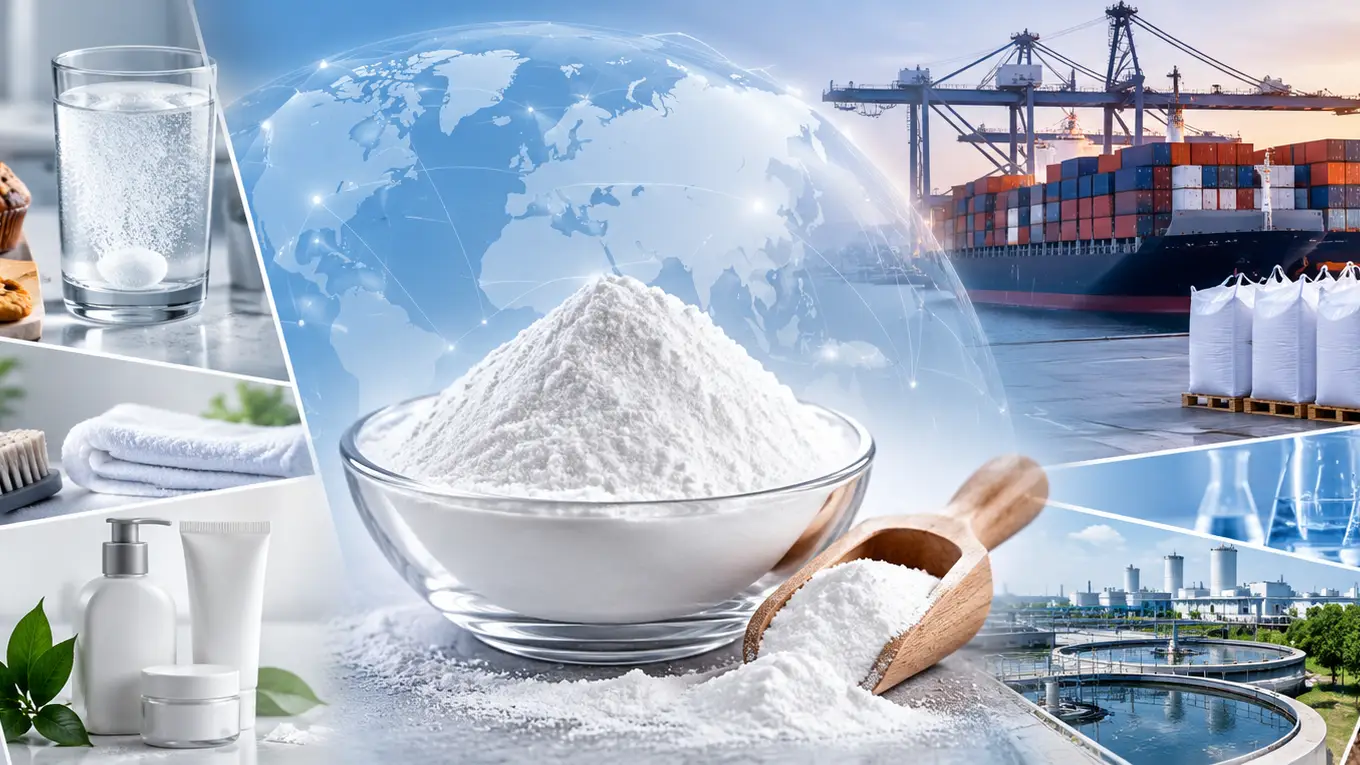
Sodium Bicarbonate Market Role and Demand Drivers
Key Food and Industrial Applications
Buyer Groups and Procurement Intent
Quality, Compliance and Supplier Evaluation
Global Supply and Sourcing Opportunities
Commercial Outlook for B2B Buyers and Suppliers
Conclusion: Turning Application Demand into Better Sourcing
Sodium bicarbonate, also known as sodium hydrogen carbonate or baking soda, is an inorganic compound with the formula NaHCO₃ and CAS number 144-55-8. PubChem describes it as a white crystalline material with mildly alkaline characteristics, while food regulations and technical standards recognize its importance as a functional food ingredient. For B2B buyers, its commercial value comes less from the commodity name itself and more from the combination of functionality, specification, grade, consistency and suitability for a particular production process.
In food manufacturing, sodium bicarbonate can perform several roles, including leavening, pH control, processing assistance and other functional applications. The U.S. Food and Drug Administration lists sodium bicarbonate among substances used for technical effects including leavening and pH control, demonstrating why demand is distributed across multiple food-processing categories rather than being limited to household baking. This functional versatility gives manufacturers flexibility when formulating products that require controlled acidity, gas generation or texture modification.
For chemical procurement teams, sodium bicarbonate demand is closely connected to production volumes in downstream industries. Bakery mixes, biscuits, noodles, beverages, processed foods and other formulations can require predictable quantities of functional ingredients, making supply reliability an operational issue rather than simply a purchasing consideration. The commercial opportunity therefore extends beyond individual buyers to ingredient distributors, contract manufacturers, food processors and companies managing regional supply networks.
A B2B sodium bicarbonate purchase involves more than comparing nominal prices. Buyers may need to assess intended application, product grade, assay, particle characteristics, packaging, documentation, regulatory suitability, minimum order quantity, lead time and logistics. This creates an opportunity for specialized chemical marketplaces to serve as an entry point between application requirements and qualified supply, particularly when procurement teams are comparing domestic and international sources.
One of the most established sodium bicarbonate applications is bakery production. When combined with suitable acidic components, sodium bicarbonate contributes to carbon dioxide generation that helps baked products rise. The FDA specifically identifies baking soda as a leavening agent, while Codex lists sodium hydrogen carbonate, INS 500(ii), among recognized food additive functions including raising and acidity regulation. These characteristics make it relevant to commercial bakeries, biscuit producers, premix manufacturers and confectionery processors.
Sodium bicarbonate also has applications where controlled acidity or buffering performance is important. Codex identifies sodium hydrogen carbonate as an acidity regulator, and its database includes provisions covering food categories such as coffee and other hot cereal or grain beverages, dried pasta and noodles, spices and selected dairy-related products. For beverage and formulated-food manufacturers, this means procurement specifications need to reflect the exact formulation and regulatory requirements of the finished product rather than treating all sodium bicarbonate requirements as interchangeable.
Another commercially relevant use is meat and seafood processing, where alkalinity can influence functional properties such as water retention, texture and processing performance. A recent peer-reviewed review reported applications of sodium bicarbonate in food, feed and pharmaceutical industries and highlighted its role in meat processing. Experimental research published in Meat Science also found that sodium bicarbonate affected pH, water-holding-related performance, texture and emulsion stability in meat batters. Such applications broaden the buyer base beyond traditional bakery procurement.
The range of recognized applications extends to products such as pasta and noodles, spices, dairy-related foods and other processed-food categories. The Codex GSFA database is particularly useful for buyers because it allows permitted food-additive provisions to be assessed by additive, functional class and food category. Consequently, the strongest sodium bicarbonate sourcing strategy starts with the buyer's specific end use and destination market before selecting a supplier or product specification.
Food manufacturers are among the most direct buyers of food-grade sodium bicarbonate because the ingredient can affect product performance, consistency and formulation economics. Commercial bakeries, biscuit producers, premix companies, processed-food manufacturers and beverage formulators may purchase through direct producers, distributors or specialized chemical marketplaces. Their procurement teams generally prioritize dependable specifications and supply continuity alongside price.
Distributors and traders have a different procurement objective: they need products that can be resold across multiple customer segments while maintaining predictable availability and documentation. A sodium bicarbonate supplier China search, for example, may represent an importer looking for competitive origin supply, a regional distributor building inventory or a trader comparing manufacturers for a particular destination market. These buyers benefit from transparent product information because it reduces the time needed to qualify potential sources.
A serious sodium bicarbonate procurement process can include technical specifications, food-grade status, conformity documentation, packaging formats, batch consistency, certificates of analysis, origin, production capacity, logistics capability and commercial terms. Regulatory suitability is also important because authorized food uses vary by jurisdiction and application. The FDA and Codex databases illustrate why buyers should validate the intended use against applicable food-additive requirements rather than relying solely on a generic product description.
A focused sodium bicarbonate sourcing page can act as the first commercial qualification point by connecting product identity with sourcing intent. For procurement teams, a dedicated page is more useful when it helps them establish whether the material matches their application, required market and purchasing requirements. In a B2B marketplace environment, this creates a direct bridge between informational search behavior and supplier inquiry.
For food-grade sodium bicarbonate, quality evaluation should begin with the specification required by the finished-product application. Buyers may consider assay, moisture-related characteristics, physical form, purity profile, packaging and other parameters relevant to manufacturing. European regulatory specifications for E 500(ii), for example, define sodium hydrogen carbonate and establish analytical requirements including assay, pH, solubility and specified impurity limits.
Food ingredient procurement is jurisdiction-specific. Codex GSFA provides an international reference framework for permitted food additives and notes that its database is updated as provisions are adopted. In the United States, the FDA's food-substance inventory identifies sodium bicarbonate and its technical effects, while individual regulatory provisions determine how ingredients may be used. Buyers therefore need to distinguish between general food-grade positioning and authorization for a particular application in a particular market.
Supplier qualification is easier when buyers can obtain consistent technical and commercial documentation. Depending on the transaction, procurement teams may request a certificate of analysis, product specification, safety documentation, origin information, packaging details and evidence supporting food-use suitability. These documents help quality, regulatory, purchasing and production teams evaluate the same material from different perspectives before a commercial order is placed.
The lowest quoted price does not necessarily represent the lowest procurement cost. Differences in packaging, minimum order quantities, freight, lead time, documentation quality, batch consistency and responsiveness can materially affect the landed cost and operational risk. A robust sodium bicarbonate sourcing process therefore compares total supply value, with price treated as one input alongside technical fit and supplier reliability.
Sodium bicarbonate is produced at significant industrial scale and participates in international chemical supply chains. Recent U.S. Geological Survey reporting provides an example from Turkey, where 2024 production by WE Soda plants included approximately 443,000 metric tons of sodium bicarbonate across Kazan Soda and Eti Soda. The same source reports further planned sodium bicarbonate capacity expansion at Kazan Soda, illustrating how industrial producers continue to invest in supply capability.
For buyers seeking sodium bicarbonate supplier China options, the sourcing decision should balance manufacturing origin with destination-market requirements. China is a significant participant in global chemical and ingredient trade, but international buyers still need to evaluate product specifications, export documentation, logistics routes, packaging and regulatory requirements for the destination. A marketplace can make this process more efficient by presenting product information in a format that procurement teams can compare with alternative supply sources.
Sodium bicarbonate's broad food functionality creates opportunities for distributors that serve multiple downstream sectors. A distributor can potentially address bakery, beverage, processed-food and other customers from a common product category, although each customer's technical and regulatory requirements still need to be validated. For traders, the commercial opportunity lies in matching suitable producers with buyers that have defined application requirements, shipment volumes and delivery markets.
The most resilient procurement strategy connects sourcing decisions with actual downstream consumption. Bakery demand may emphasize consistent leavening performance, beverage applications may focus on buffering requirements, while meat processing can place greater emphasis on functional effects on texture and water retention. Because these requirements differ, buyers should communicate the intended application clearly when requesting quotations and technical documentation.
Sodium bicarbonate has a distinctive position because one material can serve several functional roles across food manufacturing. FDA and Codex classifications demonstrate its relevance to leavening, acidity regulation and other food-related functions, while technical literature shows additional applications in meat processing. This application diversity can help sustain commercial relevance even when purchasing patterns vary between individual food sectors.
For procurement teams, the commercial trend is toward matching the product more precisely to the application rather than treating sodium bicarbonate as a completely generic commodity. Food manufacturers increasingly need traceable specifications, suitable documentation and predictable quality because formulation changes can affect finished-product performance. This makes supplier transparency and technical communication important parts of the purchasing journey.
Tradeasia, Chemtradeasia and Tradechem Marketplace can position sodium bicarbonate around the practical questions buyers ask before contacting a supplier: what is the product used for, which industries consume it, what specifications matter and which supply information should be requested. A well-structured marketplace product page can capture both research-stage traffic and higher-intent searches such as “buy sodium bicarbonate” or “sodium bicarbonate supplier,” then guide qualified buyers toward inquiry.
For manufacturers, traders and distributors, visibility around specific applications can be more valuable than generic product exposure. Positioning sodium bicarbonate around food-grade applications, sourcing requirements and buyer use cases gives suppliers an opportunity to reach procurement professionals closer to a purchasing decision. The strongest commercial content should therefore connect technical functionality with credible sourcing information without making unsupported claims about price, availability or market share.
Sodium bicarbonate is a versatile food ingredient whose commercial relevance is rooted in measurable functionality. Its recognized roles as a leavening agent and acidity regulator, combined with applications across bakery, beverages, noodles, processed foods and meat processing, create a broad B2B buyer base. Regulatory databases from the FDA and Codex provide an important foundation for assessing permitted uses and functional classifications.
For buyers, the next step after identifying an application is to define the required grade, specification, documentation, packaging, order volume and destination-market requirements. Comparing suppliers on these factors can provide a more useful procurement assessment than comparing unit prices alone. Buyers evaluating food-grade sodium bicarbonate can use the sodium bicarbonate product page as a starting point for product and supplier information.
Manufacturers, importers, distributors and traders can all participate in the sodium bicarbonate value chain because the product serves multiple downstream applications. Recent production information from the U.S. Geological Survey also demonstrates the scale and continued development of sodium bicarbonate supply in major producing regions. For international procurement, that supply depth can create opportunities to diversify sourcing while maintaining application-specific quality requirements.
The commercial opportunity is ultimately about matching the right sodium bicarbonate supply with the right industrial requirement. Buyers need credible technical information and responsive suppliers, while manufacturers and distributors need qualified demand from relevant industries. By combining application-led content, transparent product information and B2B marketplace access, Tradeasia / Chemtradeasia / Tradechem Marketplace can provide a practical discovery and sourcing pathway for sodium bicarbonate buyers.
We're committed to your privacy. Tradeasia uses the information you provide to us to contact you about our relevant content, products, and services. For more information, check out our privacy policy.


 English
 Indonesian
 简体字
简体字
 العربية
 Español
 Français
 Português
 日本語
日本語
 한국어
한국어
 Tiếng Việt



















