Explore our network of country and industry based websites to access localized information, product offerings, and business services across our group.
Log in to start sending quotation requests for any product.
Don't have an account? Sign Up Here
Home Sodium Bicarbonate Market, Applications and B2B Sourcing Guide
Trade Insights | Supply Chain | 04 September 2026
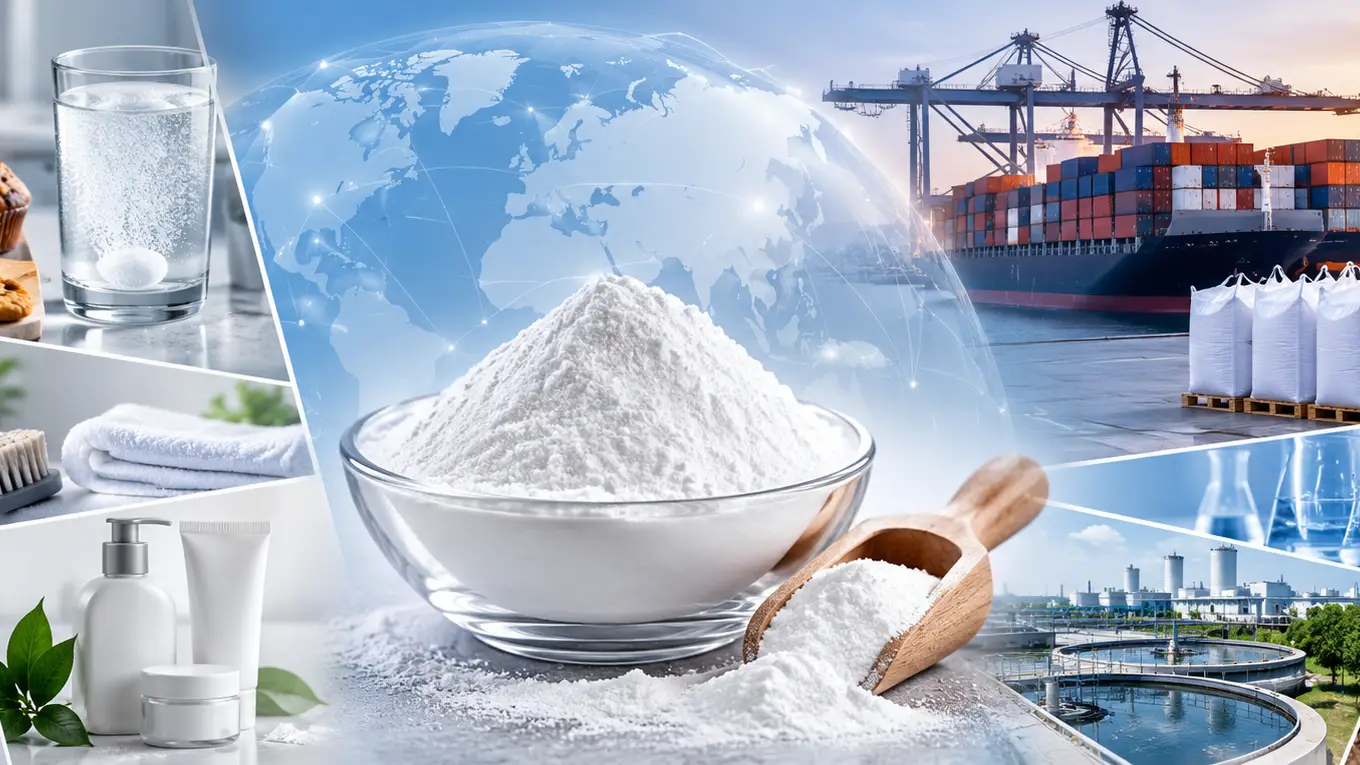
Sodium Bicarbonate Market Overview and Demand Drivers
Sodium Bicarbonate Applications Across Key Industries
Food Grade Sodium Bicarbonate and Food Industry Demand
Sodium Bicarbonate Buyer Intent and Procurement Priorities
Sodium Bicarbonate Sourcing and Supplier Evaluation
China Supply Opportunities and Regional Market Outlook
Commercial Positioning and B2B Sourcing Conclusion
Sodium bicarbonate is an inorganic compound commonly identified by the chemical formula NaHCO₃ and CAS No. 144-55-8. It is also known as sodium hydrogen carbonate, baking soda, or bicarbonate of soda. The FAO/WHO Joint FAO/WHO Expert Committee on Food Additives (JECFA) identifies sodium hydrogen carbonate as food additive INS 500(ii), while its established technical functions include acidity regulation and leavening or raising applications.
From a commercial perspective, sodium bicarbonate is important because a single chemical can serve multiple formulation and process requirements. Its alkaline and buffering characteristics make it relevant to food processing, pharmaceutical formulations, animal feed, cleaning products, chemical processing, and environmental applications. This diversity means sodium bicarbonate procurement is influenced not only by price, but also by grade, specification, consistency, documentation, and intended end use.
Recent market analysis indicates that sodium bicarbonate demand is supported by a broad base of end-use industries rather than a single application. Fortune Business Insights estimates the global sodium bicarbonate market at USD 4.13 billion in 2025 and forecasts continued growth through 2034, with food and beverages, pharmaceuticals, animal feed, industrial uses, and flue-gas treatment among the principal application categories.
For B2B buyers, this diversification creates an important market trend: sourcing decisions increasingly need to connect product specifications with downstream application requirements. Food manufacturers may prioritize food-grade compliance and consistent functional performance, while industrial users may focus more heavily on process efficiency, handling characteristics, supply continuity, and cost. This makes supplier qualification a central part of sodium bicarbonate procurement.
Sodium bicarbonate has a broad industrial role because it can participate in neutralization, pH control, cleaning, and other process functions. Technical information compiled by the U.S. National Library of Medicine's PubChem identifies uses spanning chemical manufacturing, cleaning compounds, fire extinguishing applications, pH adjustment, paper, leather, and other industrial activities.
The breadth of these sodium bicarbonate applications helps explain why industrial demand can remain commercially relevant even when individual end-use sectors fluctuate. Manufacturers and distributors can serve different customer groups with the same core material, provided the grade and specifications are appropriate. For chemical traders and procurement teams, this creates opportunities to develop supply programs around recurring industrial consumption rather than isolated transactions.
Pharmaceuticals represent another established sodium bicarbonate application, where the material can be used in appropriate formulations and processes requiring bicarbonate functionality. Animal feed is also an important end-use segment, while environmental applications include processes such as flue-gas treatment. Current market analysis continues to identify pharmaceuticals, animal feeds, and environmental treatment as important demand categories.
These applications illustrate why buyers should avoid treating sodium bicarbonate as a commodity with identical requirements across every industry. Pharmaceutical, food, feed, and industrial customers may operate under different regulatory frameworks and quality systems. A B2B sodium bicarbonate supplier therefore needs to communicate specifications clearly and help buyers match the appropriate material to the intended application.
Food processing is one of the most commercially visible applications for sodium bicarbonate. According to the U.S. Food and Drug Administration's current Substances Added to Food database, sodium bicarbonate is associated with technical effects including leavening, pH control, processing aid, flavor-related functions, and nutrient supplementation.
The Codex General Standard for Food Additives identifies sodium hydrogen carbonate as INS 500(ii) and lists functional classes including acidity regulator, anticaking agent, raising agent, stabilizer, and thickener. Its provisions cover a range of food categories, subject to the applicable conditions and notes. For manufacturers, this makes food grade sodium bicarbonate a functional ingredient whose commercial value depends on reliable performance as well as compliance.
For food manufacturers, ingredient consistency can directly affect production performance. Baking and formulated foods can depend on controlled reactions between leavening ingredients and other formulation components, while pH-sensitive processes require predictable material characteristics. Consequently, buyers typically need specifications that align with their formulation, manufacturing process, applicable food regulations, and quality-management system.
The commercial opportunity extends beyond large food manufacturers. Bakeries operating at scale, premix producers, confectionery manufacturers, beverage companies, ingredient distributors, and food-processing groups can all represent potential buyer segments. For suppliers, understanding these different requirements allows more precise positioning of food grade sodium bicarbonate and supports stronger B2B conversations than simply presenting the product as generic baking soda.
Typical sodium bicarbonate buyers include food manufacturers, food ingredient distributors, pharmaceutical companies, animal-feed producers, chemical manufacturers, cleaning-product companies, environmental-treatment operators, and industrial procurement teams. The buyer profile therefore ranges from companies purchasing material for direct formulation to distributors purchasing inventory for resale or regional supply.
Buyer intent is generally strongest when a search moves from informational language toward commercial language such as sodium bicarbonate supplier, food grade sodium bicarbonate supplier, buy sodium bicarbonate, or sodium bicarbonate sourcing. These searches indicate that the user is evaluating a potential supply relationship rather than simply researching the chemical. A B2B marketplace article should therefore provide enough technical and market context to support the next procurement step.
Procurement teams commonly compare suppliers based on product specification, applicable grade, quality documentation, packaging, minimum order requirements, lead time, logistics, commercial terms, and supply continuity. For food applications, regulatory suitability and quality documentation become especially important because the ingredient enters a controlled manufacturing environment. Codex and FDA databases demonstrate why intended use and applicable regulatory requirements should be considered before commercial purchase.
Supplier comparison is also driven by risk management. Buyers may prefer to qualify more than one source to reduce exposure to production interruptions, inconsistent specifications, freight disruption, or changes in commercial terms. A structured sodium bicarbonate product listing can help buyers make an initial assessment by connecting the product identity and intended application with the supplier information required for further qualification.
Effective sodium bicarbonate sourcing begins with defining the intended application and the specification required for that application. A food manufacturer should distinguish food-grade requirements from technical or other grades, while a chemical or environmental buyer should identify the process parameters that matter most. This prevents procurement teams from comparing suppliers solely on nominal price when differences in grade, documentation, logistics, or performance may materially affect total purchasing value.
Market conditions also reinforce the importance of supply-chain planning. Fortune Business Insights identifies Asia Pacific as the leading regional market in its 2025 analysis, while China is described as a major market within the region, supported by extensive industrial and manufacturing activity. For international buyers, China-related sourcing can therefore be commercially relevant, particularly when procurement teams are evaluating Asian supply options.
A B2B marketplace can shorten the initial supplier-discovery stage by bringing product information and commercial sourcing context together. For buyers researching food grade sodium bicarbonate, the Sodium Bicarbonate product page provides a relevant starting point for reviewing the available supply information and progressing toward a sourcing discussion.
The marketplace approach is particularly useful when procurement teams are comparing potential manufacturers, traders, distributors, or regional suppliers. Instead of treating sodium bicarbonate as a standalone commodity search, buyers can use product-level information to identify potential supply sources and then request the specifications, documentation, packaging, quantity, and commercial terms needed for qualification. This supports a more disciplined B2B purchasing process.
China is commercially relevant to sodium bicarbonate sourcing because of its substantial manufacturing ecosystem and role in Asian chemical and food-processing supply chains. Current market analysis places Asia Pacific at the forefront of global sodium bicarbonate consumption and identifies China as a significant national market, with demand spanning industrial, food, pharmaceutical, animal-feed, and environmental applications.
For international procurement teams, China sourcing can offer access to a broad supplier base, but supplier selection should remain specification-led. Buyers need to establish whether a supplier can consistently meet the required grade and quality parameters, provide appropriate documentation, support export logistics, and maintain dependable delivery schedules. The objective is not simply to find a low-cost sodium bicarbonate supplier, but to establish a supply relationship that fits the buyer's operating requirements.
The current market outlook suggests that sodium bicarbonate demand is structurally diversified. Fortune Business Insights forecasts continued market expansion from 2026 onward and highlights industrial applications as a major demand base, while food and beverage applications are also projected to maintain meaningful growth. This combination provides opportunities for suppliers serving both high-volume industrial customers and more specification-sensitive food and pharmaceutical buyers.
For manufacturers, traders, and distributors, the opportunity is therefore to segment customers according to application and purchasing requirements. Food ingredient buyers may prioritize food-grade material and regulatory documentation, whereas industrial procurement teams may place greater emphasis on availability, logistics, and cost efficiency. A marketplace such as Tradeasia / Chemtradeasia / Tradechem Marketplace can position sodium bicarbonate supply information around these different commercial requirements while helping buyers move from market research toward supplier engagement.
Sodium bicarbonate combines broad industrial utility with established food and pharmaceutical relevance. Its recognized roles in food processing, pH management, leavening, industrial processing, animal feed, pharmaceuticals, cleaning, and environmental applications create a diversified demand profile. Current market research likewise indicates continued demand across food and beverage, pharmaceuticals, animal feed, industrial, and environmental applications.
For B2B markets, this diversity creates a strong commercial positioning opportunity. Buyers searching for sodium bicarbonate supplier or food grade sodium bicarbonate are often looking for more than a product name: they need a dependable source that understands application requirements, quality expectations, documentation, logistics, and procurement continuity. Suppliers that communicate these factors clearly can differentiate themselves in a competitive chemical marketplace.
The most effective purchasing process links market intelligence with a defined technical and commercial specification. Buyers should first identify the intended application, then confirm the required grade and regulatory suitability, evaluate supplier documentation and consistency, compare logistics and commercial terms, and assess supply continuity before final qualification. For food applications, Codex and national food regulations should be checked against the specific destination market and product use.
For buyers beginning their search, the Sodium Bicarbonate sourcing page can serve as a commercial entry point for evaluating supply information. The broader opportunity for Tradeasia / Chemtradeasia / Tradechem Marketplace is to connect sodium bicarbonate buyers with relevant supply options while giving procurement teams the context needed to compare sources efficiently, qualify suppliers, and develop reliable B2B chemical supply relationships.
We're committed to your privacy. Tradeasia uses the information you provide to us to contact you about our relevant content, products, and services. For more information, check out our privacy policy.


 English
 Indonesian
 简体字
简体字
 العربية
 Español
 Français
 Português
 日本語
日本語
 한국어
한국어
 Tiếng Việt



















