Explore our network of country and industry based websites to access localized information, product offerings, and business services across our group.
To view and access the document, you are required to sign in to your account first.
Don't have an account? Sign Up Here
Home Non-GMO vs GMO Soya Lecithin Pricing Indices in 2026
Pricing Indices | 17 April 2026
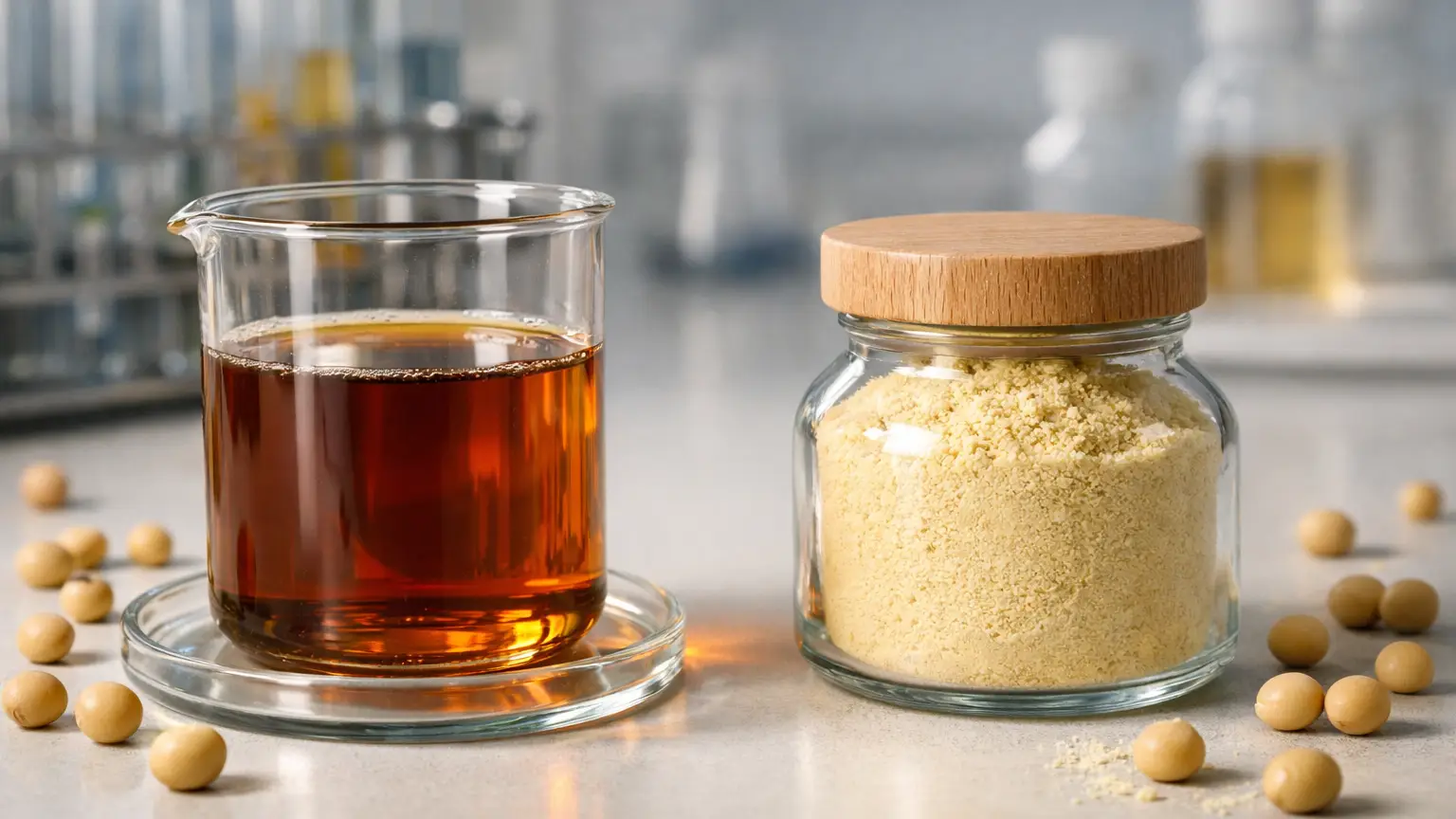
Standard GMO soya lecithin is currently priced at approximately USD 900–1,500/MT (CFR basis, early 2026), while identity-preserved non-GMO liquid and de-oiled grades trade at USD 3,000–7,600/MT depending on specification and certification tier. The premium persists because non-GMO soybean supply is structurally constrained — approximately 94% of U.S. soy is GMO — and certification costs, identity preservation throughout the crushing chain, and rising European regulatory demand all compound the price gap. The spread is not narrowing in 2026; it is widening at the high-purity end.
The GMO commodity lecithin market entered 2026 in a soft position, carrying the weight of a sustained oversupply cycle that began in mid-2025. Based on ChemAnalyst benchmark data through Q3 2025 — the most recent full quarter available — FOB Tianjin prices for GMO liquid lecithin averaged approximately USD 1,125/MT, while CFR Rotterdam settled at approximately USD 1,093/MT. Those levels reflect a year that ran below prior expectations, driven by record soybean crushing rates in Brazil, China, and the U.S., and a downstream demand pool that failed to absorb the resulting lecithin volumes.
Non-GMO lecithin trades in an entirely different register. Specialty and identity-preserved (IP) grades — liquid non-GMO, de-oiled non-GMO powder, and pharma-grade fractions — carry price indications of USD 3,000/MT and above, with enzymatically modified or high-purity phosphatidylcholine fractions reaching USD 7,600/MT per 2026 market data. De-oiled soya lecithin powder on a CFR India basis was estimated at approximately USD 4,092/MT as recently as late 2024, a level that has held structurally firm because the supply constraints driving non-GMO premiums have not resolved.
The commodity GMO market is buyer-driven. The non-GMO market is still supply-constrained. Those two dynamics coexist in the same commodity classification, which is why aggregate market reports consistently understate how differently these two products behave at the contract level.
| Grade | Benchmark Hub | Approx. Price (2026) | Trend |
|---|---|---|---|
| GMO Liquid Lecithin | FOB Tianjin | USD 1,100–1,250/MT | Soft / Sideways |
| GMO Liquid Lecithin | CFR Rotterdam | USD 1,050–1,150/MT | Soft / Sideways |
| GMO De-oiled Lecithin Powder | CFR Rotterdam | USD 1,400–1,600/MT | Stable |
| Non-GMO IP Liquid Lecithin | CFR Europe / Spot | USD 3,000–4,500/MT | Firm / Rising |
| Non-GMO De-oiled Powder | CFR India | USD 3,800–4,500/MT | Firm |
| High-Purity Non-GMO / Enzymatic | Specialty / EXW | USD 5,000–7,600/MT | Rising |
Sources: ChemAnalyst, Food Additives Asia, Mordor Intelligence, market trade indications.
Non-GMO soybean supply is not a niche constraint. It is a structural market condition. Approximately 94% of U.S. soybeans are GMO varieties, according to USDA data. Argentina, which produces roughly 25% of global soy, has adopted GM varieties at comparable rates. Brazil, historically the primary origin for non-GMO IP soy, has gradually increased GMO planting since 2003, progressively shrinking the identity-preserved supply base.
The practical result for lecithin buyers is that non-GMO raw material is sourced predominantly from specific regions of southern Brazil, India, and increasingly from Danube-basin European producers operating under Donau Soja or Europe Soya certification programs. Each of those supply channels operates with strict lot-by-lot traceability requirements and segregated crushing lines. That identity preservation costs money at every link in the chain — farm, collector, crusher, and processor — and that cost flows directly into the final lecithin price.
EU food manufacturers require non-GMO lecithin that meets a GMO contamination threshold of below 0.9%, the EU's statutory labeling trigger. Many premium buyers and ingredient processors in Germany, France, and the Netherlands specify below 0.1% tolerance. Certification at that level requires third-party verification, DNA testing at multiple production stages, and maintained physical segregation from GMO streams.
Lasenor, a Spanish lecithin manufacturer, noted that non-GMO IP soya lecithin prices rose 6–9% year-over-year in 2021 partly because of the cost burden from these verification processes. That cost structure has not decreased. In fact, as production volumes in European domestic non-GMO crushing have grown — Cargill made notable investments in European lecithin processing capacity in 2023 — the premium for verified European-origin non-GMO material has added another tier above Brazil-origin IP product.
Europe is the defining demand anchor for non-GMO soya lecithin pricing. Over 65% of European consumers actively seek products with recognizable, clean-label ingredients, creating consistent institutional demand from food manufacturers who cannot afford a "contains genetically modified" declaration on pack. No major European food brand — chocolate manufacturers, bakery producers, dairy-alternative formulators — willingly labels GMO. That means their lecithin specification defaults to non-GMO, regardless of cost.
The Europe Soya standard, managed through Danube Soya and recognized across Central and Eastern European producing regions, is adding supply-side structure. However, European-grown non-GMO soybean volumes remain small relative to total European lecithin demand, maintaining import dependency from Brazil and India. Supply adequacy is described as tight but manageable, not abundant — which is precisely the condition that sustains the premium.
The GMO lecithin market in 2026 is clearly oversupplied. Record soybean crush volumes in 2024 and 2025 — driven by strong soymeal demand from livestock and aquaculture sectors — generated lecithin as a co-product at rates that outpaced food, feed, and industrial absorption. Chinese exports from Tianjin and Qingdao were described as highly competitive, with FOB prices under consistent downward pressure through H2 2025. Indian and Vietnamese suppliers added competition at the margin, compressing Chinese exporters' negotiating room.
The non-GMO market does not share these dynamics. Supply of identity-preserved non-GMO lecithin is deliberately limited by the supply chain itself. Crushing facilities that process non-GMO soybeans must maintain complete segregation from GMO streams — many run dedicated lines or full facility segregation — which limits throughput, increases per-unit cost, and caps the volume available at any price point. ADM's regenerative agriculture program targeting 5 million acres by 2026 aims to expand non-GMO organic soybean supply, but certified volumes reaching lecithin processors remain tight.
The net result: GMO lecithin buyers have negotiating leverage in 2026. Non-GMO lecithin buyers do not, particularly those requiring EU-certified, low-contamination product with traceability documentation.
Not every buyer pays USD 3,000+/MT for non-GMO lecithin. The premium is concentrated in three buyer segments where specification and regulatory requirements are non-negotiable:
Food and confectionery manufacturers in Europe: Chocolate producers — including Lindt, Barry Callebaut contract manufacturers, and private-label European brands — require non-GMO lecithin as both a regulatory and marketing requirement. Bakery and dairy-alternative manufacturers follow the same logic.
Pharmaceutical and nutraceutical producers: Pharma-grade non-GMO lecithin, particularly high-purity phosphatidylcholine fractions used in liposome drug delivery systems and parenteral emulsions, commands the highest prices. EFSA and EMA guidelines favor natural phospholipids for biocompatibility in lipid-based drug formulations.
Premium plant-based food brands globally: Brands targeting health-conscious consumers with non-GMO, organic, or clean-label positioning in the U.S., Australia, and Asia-Pacific require non-GMO certification not for regulatory reasons, but as a brand positioning commitment validated by Non-GMO Project verification or equivalent third-party programs.
The commodity GMO market faces continued soft conditions through mid-2026. Soybean crush volumes in Brazil are running at elevated rates following a large 2024/25 harvest, and absent a significant demand recovery in food processing or a weather-driven feedstock shock, the downward bias on GMO lecithin prices is likely to persist. Procurement Resource and ChemAnalyst both flagged in early 2026 that the supply outlook continues to dominate the demand spectrum for commodity lecithin.
Non-GMO pricing is more nuanced. The demand side is structurally growing — specialty and non-GMO grades are growing faster than commodity lecithin within overall global production of approximately 1.2 million MT/year in 2026. The sunflower lecithin market, the primary non-GMO alternative to soy, is facing a separate supply constraint: global sunflower seed output dropped to approximately 51.99 MMT in 2024/25 from 55.98 MMT in 2023/24. Buyers who substitute to sunflower lecithin as a non-GMO soy alternative are finding that route also tightening.
The three-scenario view for non-GMO soya lecithin pricing through H2 2026:
Base case: Non-GMO liquid lecithin holds in the USD 3,000–4,500/MT range CFR Europe, with high-purity grades maintaining above USD 5,000/MT. Brazilian IP supply continues to serve as the primary origin, with modest volume growth from Indian suppliers. Premium over GMO commodity stays at 2.5–3.5x the commodity price.
Upside risk: If a Brazilian drought in Q2–Q3 2026 disrupts soybean harvests in IP soy-growing regions of Mato Grosso do Sul or Paraná, non-GMO lecithin supply could tighten sharply. A 10–15% reduction in IP soybean availability in those regions would be sufficient to push non-GMO liquid lecithin into the USD 4,500–5,500/MT range CFR Europe within one quarter, given the lack of alternative origins with certified IP capacity at scale.
Downside risk: If European food manufacturers accelerate tolerance relaxation — some EU buyers already accept up to 0.9% GMO contamination rather than the prior 0.1% threshold — demand for premium IP-certified non-GMO product could soften at the margin, compressing the spread. This would not eliminate the premium but could reduce it to 2x commodity rather than 3x.
For GMO lecithin buyers: Spot procurement remains advantageous in this market. With Chinese, Indian, and South American exporters competing aggressively, buyers with the ability to tender quarterly can capture current soft pricing without locking in at today's levels. The one caveat: shipping congestion periodically lifts CFR premiums for 4–6 week windows, as seen in Europe in Q3 2025. Buyers shipping from Asia to Europe or South Asia should factor in a 5–10% logistics buffer.
For non-GMO lecithin buyers: The opposite posture applies. Non-GMO supply chains are tight and IP soybean availability from Brazil is subject to seasonal and weather-driven shocks. Buyers covering H2 2026 volumes — especially those requiring EU-certified, below-0.9% GMO contamination with lot-by-lot traceability — should consider term contract commitments for at least 70% of their needs. Leaving large volumes to spot procurement in a non-GMO market tightening scenario means paying distressed spot premiums at precisely the wrong moment.
For buyers evaluating GMO-to-non-GMO switching: The cost differential in 2026 is significant. Non-GMO liquid lecithin costs 2.5–4x more than GMO commodity per MT. For most food manufacturers, the switch is driven by regulatory necessity (EU labeling rules) or brand positioning, not cost optimization. Buyers evaluating a label upgrade should quantify the full cost impact at their usage rates before committing to a non-GMO specification on new product launches.
Why is non-GMO soya lecithin so much more expensive than GMO lecithin?
The price gap reflects three compounding costs: identity-preserved (IP) non-GMO soybeans must be segregated from GMO crops at every stage of the supply chain; crushing and processing facilities require dedicated lines or full segregation protocols; and third-party certification at the EU's below-0.9% threshold adds testing and audit costs that run throughout the production cycle. Because approximately 94% of U.S. soybeans are GMO, IP non-GMO supply is structurally scarce, which allows producers to maintain price premiums of 2.5–4x the GMO commodity level.
What are the main sources of non-GMO soya lecithin in 2026?
Brazil remains the dominant origin for identity-preserved non-GMO soya lecithin, primarily from producing regions in southern and central-western states where IP farming programs are most established. India is an emerging origin, with some quality variance noted by trade buyers. Within Europe, Danube-basin producers — supported by the Donau Soja and Europe Soya certification programs — are growing in relevance, particularly for buyers seeking shorter supply chains and documented deforestation-free sourcing.
Does EU regulation require non-GMO lecithin?
EU regulation does not explicitly mandate non-GMO lecithin, but it does require mandatory GMO labeling when products contain detectable GMO-derived material above 0.9%. Since no major European food brand willingly carries a "contains GMO" label, the effective market requirement is non-GMO. This creates structural, legislation-driven demand for IP-certified lecithin that is unlikely to diminish regardless of commodity market conditions.
How does soybean crushing volume affect lecithin prices?
Soya lecithin is a co-product of soybean oil extraction, not a primary output. When soybean crush volumes rise — driven by soymeal demand from livestock and aquaculture — lecithin supply increases automatically, regardless of lecithin demand. This structural dependency means GMO lecithin prices are frequently decoupled from lecithin-specific demand signals, driven instead by soymeal market dynamics. Non-GMO lecithin is less exposed to this effect because IP soybean volumes are deliberately limited, insulating non-GMO lecithin supply from commodity crush cycle swings.
Access the complete article and discover related coverage.
We're committed to your privacy. Tradeasia uses the information you provide to us to contact you about our relevant content, products, and services. For more information, check out our privacy policy.


 English
 Indonesian
 简体字
简体字
 العربية
 Español
 Français
 Português
 日本語
日本語
 한국어
한국어
 Tiếng Việt



















