Explore our network of country and industry based websites to access localized information, product offerings, and business services across our group.
Log in to start sending quotation requests for any product.
Don't have an account? Sign Up Here
Home Private Label Expansion Impacts Sorbic Acid Sourcing
Market Insight | 23 December 2025
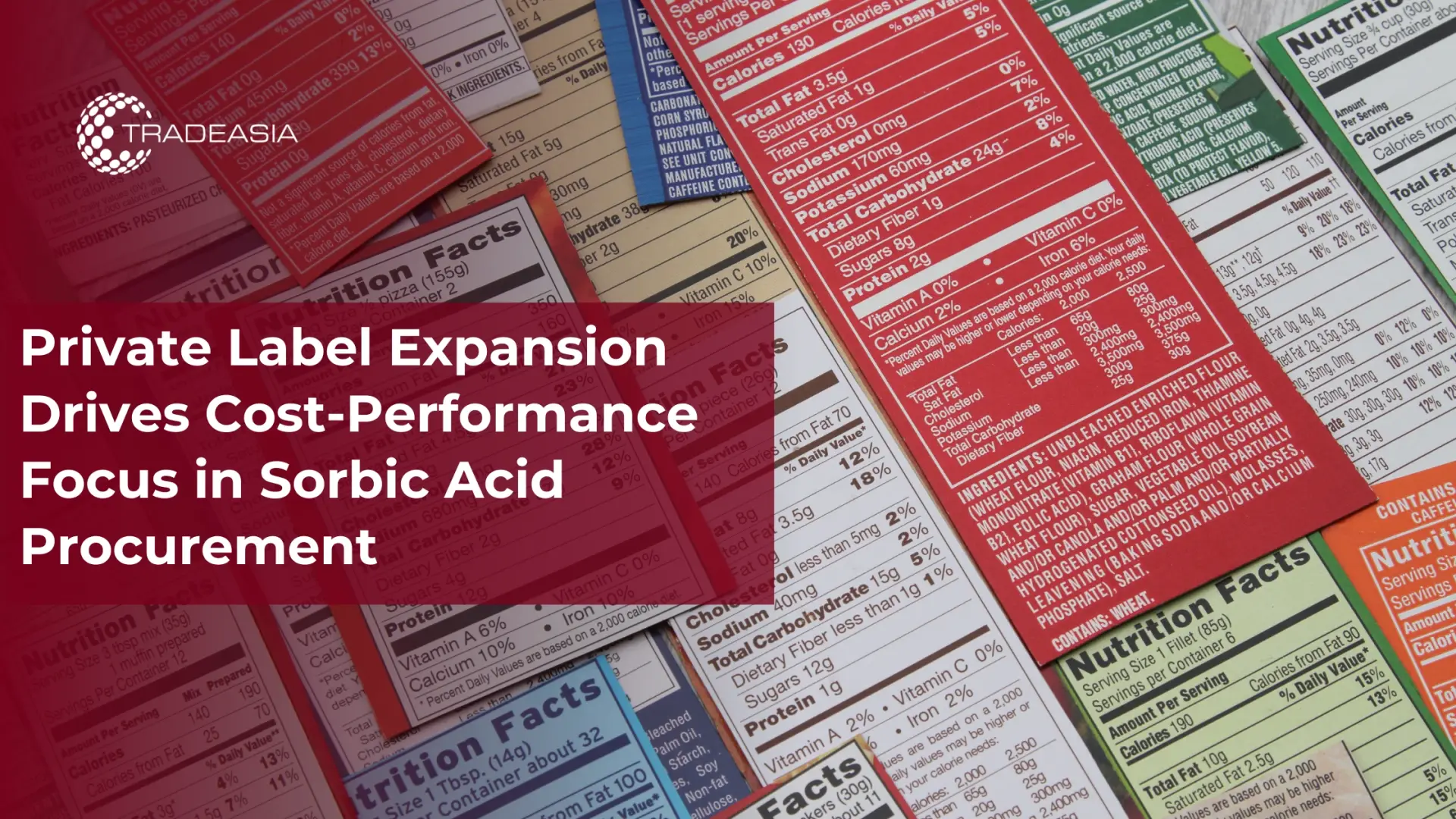
The rapid expansion of private label food brands across supermarkets, discount retailers, and online grocery platforms is fundamentally reshaping ingredient sourcing strategies. As private labels compete directly with established brands on price, retailers are placing stronger emphasis on ingredients that deliver reliable performance at optimized cost. Preservatives, in particular, are under scrutiny, as they directly influence shelf life, food safety, and product consistency across large-scale production runs.
Sorbic acid has emerged as a preferred solution in this environment due to its proven effectiveness against yeast and mold, wide regulatory acceptance, and predictable performance across diverse food matrices. For private label manufacturers operating under tight margins, the ability to achieve microbiological stability without complex reformulation is a key advantage.
Private label portfolios often span multiple categories, including bakery, sauces, dairy alternatives, ready meals, and chilled foods. Sorbic acid offers formulation flexibility, performing effectively across a wide pH range and remaining compatible with common stabilizers, emulsifiers, and flavor systems. This versatility allows manufacturers to standardize preservative systems across multiple SKUs, reducing formulation complexity and procurement fragmentation.
From a cost perspective, sorbic acid provides a favorable cost-to-performance ratio compared with more specialized or “natural” preservation systems that may require higher dosages or additional processing controls. As private label volumes scale, even marginal savings per unit translate into meaningful cost efficiencies, reinforcing sorbic acid’s role in large-volume production environments.
As private label production becomes increasingly centralized and export-oriented, retailers are prioritizing suppliers capable of delivering consistent quality, stable specifications, and reliable logistics. Sorbic acid benefits from a mature global supply base, with established producers in Asia and Europe supporting steady availability and competitive pricing.
This supply stability is particularly important for private label products distributed across multiple regions, where variations in ingredient performance could result in recalls or reputational risk. Sorbic acid’s long track record and standardized quality benchmarks reduce these risks, making it a low-uncertainty choice for retailers scaling private label offerings.
Although clean-label trends continue to influence product positioning, private label brands tend to adopt a more pragmatic approach to ingredient selection. In many cases, the cost premium associated with natural preservative systems or fermentation-based alternatives remains difficult to justify within private label pricing structures. As a result, sorbic acid continues to be favored where regulatory compliance and functional performance can be maintained without significantly increasing cost.
Rather than eliminating sorbic acid, manufacturers are increasingly optimizing dosage levels and combining it with complementary preservation techniques to balance label considerations and operational efficiency.
Looking toward 2030, sorbic acid demand is expected to grow steadily in line with the continued expansion of private label food brands, particularly in emerging markets and value-focused retail channels. Growth is likely to be incremental rather than explosive, driven by higher production volumes, broader private label penetration, and increased outsourcing of manufacturing by retailers.
While regulatory scrutiny and consumer perception pressures will persist, sorbic acid’s cost-performance balance, formulation flexibility, and supply reliability position it to remain a core preservative in private label portfolios. By 2030, demand growth is expected to be strongest in processed bakery, sauces, and dairy-alternative segments, where shelf-life stability and margin control remain critical.
Private label expansion is reinforcing a pragmatic, cost-driven approach to ingredient sourcing. In this environment, sorbic acid’s ability to deliver consistent microbial control without costly reformulation ensures its continued relevance and stable demand outlook through 2030.
We're committed to your privacy. Tradeasia uses the information you provide to us to contact you about our relevant content, products, and services. For more information, check out our privacy policy.


 English
 Indonesian
 简体字
简体字
 العربية
 Español
 Français
 Português
 日本語
日本語
 한국어
한국어
 Tiếng Việt




















