Explore our network of country and industry based websites to access localized information, product offerings, and business services across our group.
Log in to start sending quotation requests for any product.
Don't have an account? Sign Up Here
Home India and Middle East Trade Risks Reshape Liquid Glucose Supply
Trade Insights | Supply Chain | 02 April 2026
Liquid Glucose Market 2026 Remains Supply-Supported
India and Middle East Trade Corridors Are Under Pressure
Regional Asian Supply Strength Is Becoming a Strategic Advantage
Processed Food Demand Continues to Support Consumption
Logistics Inefficiency Is Reshaping Inventory and Pricing Decisions
Procurement Strategy Is Becoming More Risk-Focused in 2026
Conclusion: Regional Resilience Is Becoming the Decisive Advantage
The liquid glucose market 2026 remains fundamentally supported by strong production capacity in Asia, where China and India continue to function as major manufacturing hubs within the wider glucose and glucose syrup economy. IndexBox describes the Asia glucose and glucose syrup market as a foundational pillar of regional industrial and food supply chains, while its global market analysis shows that China, the United States, and India accounted for a combined 42% of world consumption in 2024, underlining the strategic weight of these production and demand centers. (IndexBox)
That base is reinforced by continuing end-use growth. The Business Research Company estimates that the glucose syrup market will expand from $4.17 billion in 2025 to $4.42 billion in 2026, while Grand View Research notes that glucose syrups are widely used to improve stability, volume, smoothness, gloss, and shelf life in baked goods and confectionery products. Together, those signals suggest that market fundamentals remain commercially healthy even before logistics are considered. (The Business Research Company)
Commercially, liquid glucose remains attractive because it is a versatile starch hydrolysate syrup used across food applications that require sweetness control, moisture management, and texture stability. Food Additives Asia’s India-origin product page describes liquid glucose as a starch-derived syrup used for sweetness, humectancy, crystallization prevention, and bodying properties, which aligns with the broader industry view that it remains essential in food manufacturing. (Food Additives Asia)
However, stable production does not guarantee smooth supply. UNCTAD warns that global shipping is operating in a period of fragile growth, rising costs, and mounting uncertainty, with geopolitical rerouting keeping ships busier and pushing transport costs higher. That makes global liquid glucose supply increasingly dependent on distribution efficiency rather than just manufacturing output. (UN Trade and Development (UNCTAD))
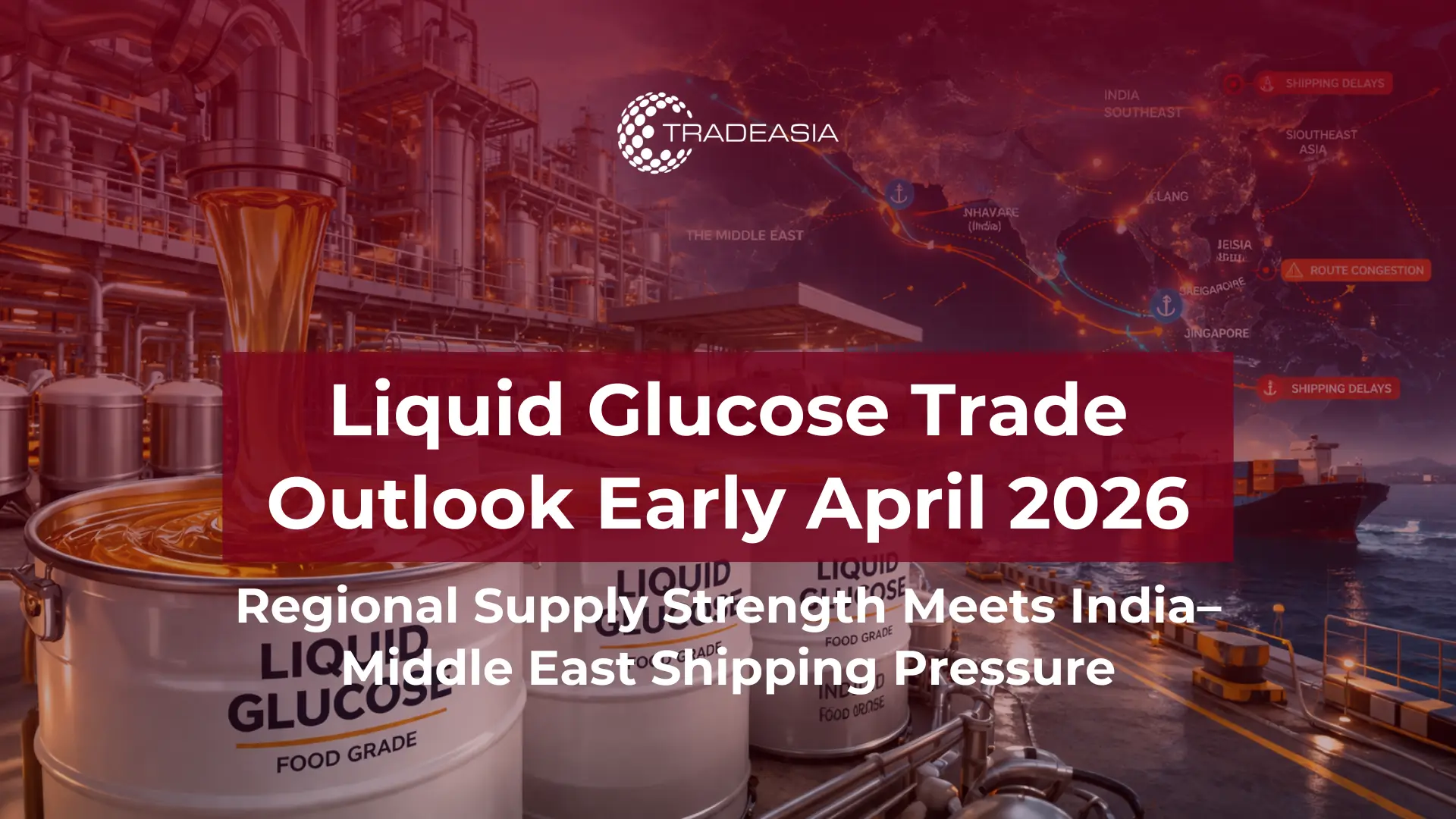
The India–Middle East corridor has become a meaningful pressure point because the IMF says the current Middle East conflict is being transmitted into the world economy primarily through energy prices, supply chains, and financial conditions. For food ingredients, that matters because even non-energy cargoes become more exposed when freight markets react to route risk and fuel shocks. (IMF)
The effect is already visible in India. The Economic Times reported on April 1, 2026 that container shipping rates for Indian exporters were rising by as much as 40% because of higher fuel costs and war-risk-linked insurance premiums. Those increases were also being reinforced by emergency conflict surcharges and rerouting-related cost escalation, which means cargo moving into or out of India is becoming materially more expensive. (The Economic Times)
For liquid glucose, this is a logistics and timing problem more than a production collapse. A syrup that is available at origin can still become commercially tight in destination markets if freight rates rise sharply, vessel schedules become unreliable, or working-capital exposure increases because cargo is delayed. In that sense, India and Middle East trade stress is directly influencing the liquid glucose price trend through landed-cost pressure rather than through a shortage of starch conversion capacity. (The Economic Times)
This also affects regional availability. When energy, insurance, and routing uncertainty build at the same time, buyers in import-dependent zones face longer replenishment cycles and less confidence in promised arrival dates. That is why the current liquid glucose trading outlook is increasingly being discussed in terms of route exposure and supply continuity, not only in terms of factory output. (IMF)
Asia’s role is becoming even more important under these conditions. IndexBox’s 2026 Asia glucose and glucose syrup analysis highlights the interplay between massive production hubs in China and India and a broader importing network across the region, which supports the view that Asia is no longer just a production center but also the market’s main resilience platform. (IndexBox)
At the global level, that concentration is also clear. IndexBox’s world glucose and glucose syrup market analysis identifies China as the largest producer in 2024, with output equal to 26% of world production, while India ranked as another major producer and consumer. That scale gives Asian suppliers an advantage when buyers need shorter or less disrupted trade corridors. (IndexBox)
For buyers seeking more dependable supply, India has become a practical regional option. The Indian liquid glucose supply source provides a commercial reference point for India-origin product availability, including origin information and technical positioning that support shorter-haul sourcing discussions within Asia and nearby export markets. (Food Additives Asia)
This matters because liquid glucose regional price trends are increasingly diverging by route risk and delivery reliability, not just by product cost. As more buyers look for nearby origins rather than long, disruption-prone corridors, Asian producers gain a structural advantage in the evolving liquid glucose trading outlook. (IndexBox)
Demand remains strong because glucose syrup is deeply embedded in food manufacturing. Grand View Research says glucose syrups are used to support product stability and shelf life in baked goods and confectionery items, while The Business Research Company links market growth to processed food consumption, confectionery manufacturing, and demand for cost-effective sweeteners. Those drivers keep the market commercially active even when logistics become more difficult. (Grand View Research)
That functional role matters across multiple categories. Grand View Research notes that glucose syrups are used in ice cream, chewing gum, chocolate, canned foods, and other processed products, while Food Additives Asia describes liquid glucose as a syrup used to prevent crystallization and improve texture control. This breadth makes the liquid glucose processed food industry a dependable source of recurring demand. (Grand View Research)
Because these food applications are continuous, many buyers cannot simply pause procurement until freight conditions improve. Confectionery, bakery, and beverage manufacturers need steady inflow to maintain formulation consistency and production schedules, which means global liquid glucose supply remains commercially engaged even when cargo movement becomes less efficient. (Grand View Research)
That demand support is one reason the market stays resilient. The challenge is not that buyers no longer want liquid glucose, but that they must now manage higher uncertainty about when shipments will arrive and what the final delivered cost will be once freight disruptions are included. (The Business Research Company)
UNCTAD’s shipping outlook makes clear that freight markets are now operating with elevated uncertainty, slower route efficiency, and structurally higher cost pressure. For food ingredients, that weakens food ingredient logistics efficiency because lead times stretch, freight planning becomes harder, and importers must absorb more timing risk in every purchase cycle. (UN Trade and Development (UNCTAD))
That changes buyer behavior. Given the Economic Times report on conflict-driven freight inflation for Indian cargoes and UNCTAD’s warning about rising shipping costs, it is reasonable to infer that more buyers are responding by adjusting order timing, raising safety stocks, and favoring suppliers with stronger shipment visibility. In other words, the old container shortage supply chain logic is being replaced by a broader resilience logic built around timing and reliability. (The Economic Times)
In this environment, documentation is no longer a routine afterthought. Buyers can use the technical document center for liquid glucose sourcing to review product paperwork earlier, which helps shorten internal approval cycles when freight windows are already tight and shipment timing matters more than before. (Food Additives Asia)
That is why liquid glucose regional price trends increasingly include a logistics premium. A supplier that can move product consistently, provide documents quickly, and reduce avoidable delays may be commercially more attractive than a cheaper offer exposed to uncertain routing and weaker shipment coordination. (UN Trade and Development (UNCTAD))
A resilient procurement model in 2026 needs to consider more than just ex-works or FOB price. Buyers should look at total landed cost, route exposure, lead-time variability, and origin diversification, because freight conditions can now change the effective economics of a shipment even when the product itself is competitively priced. (UN Trade and Development (UNCTAD))
This is consistent with the IMF’s broader framework that the conflict’s effects are being transmitted through energy, trade, and supply chains. For liquid glucose, that means procurement teams need to manage freight and continuity risk at the same time, rather than assuming that stable factory output will automatically translate into stable import performance. (IMF)
In practice, buyers benefit from faster supplier coordination. Using a bulk liquid glucose distributor contact channel can help procurement teams discuss availability, shipment timing, and documentation before delays become production issues, especially in a market where route conditions can tighten quickly. (Food Additives Asia)
The main strategic shift is therefore clear: procurement in the liquid glucose market 2026 is moving away from pure spot opportunism and toward risk-aware planning. Buyers that coordinate earlier, diversify more intelligently, and stay closer to regional suppliers are better placed to handle volatility in the liquid glucose price trend.
The liquid glucose market 2026 remains better supported than many more volatile traded commodities because Asia still provides strong production depth and demand continuity. Yet the market is no longer defined only by manufacturing capacity; it is increasingly shaped by how efficiently cargo can move through stressed shipping networks. (IndexBox)
Trade disruptions affecting India and the Middle East are making that distinction more visible. Higher freight, insurance, and routing pressure are widening the gap between available product and dependable product, which is why buyers are seeing more caution in ordering patterns, more focus on landed cost, and more interest in regional sourcing resilience. (The Economic Times)
A practical response is to combine regional sourcing with faster qualification and direct commercial coordination. Buyers can evaluate India-origin options through the India-origin liquid glucose offering, review supporting paperwork through the food additive documentation hub, and coordinate supply planning through the direct sourcing contact page. (Food Additives Asia)
In short, supply continuity is becoming the real differentiator. As long as shipping costs remain elevated and route conditions stay uneven, the companies that treat logistics planning, documentation readiness, and supplier responsiveness as part of procurement—not separate from it—will be better positioned to navigate the next phase of the liquid glucose market.
We're committed to your privacy. Tradeasia uses the information you provide to us to contact you about our relevant content, products, and services. For more information, check out our privacy policy.


 English
 Indonesian
 简体字
简体字
 العربية
 Español
 Français
 Português
 日本語
日本語
 한국어
한국어
 Tiếng Việt