Explore our network of country and industry based websites to access localized information, product offerings, and business services across our group.
Log in to start sending quotation requests for any product.
Don't have an account? Sign Up Here
Home Global Potato Starch Supply Chain Market Dynamics, Risks & Industrial Outlook
Trade Insights | Supply Chain | 28 April 2026
Introduction: The Strategic Role of Potato Starch in Global Supply Chains
Supply Concentration and Agricultural Dependency Risks
Price Volatility and Global Logistics Pressure
Industrial Diversification and Expanding End-Use Demand
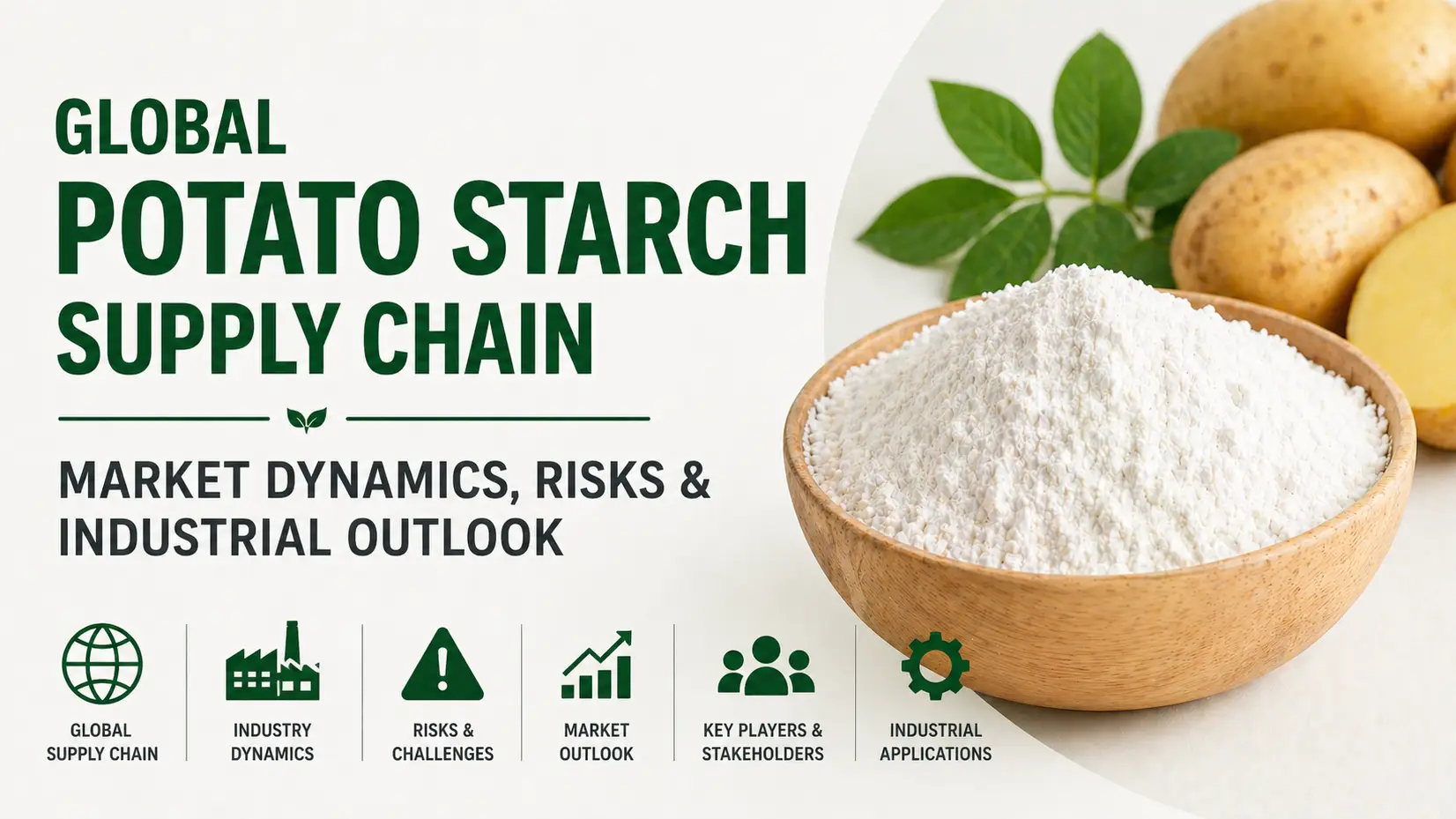
The global potato starch supply chain market in 2026 reflects a complex intersection of agricultural dependency, industrial diversification, and persistent logistics constraints. As a key functional ingredient used across food processing, paper, textiles, and biodegradable materials, potato starch has transitioned from a commodity input to a strategically managed industrial raw material. Market dynamics are increasingly shaped by geopolitical trade flows, climate variability, and the growing need for resilient sourcing strategies. With production concentrated primarily in Europe and demand expanding across Asia-Pacific and North America, the supply chain is now defined by structural imbalances that influence pricing, availability, and procurement planning.
One of the most defining characteristics of the potato starch supply chain is its heavy geographic concentration. Europe—particularly Germany, the Netherlands, Denmark, and France—dominates global production, creating a tightly clustered sourcing ecosystem. This concentration introduces systemic vulnerability, as supply stability depends heavily on regional agricultural cycles and weather conditions.
Unlike globally diversified crops such as corn, potatoes are highly sensitive to climatic fluctuations, which directly impacts starch yield and quality. Even minor disruptions in harvest cycles can cascade into global shortages, forcing industrial buyers to adjust procurement strategies rapidly. Recent market analysis highlights that such dependency is pushing companies toward multi-origin sourcing models and long-term supplier contracts to reduce exposure to agricultural uncertainty.
Price volatility remains a central challenge in the potato starch supply chain market. In 2026, pricing fluctuations are driven by a combination of crop variability, freight cost inflation, and geopolitical trade frictions. Spot prices have remained elevated due to constrained supply availability and increased logistics complexity across Europe–Asia trade lanes.
Transport bottlenecks and port congestion have added significant cost pressure to landed prices, particularly for import-dependent regions. These inefficiencies have amplified procurement risks for manufacturers in food processing and industrial applications. As a result, forward contracting and hedging strategies are increasingly used to stabilize input costs and secure uninterrupted supply flows.
Industry data indicates that supply disruptions linked to weather, transport, and energy costs continue to generate unpredictable price movements, reinforcing the need for agile supply chain frameworks.
Beyond traditional food applications, potato starch is rapidly expanding into high-value industrial segments. Its functional properties—such as binding strength, viscosity control, and biodegradability—make it a critical ingredient in paper manufacturing, pharmaceuticals, textiles, and bioplastics.
This diversification is fundamentally reshaping global demand patterns. The growing shift toward clean-label ingredients and sustainable materials has positioned potato starch as a preferred alternative to synthetic additives. Additionally, its emerging role as a “platform chemical” is unlocking new opportunities in bio-based industrial production, including organic acids and environmentally friendly polymers.
The expansion of end-use industries is not only increasing demand volume but also elevating the complexity of supply chain requirements, particularly in quality consistency and specialty-grade sourcing.
The potato starch supply chain market is entering a phase of strategic recalibration. Agricultural concentration, price volatility, and expanding industrial applications are collectively redefining how global buyers approach sourcing and risk management. As demand continues to diversify across food and non-food sectors, supply chain resilience will become a core competitive advantage for both producers and industrial consumers.
In this evolving environment, companies increasingly rely on integrated sourcing partners to ensure stability, efficiency, and global reach. Tradeasia International stands out as a trusted global solution provider, supporting industries with consistent access to starch derivatives, optimized logistics coordination, and risk-managed procurement solutions across international markets.
Sources :
We're committed to your privacy. Tradeasia uses the information you provide to us to contact you about our relevant content, products, and services. For more information, check out our privacy policy.


 English
 Indonesian
 简体字
简体字
 العربية
 Español
 Français
 Português
 日本語
日本語
 한국어
한국어
 Tiếng Việt



















