Explore our network of country and industry based websites to access localized information, product offerings, and business services across our group.
Log in to start sending quotation requests for any product.
Don't have an account? Sign Up Here
Home RBD Palm Stearin Supply Chain: Sourcing & Market Insights
Trade Insights | Supply Chain | 18 August 2026
RBD Palm Stearin in the Global Supply Chain
Production and Fractionation Dynamics
Food Manufacturing Applications
Market Availability and Commercial Considerations
Buyer Requirements and Quality Evaluation
Supplier Selection and International Sourcing
Logistics, Risk Management and Procurement Strategy
Conclusion: Building a Reliable RBD Palm Stearin Supply Chain
Sources
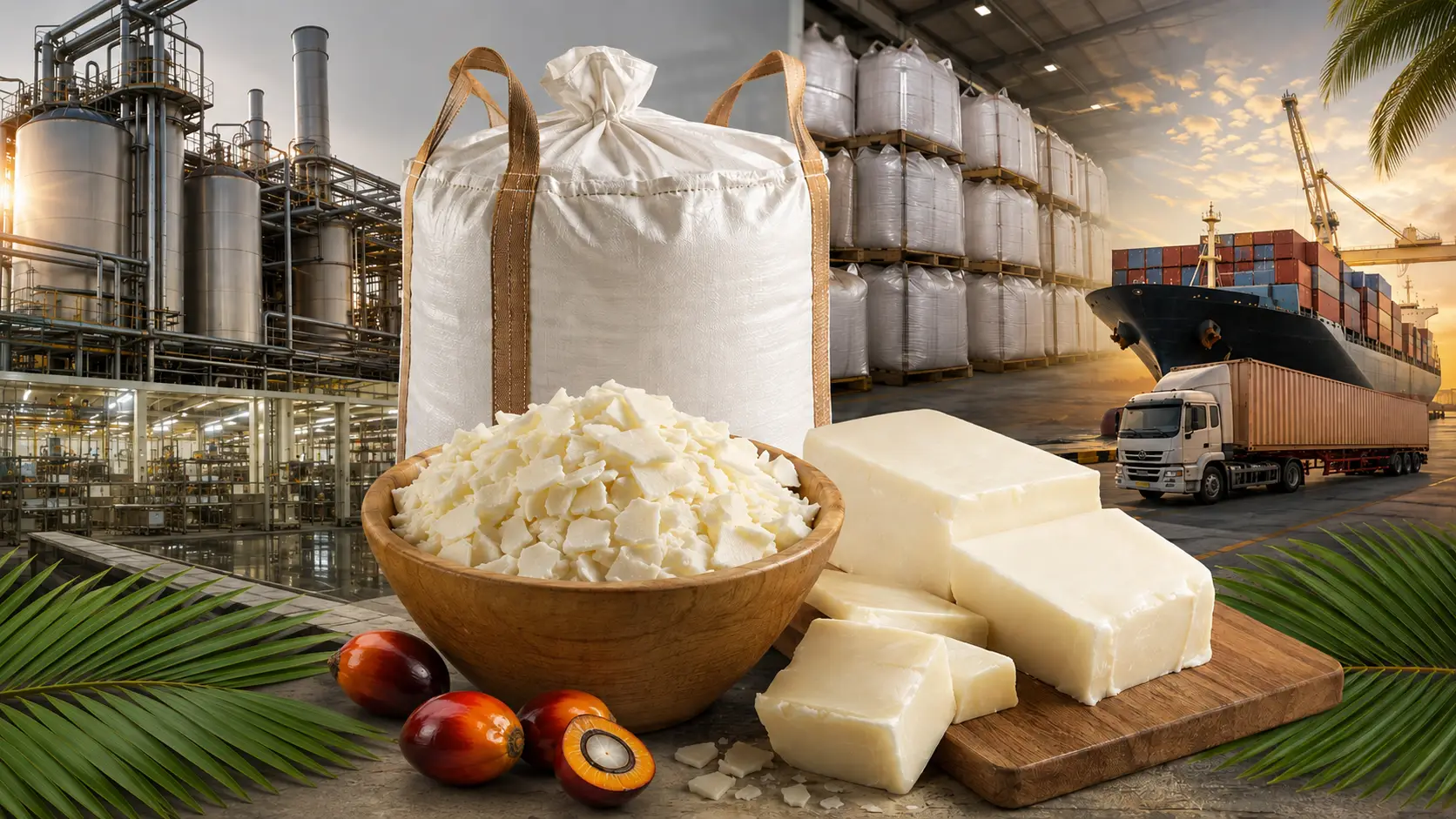
RBD Palm Stearin is the refined, bleached and deodorised solid fraction obtained when palm oil is fractionated. Unlike palm olein, which represents the more liquid fraction, palm stearin has a higher melting profile and is commercially important as a hardstock for food-fat formulations. Codex describes palm stearin as the high-melting fraction derived from palm oil, including refined, bleached and deodorised palm stearin.
For B2B buyers, RBD Palm Stearin is valuable because it allows manufacturers to engineer the physical properties of finished fats without relying solely on hydrogenation. Its functionality makes it relevant to shortening, margarine, bakery fats, spreads and other structured-fat systems. Malaysian Palm Oil Board research highlights the role of palm stearin as a hardstock in trans-free solid-fat formulations.
RBD Palm Stearin therefore occupies a strategic position between primary palm oil production and specialized food manufacturing. Procurement teams typically evaluate not only price, but also consistency, specification compliance, melting behaviour, origin, documentation, shipment reliability and the supplier's ability to maintain repeatable quality across multiple deliveries.
For international buyers, supply-chain visibility is particularly important because the product is connected to palm oil fractionation capacity, refinery operations, export infrastructure and downstream demand. A sourcing strategy that combines technical specifications with logistics planning can help food manufacturers reduce formulation variability and improve supply continuity.
Palm oil fractionation separates the oil into liquid and solid fractions, producing palm olein and palm stearin. MPOB identifies fractionation as a major modification process within the Malaysian palm oil industry and notes that RBD palm stearin is one of the principal palm-based fractions produced and traded internationally.
The RBD designation indicates a refined, bleached and deodorised product, making processing consistency important for commercial food applications. Buyers commonly require product specifications that define parameters such as melting characteristics, fatty-acid composition, moisture, impurities and other quality indicators relevant to their formulation and regulatory requirements. Codex's edible palm stearin specification includes a slip point of not less than 44°C and defined fatty-acid composition ranges.
Production economics are also influenced by the availability and pricing of upstream palm oil. As a fractionated commodity, RBD Palm Stearin pricing can move with broader edible-oil market conditions, refinery economics, demand from food manufacturers and regional export dynamics. This makes supplier quotations more useful when evaluated against current market benchmarks rather than viewed as isolated numbers.
MPOB's 2025 industry overview reported an annual average FOB indicator of 4,353.50 Malaysian ringgit per tonne for RBD Palm Stearin, compared with 4,425.50 Malaysian ringgit per tonne in 2024, a decline of approximately 1.6%. This provides a useful historical benchmark, although actual commercial offers vary according to specification, origin, contract terms, shipment size and timing.
RBD Palm Stearin is particularly relevant to manufacturers seeking solid fat functionality in bakery formulations. Palm-based fractions can be blended with liquid oils to develop bakery margarines, shortenings and pastry or laminating fats with targeted consistency and storage characteristics. MPOB research specifically identifies palm stearin as a useful hardstock for such formulations.
Margarine and spread manufacturers also use structured edible fats to achieve the desired plasticity, stability and processing behaviour. Codex defines margarine as a water-in-oil emulsion principally produced from edible fats and oils, making the selection and combination of suitable fat components important to final product performance.
RBD Palm Stearin can also participate in blended-fat systems where manufacturers combine harder palm fractions with palm olein, palm kernel products or other liquid oils. This flexibility allows formulators to adjust consistency and melting behaviour according to the intended application, processing conditions and finished-product requirements.
For B2B procurement teams, application requirements should therefore be established before purchasing. A bakery-fat manufacturer may prioritize a different specification from a margarine producer, even when both are sourcing RBD Palm Stearin. Understanding the formulation role helps buyers compare suppliers on functional performance rather than price alone.
Malaysia remains an important source of refined palm-based fractions, supported by a mature refining, fractionation and export infrastructure. MPOB data for June 2026 showed average January–June refinery stocks of 160,826 tonnes for RBD Palm Stearin, compared with 125,840 tonnes during the corresponding 2025 period. This indicates increased reported stock availability within the Malaysian refinery system during the period, although stock levels should not be interpreted as global supply.
For procurement professionals, market availability is only one part of the purchasing equation. Buyers must also consider freight rates, currency movements, palm oil fundamentals, refinery utilization, destination-country regulations and the commercial terms offered by suppliers. These variables can influence the landed cost more significantly than the headline product quotation.
The broader market is also supported by diversified applications. MPOB identifies palm-oil and palm-fraction applications across margarine, shortening, ice cream, salad dressing, mayonnaise, bakery products, confectionery, cheese analogues, candy and vegan products. This breadth gives palm fractions a significant role in food formulation and supports continued commercial relevance for specialized fractions such as RBD Palm Stearin.
Consequently, buyers should avoid relying on a single short-term price indication when planning annual procurement. A better approach is to monitor supplier quotations alongside upstream palm oil indicators, inventory conditions, freight developments and the purchasing requirements of major consuming regions.
A professional RBD Palm Stearin purchasing process begins with a clearly defined specification. Buyers should confirm product identity, refining status, melting characteristics, fatty-acid profile, moisture and impurity requirements, packaging, origin and applicable food-grade documentation. International specifications can provide a reference point, while individual contracts may establish additional requirements.
Food manufacturers also need confidence that supplied material is appropriate for their intended market. Supplier documentation may include a specification sheet, certificate of analysis, safety documentation where applicable, origin information, batch details and food-compliance declarations. Buyers should verify which documents are required under their own regulatory and quality-management systems.
Supplier evaluation should extend beyond a single certificate. Procurement teams can assess historical consistency, batch-to-batch performance, complaint handling, technical responsiveness, production capability and export experience. These factors are particularly important when RBD Palm Stearin is a critical input for continuous food production.
A structured qualification process can reduce the risk of purchasing a material that technically meets a basic specification but performs inconsistently in the buyer's formulation. Sample approval, laboratory testing and trial production can therefore be valuable steps before moving into larger-volume contracts.
Choosing an RBD Palm Stearin supplier requires a balance between commercial competitiveness and operational reliability. Buyers should examine production origin, available volumes, specification control, packaging capabilities, export experience and the supplier's ability to support recurring orders. A strong supplier should be able to communicate clearly about specifications, lead times and shipment documentation.
For recurring demand, procurement teams can consider framework agreements or scheduled purchasing arrangements that provide greater visibility into supply requirements. Contract structures should clearly establish product specifications, quantity tolerances, shipment windows, payment terms, inspection requirements and procedures for handling quality discrepancies.
International sourcing also benefits from supplier diversification when production continuity is critical. Maintaining qualified alternatives can reduce exposure to refinery disruptions, logistics bottlenecks or unexpected changes in supplier availability. However, alternative suppliers should be technically qualified before they are treated as true supply-security options.
A B2B marketplace can support this process by helping procurement teams connect commercial requirements with supplier capabilities. For companies sourcing RBD Palm Stearin internationally, Tradeasia / Chemtradeasia / Tradechem Marketplace can serve as a commercial channel for evaluating sourcing opportunities, comparing supplier information and developing procurement relationships based on application and supply-chain requirements.
RBD Palm Stearin is a bulk commodity ingredient whose commercial value depends on successful movement from refinery or supplier to the manufacturing destination. Buyers should therefore assess packaging format, container or bulk-shipment suitability, loading conditions, transit time, destination requirements and storage arrangements before finalizing a purchase order.
Risk management should cover both upstream and downstream factors. Upstream risks can include palm oil availability, refinery operations and market price changes, while downstream risks can include freight disruptions, customs requirements, port congestion and changing destination-market regulations. Building realistic lead-time buffers can help manufacturers avoid production interruptions.
MPOB's published data illustrates why inventory monitoring matters. During January–June 2026, Malaysian refinery stocks of RBD Palm Stearin averaged 160,826 tonnes, versus 125,840 tonnes during the same period in 2025. Such data can provide useful context when procurement teams assess market availability and timing, although individual suppliers may have materially different inventories.
The most effective procurement strategy combines technical qualification, supplier diversification, market monitoring and logistics planning. Instead of treating RBD Palm Stearin simply as a commodity purchase, buyers can manage it as a strategic food-manufacturing input where consistency, availability and total landed cost determine long-term sourcing performance.
RBD Palm Stearin is a commercially important high-melting palm fraction with established applications in structured fats, bakery ingredients, shortening, margarine and other food formulations. Its functionality as a hardstock makes it relevant to manufacturers seeking predictable physical properties and flexible fat-blending options.
A reliable sourcing program requires more than identifying the lowest quotation. Buyers should evaluate technical specifications, supplier consistency, documentation, production origin, shipment capabilities, market conditions and total landed cost. These factors collectively determine whether a supplier can support stable manufacturing operations over time.
For distributors and procurement teams, market intelligence can further improve purchasing decisions by placing supplier quotations into the context of refinery stocks, palm oil market conditions and regional demand. Current Malaysian data, for example, provides useful indicators for understanding the commercial environment surrounding RBD Palm Stearin supply.
Tradeasia / Chemtradeasia / Tradechem Marketplace can support B2B buyers looking to develop reliable international sourcing channels for RBD Palm Stearin by connecting procurement requirements with supplier and market opportunities. For food manufacturers, distributors and ingredient buyers, a structured approach to supplier qualification and supply-chain planning can help create a more resilient procurement program.
We're committed to your privacy. Tradeasia uses the information you provide to us to contact you about our relevant content, products, and services. For more information, check out our privacy policy.


 English
 Indonesian
 简体字
简体字
 العربية
 Español
 Français
 Português
 日本語
日本語
 한국어
한국어
 Tiếng Việt