Explore our network of country and industry based websites to access localized information, product offerings, and business services across our group.
Log in to start sending quotation requests for any product.
Don't have an account? Sign Up Here
Home How the Global RBD Palm Stearin Supply Chain Supports Industrial Procurement
Trade Insights | Supply Chain | 28 July 2026

Introduction to the RBD Palm Stearin Supply Chain
Production and Upstream Raw Material Network
Processing, Quality Control, and Manufacturing
Global Trade and Distribution Network
Industrial Buyers and Procurement Considerations
Supply Chain Challenges and Market Opportunities
Future Outlook and Strategic B2B Sourcing
Sources
RBD Palm Stearin is the solid fraction obtained during the fractionation of refined, bleached, and deodorized palm oil. It is widely utilized in food manufacturing, oleochemical production, animal feed, soaps, candles, shortening, bakery fats, and numerous industrial formulations because of its stability, melting profile, and cost efficiency. As international demand for vegetable-based raw materials continues to increase, the supply chain surrounding RBD palm stearin has become increasingly important for manufacturers seeking dependable feedstock and consistent product quality.
The product's commercial value depends not only on production capacity but also on logistics, certification, storage infrastructure, and long-term supplier relationships. Countries with integrated palm oil industries have established sophisticated production ecosystems that support large-scale exports while maintaining compliance with international food safety and sustainability requirements.
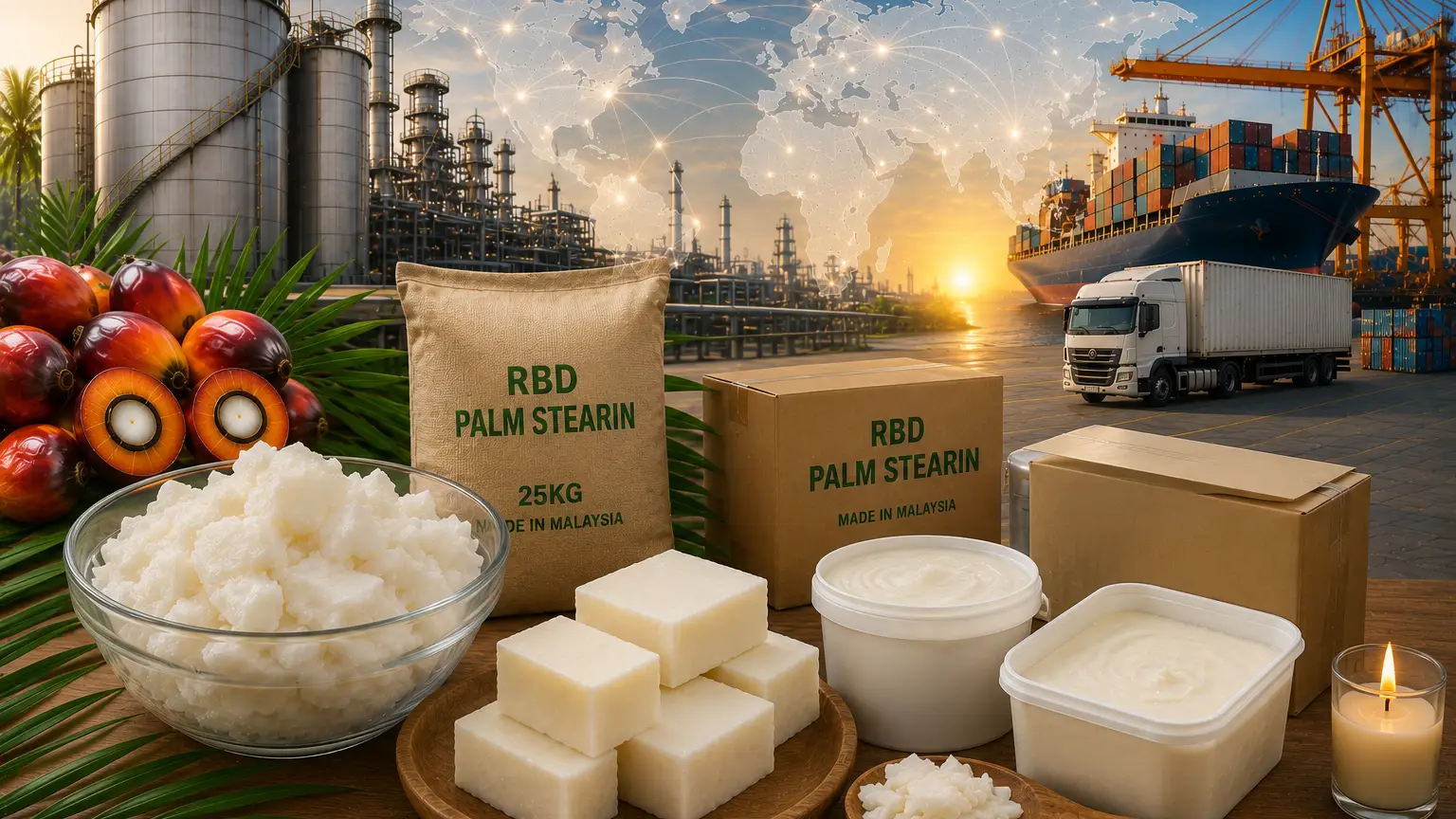
The global RBD palm stearin supply chain begins with oil palm cultivation, followed by fresh fruit bunch harvesting, crude palm oil extraction, refining, fractionation, storage, and international distribution. Each stage contributes to maintaining consistent physical properties required by downstream manufacturers operating in diverse industrial sectors.
As supply chains become increasingly digitalized, procurement teams rely on supplier transparency, inventory visibility, and reliable shipping schedules to reduce operational risks. International trading companies play a significant role by connecting producers with industrial buyers, providing flexible sourcing options, documentation support, and logistics coordination across multiple regions.
Palm plantations located primarily in Southeast Asia form the backbone of global RBD palm stearin production. Indonesia and Malaysia together account for the majority of worldwide palm oil output, supported by extensive plantation management, modern milling facilities, and integrated refining complexes. Their production capacity enables continuous availability for both domestic consumption and international exports.
Following harvesting, fresh fruit bunches are rapidly transported to nearby mills where crude palm oil is extracted to preserve oil quality. Efficient transportation between plantations and mills is essential because processing delays can negatively affect oil characteristics and downstream refining performance.
Crude palm oil undergoes refining to remove impurities, free fatty acids, pigments, and undesirable odors. The refined oil then enters the fractionation process, where controlled cooling separates liquid palm olein from solid palm stearin. This stage determines many of the product's functional characteristics, including hardness, melting point, and suitability for specific industrial applications.
Manufacturers continually invest in automation, process optimization, and quality assurance systems to improve production efficiency while minimizing waste. Increasing adoption of sustainability certifications and traceability initiatives further strengthens confidence among multinational buyers seeking responsibly sourced raw materials.
Modern RBD palm stearin manufacturing relies on advanced refining technologies designed to deliver consistent product specifications for industrial users. Temperature control, filtration efficiency, deodorization, and fractionation accuracy all contribute to producing material that meets the technical requirements of food processors, oleochemical manufacturers, and consumer goods producers.
Quality assurance extends throughout production, encompassing laboratory analysis, batch consistency testing, contamination prevention, and compliance with international standards. These measures help manufacturers maintain stable product performance while supporting regulatory requirements across multiple export destinations.
Industrial buyers increasingly prioritize suppliers capable of delivering standardized specifications over long-term contracts. Parameters such as free fatty acid levels, moisture content, color, iodine value, and melting characteristics directly influence production efficiency for downstream manufacturers.
In addition to product quality, suppliers differentiate themselves through reliable packaging, bulk shipment capabilities, export documentation, inventory management, and responsive technical support. These value-added services enhance procurement efficiency and contribute to resilient supply chains capable of adapting to evolving global market conditions.
The international trade of RBD palm stearin is supported by an extensive logistics ecosystem that connects major producing countries with manufacturing hubs across Asia-Pacific, Europe, the Middle East, Africa, and the Americas. Bulk exports are typically shipped through specialized storage terminals and port facilities equipped to handle edible oils, ensuring product integrity throughout transportation. Efficient maritime logistics enable manufacturers to maintain stable inventories while supporting long-term production planning.
Export competitiveness depends on multiple factors, including production volumes, freight availability, trade agreements, and compliance with destination market regulations. As global food processing and oleochemical industries continue expanding, demand for dependable cross-border supply chains has increased significantly. Suppliers capable of offering consistent shipment schedules and comprehensive export documentation are often preferred by industrial procurement teams.
After production, RBD palm stearin is transported in bulk tankers, ISO tanks, flexitanks, drums, or intermediate bulk containers depending on customer requirements and shipment size. Proper temperature management throughout storage and transportation is essential to preserve product characteristics and prevent unnecessary solidification or quality deterioration during transit.
International distributors and chemical trading companies contribute substantial value by consolidating supply from multiple manufacturers, managing regional inventories, and providing flexible purchasing solutions. Their ability to coordinate customs clearance, quality certificates, and delivery schedules simplifies procurement for manufacturers seeking reliable long-term sourcing partners.
RBD palm stearin serves a broad range of industrial sectors due to its versatile functional properties and competitive economics. Food manufacturers utilize it in shortening, margarine, bakery fats, confectionery products, frying applications, and specialty fats. Beyond the food sector, oleochemical producers incorporate the material into fatty acids, fatty alcohols, soaps, detergents, candles, and various industrial formulations requiring stable saturated vegetable oils.
Growing industrial demand has encouraged procurement professionals to evaluate suppliers based on operational reliability rather than price alone. Long-term sourcing strategies increasingly emphasize consistent quality, production capacity, sustainability practices, and responsive customer support to reduce supply chain disruptions and improve manufacturing efficiency.
Successful procurement strategies begin with supplier qualification processes that evaluate manufacturing capabilities, quality management systems, export experience, and regulatory compliance. Buyers also assess production flexibility to ensure suppliers can accommodate changing demand while maintaining consistent product specifications across multiple shipments.
Industrial organizations frequently establish strategic partnerships with international trading companies to diversify sourcing options and improve resilience against market volatility. Access to multiple production origins, flexible logistics solutions, and professional documentation services enables procurement teams to minimize operational risks while maintaining uninterrupted production schedules.
Like many globally traded agricultural commodities, the RBD palm stearin supply chain is influenced by seasonal production patterns, weather conditions, labor availability, transportation costs, geopolitical developments, and changing regulatory requirements. These variables can affect production costs, export availability, and delivery timelines, requiring manufacturers and buyers to continuously adapt their sourcing strategies.
Sustainability has become another defining factor in international palm oil trade. Increasing customer expectations regarding responsible sourcing, environmental stewardship, and supply chain transparency have encouraged producers to invest in certification programs, digital traceability systems, and continuous operational improvements that enhance market credibility.
Digital procurement technologies, predictive inventory management, and integrated supply chain analytics are transforming how industrial buyers manage raw material sourcing. Enhanced visibility across production, logistics, and inventory enables organizations to respond more effectively to market fluctuations while optimizing purchasing decisions.
Despite ongoing market challenges, long-term demand for RBD palm stearin remains positive due to continued growth in food processing, personal care, oleochemicals, and industrial manufacturing. Companies that prioritize diversified sourcing networks, collaborative supplier relationships, and sustainable procurement practices will be better positioned to secure stable supplies and support future business expansion.
The global RBD palm stearin market is expected to maintain steady growth as food processing, oleochemical manufacturing, and industrial production continue expanding across emerging and developed economies. Rising demand for cost-effective vegetable-based raw materials, combined with investments in refining capacity and logistics infrastructure, will strengthen the resilience of international supply chains. Procurement teams are increasingly adopting digital sourcing platforms and data-driven purchasing strategies to improve visibility and secure long-term supply agreements.
Changing regulatory frameworks and customer expectations are also influencing sourcing decisions. Buyers increasingly require suppliers to demonstrate traceability, consistent product quality, and compliance with international food safety and sustainability standards. As a result, manufacturers are investing in automation, quality management systems, and certification programs to remain competitive in global markets.
For industrial buyers, selecting a dependable supplier extends beyond comparing prices. Factors such as manufacturing expertise, export experience, inventory availability, technical documentation, and responsive customer service all contribute to a successful procurement strategy. Strong supplier relationships help reduce operational risks, improve production planning, and ensure continuity during periods of market uncertainty.
Global chemical trading companies provide additional value by connecting buyers with qualified manufacturers, coordinating international logistics, and offering flexible sourcing solutions tailored to regional requirements. By leveraging diversified supplier networks and professional supply chain management, organizations can optimize procurement efficiency while supporting long-term business growth in competitive industrial markets.
RBD palm stearin has become an essential industrial raw material supporting a wide range of sectors, including food manufacturing, oleochemicals, personal care, and industrial processing. Its global supply chain encompasses oil palm cultivation, refining, fractionation, quality assurance, international logistics, and strategic distribution, creating a highly integrated ecosystem that enables manufacturers worldwide to access consistent, high-quality products.
As international demand continues to evolve, businesses must prioritize supplier reliability, sustainability, regulatory compliance, and supply chain resilience when developing procurement strategies. Diversified sourcing, transparent logistics, and long-term partnerships will remain fundamental to maintaining operational efficiency and minimizing supply risks.
Tradeasia International, through the Chemtradeasia and Tradechem Marketplace platforms, supports industrial buyers by connecting them with trusted global manufacturers and suppliers of RBD palm stearin. With comprehensive sourcing capabilities, export expertise, quality-focused supplier networks, and professional logistics coordination, Tradeasia helps businesses streamline procurement processes and secure reliable supplies for diverse industrial applications across international markets.
We're committed to your privacy. Tradeasia uses the information you provide to us to contact you about our relevant content, products, and services. For more information, check out our privacy policy.


 English
 Indonesian
 简体字
简体字
 العربية
 Español
 Français
 Português
 日本語
日本語
 한국어
한국어
 Tiếng Việt