Explore our network of country and industry based websites to access localized information, product offerings, and business services across our group.
Log in to start sending quotation requests for any product.
Don't have an account? Sign Up Here
Home Red Rice Supply Chain: B2B Sourcing, Trade, and Global Distribution
Trade Insights | Supply Chain | 11 August 2026

Red Rice Supply Chain Overview
Red Rice Production and Supply Chain Structure
Red Rice Processing and Distribution
Red Rice Applications and Commercial Demand
Red Rice Market and Trade Dynamics
Buyer and Procurement Considerations
Red Rice Sourcing Through B2B Marketplaces
Conclusion: Building a Reliable Red Rice Supply Strategy
Sources
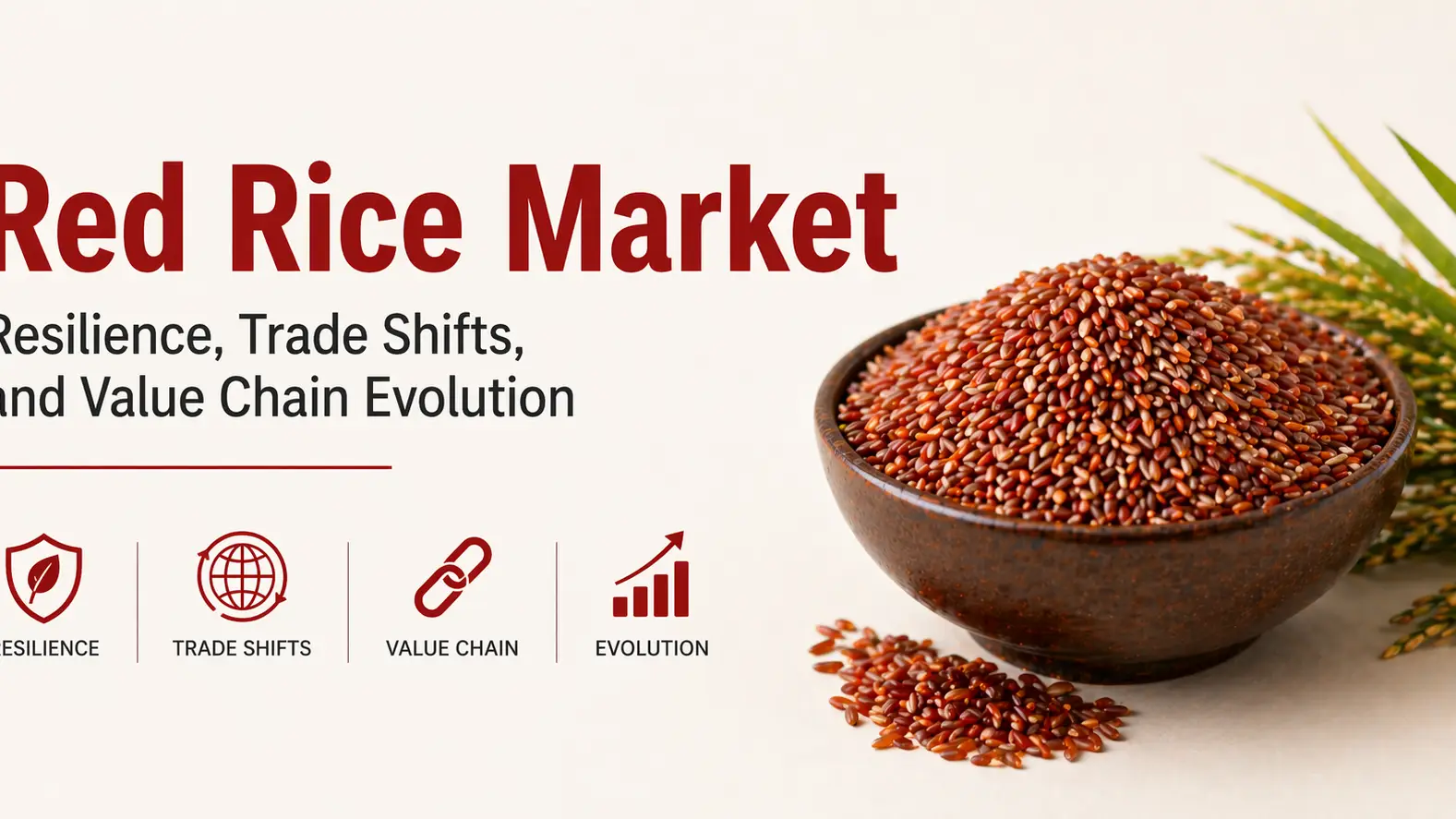
Red Rice is positioned within the broader rice and agricultural commodity supply chain, making sourcing efficiency, product consistency, logistics, and supplier reliability important considerations for B2B buyers. For procurement teams, the commercial value of Red Rice extends beyond the product itself to the ability of suppliers and distributors to maintain dependable availability and fulfill requirements across different purchasing cycles.
The global rice sector is supported by established production, processing, storage, transportation, and international trade networks. The Food and Agriculture Organization (FAO) maintains dedicated rice-market intelligence covering supply, demand, stocks, prices, and trade, demonstrating the importance of structured market monitoring when evaluating rice procurement opportunities.
For Red Rice buyers, supply-chain visibility can help connect purchasing decisions with production availability, market conditions, logistics requirements, and downstream demand. A transparent sourcing process allows procurement teams to compare suppliers more systematically while reducing uncertainty around lead times, shipment planning, documentation, and commercial specifications.
The broader rice value chain also demonstrates how post-harvest handling, storage, milling, transportation, and value-added processing can influence supply-chain efficiency. FAO research highlights improved drying, storage, milling, transportation infrastructure, and stronger vertical coordination as important opportunities for improving rice value chains.
The Red Rice supply chain begins with agricultural production and moves through post-harvest handling before reaching processors, distributors, traders, and industrial or commercial buyers. Each stage can influence availability, quality management, inventory planning, and the final procurement experience.
At the broader rice-market level, supply conditions can change because of production levels, harvested area, stocks, imports, exports, and market demand. USDA's rice data systems track production, yield, prices, supply, utilization, stocks, imports, and exports, providing a useful framework for understanding the variables that influence rice procurement.
For B2B buyers, supply planning should therefore consider more than the immediate quoted price. Availability, supplier capacity, shipment schedules, origin, required documentation, storage conditions, and continuity of supply can all influence the effective commercial value of a Red Rice sourcing program.
Current global rice conditions also reinforce the importance of monitoring supply fundamentals. FAO's July 2026 cereal outlook forecasts international rice trade in 2026 at 59.8 million tonnes, while world rice stocks at the close of the 2026/27 marketing seasons are forecast at 214.1 million tonnes. These figures describe the broader rice market rather than Red Rice specifically, so they should be treated as market context rather than product-specific benchmarks.
Processing and post-harvest handling represent critical stages between agricultural production and commercial distribution. For Red Rice procurement, buyers may need to assess how the product is handled, prepared, packaged, stored, and transported before reaching its destination.
These stages matter because supply-chain performance can affect product consistency and delivery reliability. FAO identifies improved drying, storage, milling, secondary processing, transportation infrastructure, and vertical coordination as areas capable of improving rice value-chain efficiency.
Distribution connects suppliers with food processors, distributors, traders, and other commercial purchasers. International sourcing adds further considerations, including export availability, freight planning, customs documentation, shipment consolidation, and destination-market requirements.
A professional sourcing strategy should consequently evaluate suppliers according to their ability to support repeat procurement rather than focusing exclusively on a single transaction. For Red Rice buyers operating across international markets, aligning shipment planning with market intelligence can improve purchasing visibility and help procurement teams respond to changes in supply and trade conditions.
Red Rice is relevant to commercial food supply chains where buyers require rice-based agricultural ingredients or food products. Its role within food-oriented procurement makes supplier consistency, specification alignment, packaging, and dependable availability important factors for businesses managing production or distribution requirements.
For B2B buyers, application-led sourcing can make procurement more efficient because supplier evaluation can be aligned with the intended commercial use. Instead of treating Red Rice as a generic commodity purchase, buyers can define requirements around product specifications, order quantities, delivery schedules, documentation, and downstream processing needs.
Potential commercial buyers can include food processors, ingredient distributors, wholesalers, importers, traders, and procurement organizations seeking dependable rice supply. Their purchasing priorities can differ according to business model, with some emphasizing competitive bulk sourcing while others place greater importance on supply continuity, documentation, logistics coordination, or supplier responsiveness.
The broader rice market is highly trade-oriented, with FAO maintaining dedicated monitoring of international prices, trade, supply, demand, and stocks. This makes market intelligence particularly relevant for businesses purchasing rice products internationally and attempting to manage procurement decisions against changing commodity-market conditions.
Red Rice procurement should be considered within the wider rice-market environment because changes in production, inventories, international trade, and pricing can influence commercial sourcing conditions. FAO regularly publishes rice-market intelligence and price updates, while USDA provides rice outlooks and datasets covering global and U.S. supply and use.
The latest USDA July 2026 Rice Outlook provides updated U.S. and global rice supply-and-use estimates and projections. Its accompanying market outlook also demonstrates how changes in production, imports, exports, consumption, and stocks can alter supply expectations and pricing conditions.
For buyers, market intelligence is most useful when translated into purchasing decisions. Monitoring broader rice indicators can support decisions concerning inventory timing, supplier diversification, shipment planning, and contract discussions without assuming that generic rice-market data represents a direct Red Rice price.
Because Red Rice is a specific product category, procurement teams should validate product-specific specifications, availability, origin, packaging, order quantities, and commercial terms directly with suppliers. This distinction is important when using broad rice-market statistics to inform—but not replace—product-level sourcing assessments.
A Red Rice supplier should be assessed through a combination of product suitability and supply-chain capability. Buyers can consider consistency of specifications, production or sourcing capacity, order flexibility, documentation, communication, shipment coordination, and the supplier's ability to support recurring requirements.
For procurement teams, supplier reliability becomes particularly important when Red Rice is incorporated into regular production or distribution programs. A supplier capable of supporting predictable replenishment can provide greater operational value than a supplier offering an attractive price for only a single transaction.
Procurement risk can also be reduced through structured supplier comparisons and clear purchasing specifications. Buyers should establish their required product characteristics, packaging format, quantity, destination, delivery schedule, documentation requirements, and commercial terms before final supplier selection.
This approach is consistent with the broader principle of data-driven commodity procurement. USDA's Rice Yearbook, for example, brings together production, yield, price, supply, utilization, stocks, imports, exports, and other indicators to support decision-making across the rice sector.
B2B marketplaces can simplify the early stages of Red Rice sourcing by connecting buyers with potential suppliers, distributors, and trading partners. For procurement teams, a marketplace approach can improve supplier discovery while creating a more structured starting point for comparing commercial requirements.
For a product such as Red Rice, effective digital sourcing should ultimately connect product requirements with supplier capability, logistics, documentation, and order specifications. The objective is not simply to identify the lowest quotation, but to establish a commercially workable supply relationship.
Trade-focused sourcing platforms can support a more organized procurement process by helping buyers communicate specifications and evaluate potential supply partners. For businesses purchasing Red Rice in commercial quantities, this can create a pathway from initial supplier discovery toward repeat orders and longer-term supply planning.
Tradeasia International, Chemtradeasia, and the Tradechem Marketplace can serve as a commercial connection point for businesses seeking to explore sourcing opportunities across international B2B markets. For buyers, the strongest sourcing strategy remains one that combines competitive commercial terms with reliable supply, transparent communication, suitable specifications, and practical logistics coordination.
Red Rice procurement is best approached as a supply-chain decision rather than a simple commodity purchase. Production conditions, post-harvest handling, processing, distribution, market availability, logistics, and supplier capability all contribute to the reliability of the final procurement outcome.
With global rice markets continuing to be monitored through dedicated FAO and USDA market intelligence systems, B2B buyers have access to broader information that can support more informed purchasing decisions.
For importers, distributors, food-industry buyers, and procurement teams, the opportunity lies in developing sourcing relationships that balance product requirements with supply continuity and commercial efficiency. Tradeasia International and its Chemtradeasia and Tradechem Marketplace platforms can support this broader B2B sourcing journey by connecting buyers with international trade opportunities and supplier networks. The result is a procurement approach focused not only on obtaining Red Rice, but on building a more dependable and scalable supply chain.
USDA Economic Research Service – Rice Market Outlook
USDA Economic Research Service – Rice Yearbook
We're committed to your privacy. Tradeasia uses the information you provide to us to contact you about our relevant content, products, and services. For more information, check out our privacy policy.


 English
 Indonesian
 简体字
简体字
 العربية
 Español
 Français
 Português
 日本語
日本語
 한국어
한국어
 Tiếng Việt