Explore our network of country and industry based websites to access localized information, product offerings, and business services across our group.
Log in to start sending quotation requests for any product.
Don't have an account? Sign Up Here
Home Supply Chain Risks Behind Soybean Oil Pricing
Trade Insights | Supply Chain | 12 May 2026
1. Introduction
2. Global Dynamics Shaping Soybean Oil Supply
3. Key Supply Chain Risks Behind Soybean Oil Pricing
4. Product Focus: Food-Grade Soybean Oil for US Buyers
5. Applications, Quality Requirements, and Sourcing Strategies
6. Conclusion (give the disclaimer that )
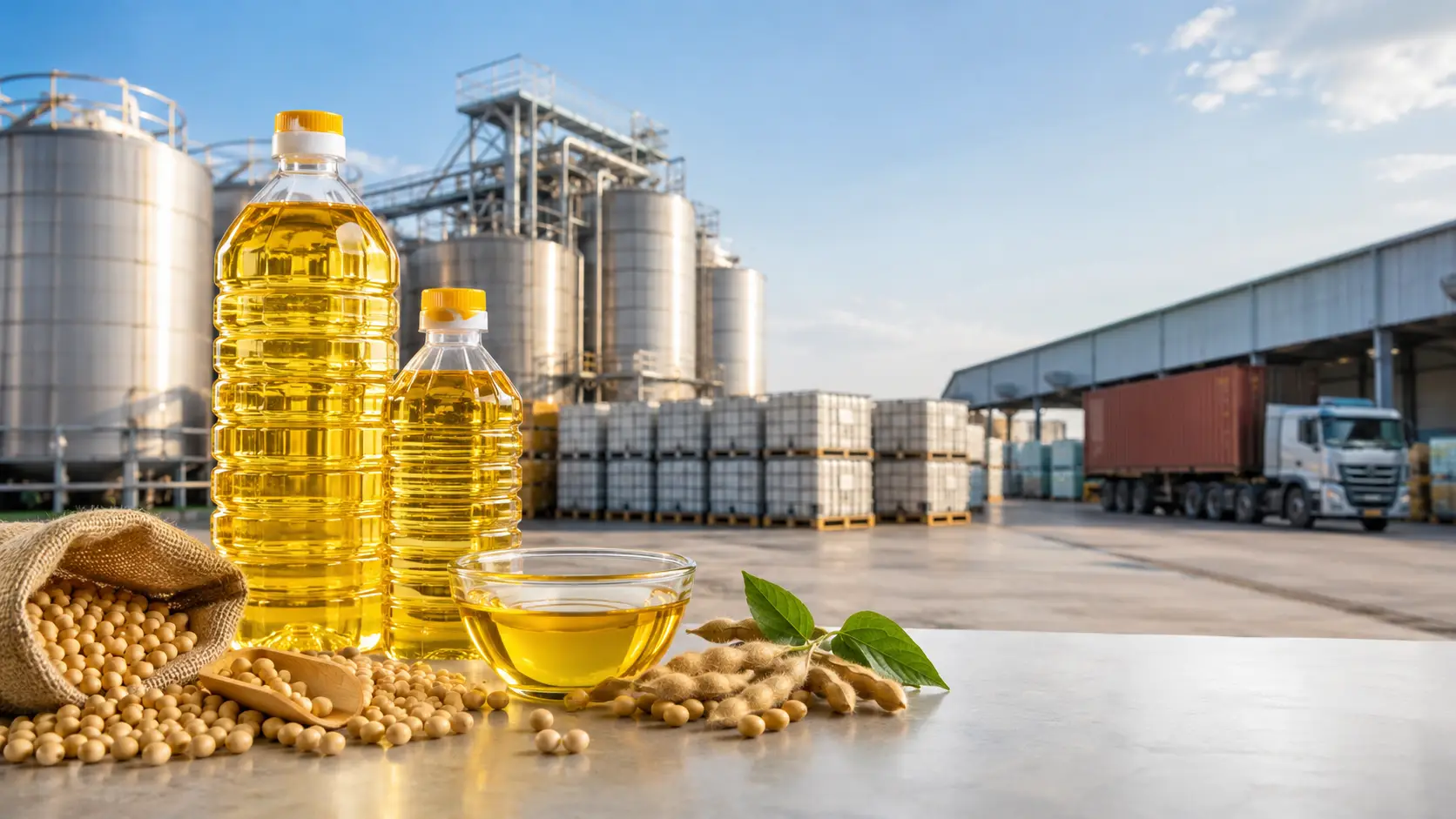
Soybean oil is one of the most widely used edible oils in the United States, underpinning everything from frying operations in quick‑service restaurants to large‑scale food manufacturing, biodiesel blending, and industrial applications. According to the United States Department of Agriculture (USDA), the U.S. typically produces more than 11 million metric tons of soybean oil annually, making it both a major producer and consumer. Yet, despite this strong domestic base, pricing and availability remain highly sensitive to global supply chain risks.
Over the last decade, volatility in soybean oil prices has been driven by a combination of climate events in key growing regions, trade policy shifts, logistics disruptions, and competing demand from the biofuel sector. These dynamics were highlighted during the COVID‑19 pandemic and again during the 2021–2023 period, when edible oil prices surged worldwide. For U.S. buyers, from food manufacturers to ingredient distributors, understanding these risks is now a strategic necessity rather than an academic exercise.
This article analyzes the main supply chain risks behind soybean oil pricing and availability in the U.S. market, with a particular focus on how professional sourcing platforms such as foodadditivesasia.com and specialized suppliers of bulk soybean oil can help mitigate volatility. We will explore global production trends, logistics bottlenecks, regulatory and sustainability pressures, and practical strategies for building a more resilient supply base.
The soybean oil supply chain begins with soybean cultivation, which is highly concentrated in a few regions. Globally, the United States, Brazil, and Argentina account for the majority of soybean production and crushing. Brazil has overtaken the U.S. as the largest soybean producer, and its export behavior significantly influences world prices of both soybeans and derivative products like soybean oil and meal. When weather events such as droughts in Brazil’s Cerrado or floods in the U.S. Midwest occur, they can quickly tighten global supplies and push up prices.
Once soybeans are harvested, they are crushed to produce oil and meal. The allocation of soybeans to domestic crushing versus export is itself a crucial factor. For example, when China increases its soybean imports for animal feed, it can pull more beans away from crushing in certain regions, indirectly affecting soybean oil availability. Similarly, policy incentives in Argentina and Brazil for biodiesel production can divert more oil to the energy sector, reducing the volume available for food uses and raising international prices.
Currency movements and trade policy also play a significant role. Import tariffs, export taxes, and trade disputes between major economies can alter trade flows overnight. The U.S.–China trade tensions in 2018–2019 reshaped soybean trade patterns, while export restrictions on edible oils from countries like Indonesia (for palm oil) and temporary measures in South America have periodically tightened the global vegetable oil balance sheet. Even though the U.S. is relatively self‑sufficient, international benchmarks and arbitrage opportunities mean domestic soybean oil price trends remain closely tied to global market conditions.
One of the most visible risks in the soybean oil supply chain is climate variability. Droughts in major producing states like Iowa, Illinois, and Minnesota can reduce yields and oil content, while extreme weather events can disrupt harvest and transportation. The USDA has documented increasing yield volatility in several key states over the past decade, and climate models suggest that weather‑related disruptions may become more frequent. For U.S. refiners and food manufacturers, this means that even domestic supply cannot be assumed to be consistently abundant and stable.
Logistics and infrastructure constraints are another critical risk. Soybeans and crude soybean oil often move by barge along the Mississippi River, by rail, and by truck to crushing plants, refineries, and ports. Periods of low water levels on the Mississippi, such as in 2022, forced barge operators to reduce loads and raised freight costs, which ultimately fed into higher delivered oil prices. Port congestion, container shortages, and trucking capacity constraints can also delay shipments of refined, food-grade soybean oil to end users, creating spot shortages even when overall supply is sufficient.
Policy and regulatory shifts compound these challenges. In the U.S., the Renewable Fuel Standard (RFS) and state‑level low‑carbon fuel programs have spurred rapid growth in renewable diesel and biodiesel. This has increased demand for feedstocks such as soybean oil, used cooking oil, and distillers corn oil. When renewable diesel plants ramp up capacity, they can bid aggressively for bulk soybean oil, tightening availability for food applications and pushing up prices. At the same time, evolving regulations on sustainability, traceability, and deforestation‑free supply chains can alter sourcing strategies and increase compliance costs, particularly for companies that rely on imports to complement domestic supply.
For U.S. buyers, the core product of interest is typically refined, bleached, and deodorized (RBD) food-grade soybean oil. This oil is valued for its neutral flavor, high smoke point, and versatility in frying, baking, and formulation of processed foods, sauces, dressings, and margarines. Typical specifications include low free fatty acid content, controlled peroxide value, and compliance with U.S. FDA regulations for edible oils. Many industrial users also require non‑GMO or identity‑preserved (IP) soybean oil, kosher or halal certification, and strict allergen‑control documentation.
In addition to RBD oil, some buyers procure crude soybean oil for in‑house refining or use in biodiesel and oleochemical applications. Crude oil carries higher levels of impurities, phospholipids, and color bodies, and therefore requires additional processing, but can sometimes be sourced at more competitive prices depending on market conditions. A diversified sourcing strategy may involve a mix of crude and refined oil, depending on the buyer’s processing capabilities and end‑use requirements.
Professional sourcing platforms such as foodadditivesasia.com are increasingly used by North American buyers to identify and qualify reliable suppliers of bulk soybean oil and other vegetable oils. These platforms typically provide product specifications, quality certifications, indicative pricing, and origin information, enabling procurement teams to benchmark offers and reduce search time. By engaging with vetted suppliers through such channels, U.S. companies can gain access to multiple origins, packaging formats (bulk tankers, IBCs, drums), and contract structures that help them manage price and supply risk more effectively.
Soybean oil’s broad application base is both a strength and a source of pricing pressure. In the food sector, it is widely used for deep‑frying in restaurants and industrial fryers, as an ingredient in baked goods, snacks, confectionery, and as a base for mayonnaise and salad dressings. Its relatively favorable fatty acid profile, with a mix of polyunsaturated and monounsaturated fats, makes it a common choice for reformulation efforts aimed at reducing trans fats. Outside the food sector, soybean oil serves as a key feedstock for biodiesel and renewable diesel, as well as a raw material in lubricants, inks, coatings, and plastics.
Each application segment has distinct quality and supply requirements. Food manufacturers prioritize consistent sensory characteristics, oxidative stability, and compliance with food safety standards such as HACCP, FSSC 22000, or SQF. Biodiesel producers focus more on parameters like iodine value, moisture, and impurity levels that affect fuel quality. Industrial users may tolerate broader specifications but demand predictable delivery schedules. For all segments, documentation such as Certificates of Analysis (COA), non‑GMO declarations, allergen statements, and safety data sheets (SDS) are critical for regulatory and customer audits.
To navigate supply chain risks, U.S. buyers are adopting more sophisticated sourcing strategies. These include diversifying suppliers across regions, combining domestic and international sources, and using platforms like foodadditivesasia.com to compare offers for soybean oil and alternative oils. Some companies negotiate medium‑ to long‑term contracts with price adjustment clauses linked to recognized benchmarks, while others use spot purchases to exploit short‑term price dips. Risk management tools such as futures and options on soybean oil or related commodities can also be used to hedge exposure. Additionally, many buyers are exploring partial substitution with other oils (e.g., canola, high‑oleic sunflower) when formulation and labeling constraints allow, as a way to reduce dependence on any single oil.
Soybean oil will remain a cornerstone of the U.S. food and industrial sectors, but its pricing and availability are increasingly shaped by complex global supply chain dynamics. From climate‑driven yield variability and infrastructure bottlenecks to policy‑induced shifts in biofuel demand, multiple risk factors converge to influence the cost and reliability of supply. For procurement and supply chain teams, understanding these drivers is essential for budgeting, contract negotiation, and strategic planning.
By focusing on clear product specifications, diversified sourcing, and robust supplier relationships, U.S. buyers can better navigate volatility in the soybean oil market. Leveraging specialized platforms such as foodadditivesasia.com to access vetted suppliers of bulk soybean oil and related ingredients can enhance transparency, improve bargaining power, and support more resilient supply chains. Combined with proactive risk management and ongoing monitoring of market indicators, these measures help protect margins and ensure continuity of supply in a market that is likely to remain dynamic.
This article is provided solely for informational and market insight purposes and does not constitute technical, safety, regulatory, or other professional advice. Readers should independently verify all information with qualified experts, consult official documentation such as MSDS/SDS and relevant regulations, and, where appropriate, contact our team or their suppliers directly to assess suitability for specific products, processes, or applications.
We're committed to your privacy. Tradeasia uses the information you provide to us to contact you about our relevant content, products, and services. For more information, check out our privacy policy.


 English
 Indonesian
 简体字
简体字
 العربية
 Español
 Français
 Português
 日本語
日本語
 한국어
한국어
 Tiếng Việt



















