Explore our network of country and industry based websites to access localized information, product offerings, and business services across our group.
Log in to start sending quotation requests for any product.
Don't have an account? Sign Up Here
Home Textured Soy Protein Sourcing Guide for Global Food Industry Buyers
Trade Insights | Supply Chain | 13 July 2026
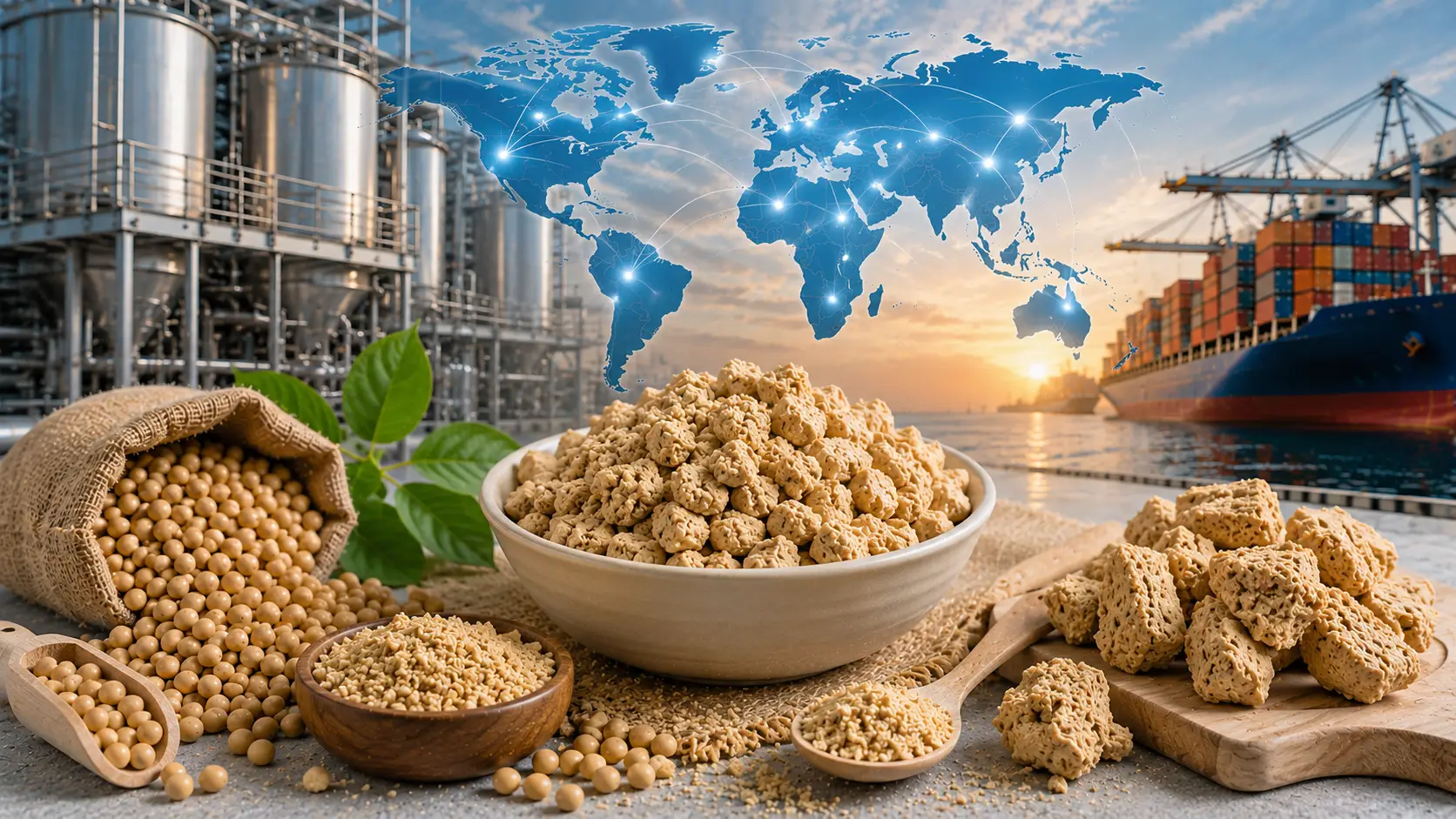
Understanding Textured Soy Protein and Its Commercial Importance
Industrial Applications Driving Textured Soy Protein Demand
Market Trends and Growth Opportunities in Alternative Proteins
Key Buyer Considerations When Sourcing Textured Soy Protein
Supply Chain Role of Manufacturers, Traders, and Distributors
Commercial Opportunities for Textured Soy Protein Marketplace Buyers
Textured Soy Protein (TSP) is a processed soy-based ingredient produced by transforming soy protein into a fibrous, textured structure that resembles the appearance and mouthfeel of meat-based ingredients. It is widely used by food manufacturers because it provides protein content, functional texture, and formulation flexibility across different food categories.
According to technical information from the Food and Agriculture Organization of the United Nations, soy products are important sources of plant-based protein due to their nutritional value and global availability. This has supported continued interest in soy-derived ingredients for food production.
Textured Soy Protein is commonly supplied in forms such as granules, flakes, or chunks depending on end-use requirements. Food processors evaluate factors including protein concentration, texture consistency, moisture absorption, processing compatibility, and supply reliability when selecting suitable products.
For B2B buyers, understanding the technical characteristics of Textured Soy Protein is essential because the ingredient directly influences product quality, manufacturing efficiency, and consumer acceptance in finished food applications.
The commercial value of Textured Soy Protein comes from its ability to support manufacturers developing affordable protein-rich food products. As consumer interest in plant-based nutrition increases, food companies require dependable ingredient suppliers capable of maintaining consistent specifications.
Industry research from The Good Food Institute highlights continued investment and innovation in plant-based protein categories, including ingredients that enable scalable food manufacturing.
For distributors and procurement teams, sourcing Textured Soy Protein involves more than product availability. Buyers also consider supplier credibility, documentation, international logistics capability, and consistency across multiple shipments.
A reliable supply chain helps manufacturers reduce production disruptions while meeting growing demand from retailers, foodservice operators, and consumers seeking alternative protein options.
One of the largest application areas for Textured Soy Protein is plant-based meat manufacturing. Its fibrous structure allows formulators to create products such as vegetarian meat substitutes, plant-based burgers, nuggets, and protein-based prepared foods.
According to research published by National Center for Biotechnology Information, soy protein has been extensively studied for its functional properties, including its role in improving texture and nutritional profiles in food formulations.
Manufacturers select different grades of Textured Soy Protein depending on desired characteristics such as bite, hydration capacity, and compatibility with other ingredients.
As food companies expand plant-based product portfolios, demand for specialized soy protein ingredients continues to influence global sourcing strategies.
Textured Soy Protein is also used in various processed food applications where manufacturers require protein enhancement and improved product structure. These include snack products, ready-to-eat meals, nutritional foods, and blended protein formulations.
Technical guidance from the United States Department of Agriculture recognizes soy as an important agricultural commodity with broad food industry applications.
Food producers often combine Textured Soy Protein with other ingredients to achieve targeted nutritional and sensory characteristics.
This versatility makes the product relevant for multiple food sectors rather than being limited to a single application category.
The global food industry has experienced increasing demand for plant-derived protein ingredients as manufacturers respond to changing dietary preferences and sustainability discussions.
Market analysis from MarketsandMarkets indicates continued expansion of alternative protein-related industries, driven by innovation in food technology and increasing product development activities.
Textured Soy Protein remains commercially attractive because soy has established agricultural production networks and mature processing technologies.
For suppliers and traders, these trends create opportunities to connect producers with food manufacturers seeking scalable protein ingredient solutions.
Demand patterns for Textured Soy Protein vary across regions depending on food manufacturing capacity, consumer preferences, and regulatory environments.
Asia-Pacific markets benefit from established soy production and processing infrastructure, while North American and European markets continue developing plant-based food categories.
International buyers increasingly compare suppliers based on export capability, quality documentation, logistics performance, and long-term availability.
A global marketplace approach can help connect regional suppliers with buyers searching for reliable ingredient sources.
Procurement teams purchasing Textured Soy Protein typically evaluate technical specifications, including protein percentage, moisture level, particle size, appearance, and application suitability.
Quality assurance documentation, manufacturing standards, and traceability information are important factors when selecting suppliers for food production.
Buyers also assess whether suppliers can provide consistent batches that meet production requirements.
A supplier’s ability to support technical communication and documentation requirements can influence long-term purchasing decisions.
B2B buyers often compare multiple Textured Soy Protein suppliers because pricing, logistics, quality standards, and availability can vary between regions.
Food manufacturers must balance cost efficiency with product performance and supply reliability.
Marketplaces that provide supplier discovery, product information, and sourcing connections help procurement teams evaluate available options more efficiently.
For companies operating across international supply chains, supplier transparency becomes an important factor in reducing sourcing risks.
Manufacturers play a central role in maintaining Textured Soy Protein availability by investing in processing capabilities, quality control systems, and production scalability.
As demand for alternative protein ingredients grows, producers must adapt to changing requirements from food companies and international buyers.
Reliable manufacturing partnerships allow downstream businesses to develop stable product portfolios.
Strong supplier relationships are especially valuable for companies requiring recurring bulk ingredient supply.
Traders and distributors help bridge geographical gaps between producers and end users by managing sourcing, logistics, and commercial coordination.
According to supply chain principles discussed by industry organizations such as the Institute of Food Technologists, efficient ingredient supply networks support food industry resilience.
For international buyers, distributors can simplify access to suitable suppliers while supporting communication and documentation processes.
This makes marketplace platforms valuable tools for connecting global Textured Soy Protein supply and demand.
Digital B2B marketplaces provide food manufacturers, distributors, and procurement teams with improved visibility into available ingredient suppliers.
Tradeasia / Chemtradeasia / Tradechem Marketplace positioning supports buyers by creating a platform where industrial customers can explore sourcing opportunities and connect with suppliers.
For Textured Soy Protein buyers, marketplace access can support supplier comparison, purchasing decisions, and international sourcing strategies.
The commercial objective is not only finding a product but building dependable supply relationships.
The continued expansion of plant-based food categories is expected to maintain interest in protein ingredients that provide functionality, scalability, and cost efficiency.
Companies involved in food manufacturing, distribution, and ingredient trading will continue evaluating sourcing strategies to meet changing market requirements.
Textured Soy Protein remains an important ingredient opportunity because it supports multiple applications across the growing alternative protein sector.
For B2B buyers, selecting the right sourcing partner will remain a key factor in achieving consistent product quality and supply chain performance.
Sources
We're committed to your privacy. Tradeasia uses the information you provide to us to contact you about our relevant content, products, and services. For more information, check out our privacy policy.


 English
 Indonesian
 简体字
简体字
 العربية
 Español
 Français
 Português
 日本語
日本語
 한국어
한국어
 Tiếng Việt



















