Explore our network of country and industry based websites to access localized information, product offerings, and business services across our group.
Log in to start sending quotation requests for any product.
Don't have an account? Sign Up Here
Home Vital Wheat Gluten Applications, Buyers and B2B Sourcing
Trade Insights | Applications and Buyers | 02 September 2026
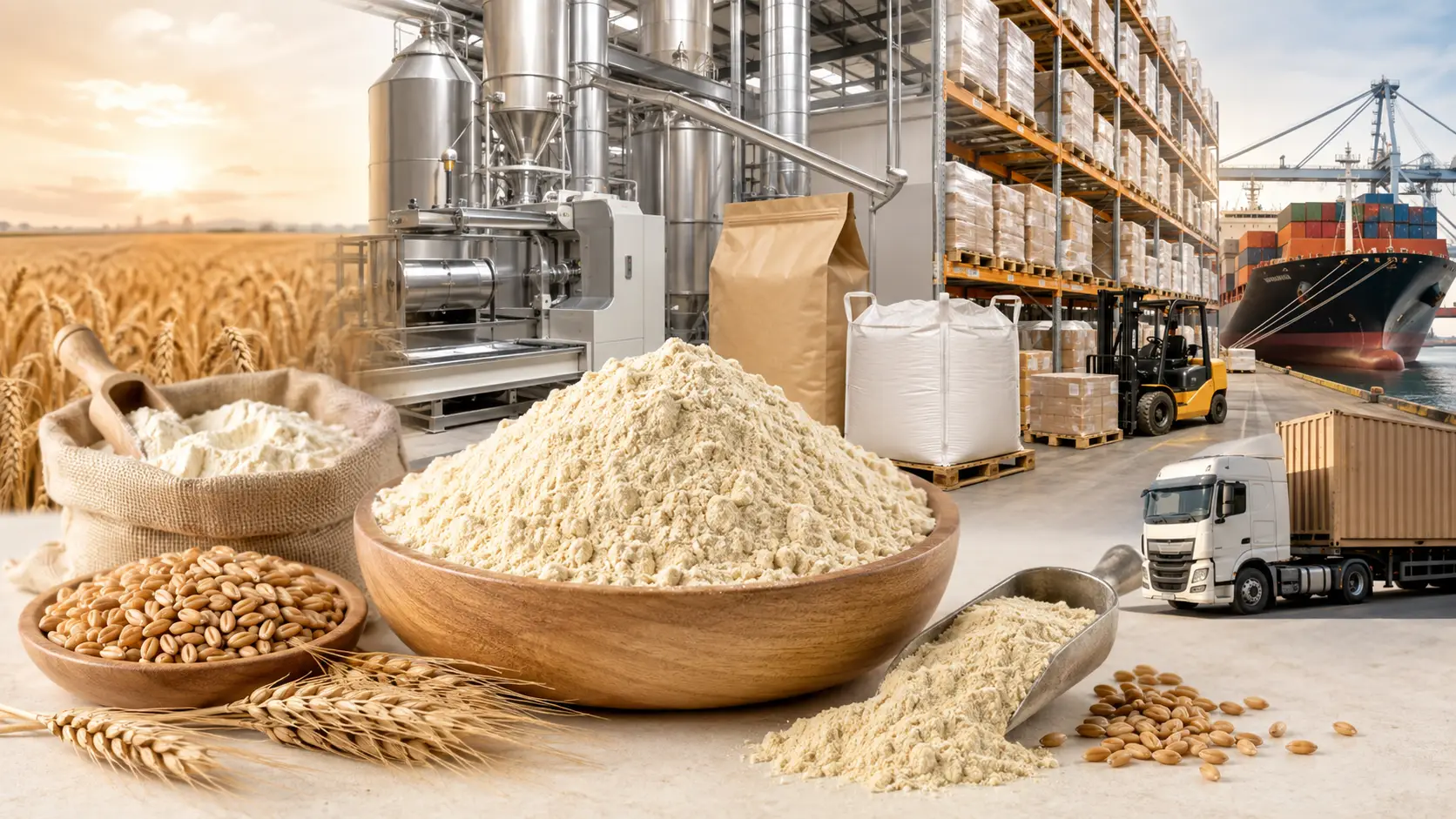
Vital Wheat Gluten in the Food Ingredient Market
Functional Applications in Bakery Products
Vital Wheat Gluten for Pasta, Cereals and Processed Foods
Applications in Plant-Based Protein Formulations
Key Buyers and Procurement Requirements
B2B Sourcing and Supply Considerations
Market Opportunities and Strategic Procurement
Conclusion: Building Reliable Vital Wheat Gluten Supply
Sources
Vital wheat gluten is a concentrated wheat protein ingredient valued primarily for its functional properties rather than simply its nutritional contribution. When hydrated, it develops a highly viscoelastic structure that can provide strength, elasticity, cohesion, and processing performance. Codex describes vital wheat gluten as a wheat protein product characterized by high viscoelasticity when hydrated, making it particularly relevant to food-processing applications.
For commercial food manufacturers, this functionality makes vital wheat gluten a formulation tool for improving dough structure, protein content, binding, and texture. Its role is particularly important where manufacturers need predictable processing characteristics while maintaining the desired texture of the finished product. This positions the ingredient between commodity flour inputs and specialized functional proteins in the broader food-ingredient supply chain.
Codex establishes 80% or more crude protein for vital wheat gluten on a dry-weight basis, with moisture not exceeding 10% and ash not exceeding 2%. These benchmarks provide useful reference points for procurement teams evaluating technical specifications, although individual commercial specifications can be more detailed depending on application and supplier.
For B2B buyers, quality evaluation therefore extends beyond protein percentage. Consistency in functionality, moisture, microbiological quality, packaging, documentation, and batch performance can influence production efficiency and finished-product quality. Buyers should align supplier specifications with the exact requirements of their formulation rather than selecting solely on headline protein content.
Bakery remains one of the most established application areas for vital wheat gluten. Its protein network can strengthen dough, support elasticity, improve water absorption, and contribute to dough handling during mixing, fermentation, forming, and baking. Commercial ingredient suppliers identify these characteristics as important for breads, pizza, bagels, and other bakery formulations.
For industrial bakeries, the commercial value is closely connected to process consistency. Dough that maintains suitable strength and machinability can help manufacturers manage high-speed production while targeting consistent product dimensions and textures. Vital wheat gluten can therefore be particularly relevant when flour characteristics alone do not provide the required protein functionality.
Vital wheat gluten is also useful where manufacturers formulate products requiring stronger internal structure. Applications can include pan breads, artisan breads, pizza bases, bagels, baking mixes, and selected specialty bakery products. ADM specifically identifies structure building, fermentation tolerance, water absorption, and dough machinability among its functional benefits.
From a procurement perspective, bakery manufacturers should assess gluten performance alongside flour characteristics, enzyme systems, hydration levels, mixing conditions, and baking processes. The best specification is therefore application-dependent. A supplier capable of providing consistent batches and technical documentation can be more valuable than a supplier competing only on nominal ingredient price.
Vital wheat gluten can contribute structure and binding in pasta and noodle formulations, particularly where manufacturers are targeting specific firmness, resilience, or protein characteristics. Its functional protein network can help support product integrity during processing and cooking. Commercial wheat-protein suppliers identify pasta and noodles among relevant applications for vital wheat gluten.
For large-scale pasta producers, ingredient selection is closely connected to process stability. Manufacturers must consider how the gluten interacts with flour, water, mixing, extrusion, drying, and cooking conditions. Procurement teams therefore benefit from technical specifications that explain not only protein concentration but also functional performance and recommended application parameters.
Cereal products and nutrition-oriented bars represent another opportunity for vital wheat gluten because the ingredient can provide protein enrichment, binding, structure, and chewiness. ADM identifies cereals and bars as applications where wheat gluten can support protein enrichment and extrusion performance.
These applications create opportunities for food manufacturers developing products where texture and protein content need to be balanced. However, formulation decisions must account for consumer positioning and regulatory requirements because wheat and gluten have important labeling implications. Codex specifically provides provisions for wheat protein products and requires appropriate labeling and instructions for use, including cautionary statements where national legislation requires them.
Vital wheat gluten is relevant to plant-based food development because wheat protein can contribute binding and structural characteristics to meat-alternative formulations. Its functionality can help manufacturers develop products with a firm, cohesive, or chewy texture while combining it with other plant proteins and ingredients. Commercial wheat-protein portfolios position wheat proteins for meat-alternative development and texture applications.
For product developers, the attraction is not simply protein content. Functional behavior during hydration, mixing, heating, and shaping can influence the eating experience and manufacturing process. This makes vital wheat gluten particularly relevant to formulations where structural integrity is a central technical challenge.
Plant-based manufacturers may use wheat protein alongside other plant ingredients to achieve specific texture and formulation objectives. The precise combination depends on the product category, processing system, nutritional targets, and sensory requirements. Wheat protein can be especially useful when the formulation needs additional binding or structural support.
At the same time, wheat gluten is unsuitable for products intended to meet gluten-free requirements. Codex states that wheat gluten products should not be used for technological purposes in foods that are naturally gluten-free, while labeling requirements and national regulations must also be considered.
The primary B2B buyers include industrial bakeries, flour and bakery-mix manufacturers, pasta and noodle producers, cereal manufacturers, nutrition-food companies, plant-based food producers, ingredient distributors, and food-processing companies. Each buyer segment evaluates the ingredient differently according to its manufacturing process and finished-product requirements.
Bakery manufacturers may prioritize gluten strength, consistency, water absorption, and dough handling, while plant-based producers can place greater emphasis on binding and texture. Distributors, meanwhile, often focus on supplier reliability, packaging formats, shelf life, documentation, and international logistics. Understanding these differences helps suppliers position vital wheat gluten according to actual buyer needs rather than using a one-size-fits-all specification.
Commercial procurement typically evaluates protein content, moisture, ash, microbiological specifications, packaging, origin, certificates, regulatory documentation, and batch consistency. Codex provides internationally recognized compositional and handling benchmarks, including minimum protein and maximum moisture requirements for vital wheat gluten.
Buyers should also evaluate the supplier's ability to maintain consistent quality across shipments. For international purchasing, documentation and logistics can be as important as the product specification itself. A competitive B2B sourcing program should therefore compare technical compliance, landed cost, supply continuity, packaging, lead time, and supplier responsiveness together.
A reliable vital wheat gluten supplier should be capable of providing consistent specifications supported by appropriate quality documentation. Buyers should establish clear technical requirements before requesting quotations so that suppliers can quote comparable grades and specifications. This reduces the risk of selecting a low-priced material that performs differently in production.
Supplier qualification can include review of certificates of analysis, food-safety systems, microbiological parameters, allergen declarations, packaging standards, country of origin, and traceability documentation. Codex also emphasizes hygienic preparation, suitable packaging, and maintaining wheat protein products in dry and sanitary conditions during storage and transport.
For international buyers, sourcing strategy should account for shipment planning, minimum order quantities, port logistics, payment terms, documentation, and inventory requirements. Wheat-based ingredients are connected to agricultural supply chains, meaning raw-material availability, milling conditions, and logistics can affect procurement decisions.
A B2B marketplace can simplify supplier discovery by allowing procurement teams to compare product specifications and commercial requirements before progressing to detailed negotiations. For distributors and manufacturers operating across multiple markets, establishing alternative supply routes can also reduce dependence on a single source and improve continuity of production.
The breadth of vital wheat gluten applications gives suppliers access to several food-industry demand segments rather than a single end-use market. Bakery remains central, while pasta, cereals, bars, sauces, fillings, and plant-based products create additional formulation opportunities. Commercial ingredient suppliers currently position vital wheat gluten across these diverse applications.
This application diversity is strategically important for B2B trade because buyers increasingly need ingredients that solve specific formulation challenges. Vital wheat gluten can provide functionality that is difficult to replicate through simply increasing conventional flour input. Its value is therefore connected to performance per unit of ingredient, not just its commodity identity as a wheat-derived product.
Price remains important in ingredient purchasing, but procurement teams should evaluate total formulation value. A material that delivers consistent processing performance can reduce production variability, reformulation requirements, and quality losses. For this reason, supplier qualification should consider technical performance and supply reliability alongside the quoted price.
For distributors and international buyers, the opportunity lies in building dependable sourcing relationships with suppliers capable of serving recurring requirements. Tradeasia / Chemtradeasia / Tradechem Marketplace can support this B2B sourcing approach by connecting commercial requirements with appropriate food-ingredient supply opportunities, helping buyers move from product discovery toward structured procurement.
Vital wheat gluten is a functional wheat protein with established relevance across bakery, pasta, cereals, bars, processed foods, and plant-based formulations. Its high viscoelasticity when hydrated and its ability to contribute structure, binding, strength, and texture explain why it remains valuable to food manufacturers.
For buyers, the most effective sourcing strategy starts with application-specific specifications. Protein content, moisture, functionality, food-safety documentation, packaging, consistency, and logistics should all be evaluated before commercial selection. This approach helps procurement teams distinguish between suppliers offering superficially similar products but potentially different performance profiles.
As food manufacturers continue developing bakery, cereal, pasta, and alternative-protein products, functional ingredients remain important tools for formulation and process optimization. Vital wheat gluten offers a particularly versatile combination of protein enrichment and structural functionality, making it relevant across several industrial food categories.
For companies seeking dependable international sourcing, Tradeasia / Chemtradeasia / Tradechem Marketplace can serve as a B2B platform for exploring food-ingredient supply opportunities and connecting procurement requirements with suitable commercial partners. The objective is not simply to buy vital wheat gluten, but to establish a supply relationship aligned with specification, application, quality, and delivery requirements.
We're committed to your privacy. Tradeasia uses the information you provide to us to contact you about our relevant content, products, and services. For more information, check out our privacy policy.


 English
 Indonesian
 简体字
简体字
 العربية
 Español
 Français
 Português
 日本語
日本語
 한국어
한국어
 Tiếng Việt



















